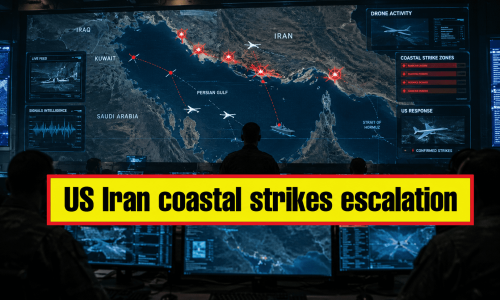
The timing didn’t line up with expectations. Just hours after Iran launched drones across contested zones, the United States responded with direct strikes on Iranian coastal sites—an escalation that shifts the pattern from shadow engagement to overt military signaling.
What followed wasn’t just another exchange. The strikes, confirmed in reporting by Reuters, mark a visible widening of the operational theatre, drawing attention from Washington to Tehran and across the Persian Gulf.
What remains unclear is whether this was a contained response—or the opening move in a broader recalibration of military posture in the region.
What Actually Happened
The United States launched targeted attacks on Iranian coastal infrastructure after Iran deployed drones in what officials described as a coordinated action tied to ongoing regional tensions.
According to early reports, the strikes focused on strategic coastal positions believed to support drone operations and surveillance. The U.S. response was framed as defensive, yet the geographic scope suggests a deliberate message aimed at both Iranian command structures and regional observers.
Iran’s initial drone activity had already raised alarms across the Gulf, but the speed and visibility of the U.S. reaction introduced a different layer—less covert, more declarative.
Why This Moment Matters
This moment represents a shift from indirect confrontation to direct signaling between two long-standing adversaries.
The United States, already maintaining a significant presence in the Middle East, appears to be redefining its deterrence posture. Iran, meanwhile, continues to rely on asymmetric tactics like drones to project influence without triggering full-scale conflict.
The involvement of coastal sites is particularly significant. These areas are not just military assets—they are logistical nodes tied to shipping routes, surveillance networks, and regional power projection.
______________________________________________
🔴 Help keep this independent voice alive and uncensored -> Buy us a Coffee <-
For observers tracking military posture changes, this isn’t just about retaliation—it’s about positioning.
The Pattern Behind the Event
This escalation follows a familiar but evolving pattern.
Iran deploys drones or proxies in contested regions. The United States responds—historically through indirect means or limited strikes. But over time, the responses have become more visible and geographically expansive.
What’s different now is the clarity of attribution and the reduced ambiguity. There is less effort to obscure responsibility, and more emphasis on controlled escalation.
This pattern suggests a gradual normalization of direct engagement, where both sides test boundaries without crossing into full conflict.
Where the Tensions Are Building
The pressure points are no longer confined to isolated incidents.
The Persian Gulf remains a critical flashpoint, but tensions are also spreading across adjacent regions tied to trade routes, energy flows, and military positioning.
U.S. defense officials have increasingly emphasized readiness and rapid response capability, while Iran continues to expand its drone and missile programs.
There is also a growing layer of institutional involvement—military alliances, intelligence coordination, and regional governments adjusting their own defensive postures.
For a deeper breakdown of how regional tensions evolve, see our internal analysis on shifting Middle East military dynamics.
What This Could Signal Next
The immediate aftermath is quiet—but not stable.
Neither side has indicated a desire for full escalation, yet both are operating in ways that reduce the margin for miscalculation.
Future actions may not come as large-scale attacks, but as smaller, faster, harder-to-attribute moves that gradually raise the stakes.
What stands out is the narrowing space between action and response. Each move now carries more weight, more visibility, and less room for de-escalation narratives.
And in that narrowing space, the next development may not arrive with warning—it may arrive as another step that looks familiar, but feels different.
About the Author