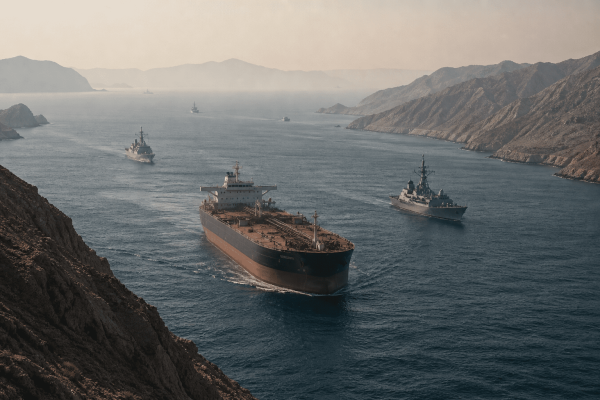
Something isn’t lining up in the waters that carry nearly a fifth of the world’s oil.
Even as talk of restraint surfaces, the movements on the ground—and at sea—suggest something far less stable is unfolding behind the scenes.
What Actually Happened
A fragile sense of calm has settled over parts of the Middle East, but it’s not built on certainty. Recent developments indicate that while open confrontation between the United States and Iran has paused, control over the Strait of Hormuz remains deeply contested.
According to a Reuters report, both sides are maneuvering carefully around the vital shipping lane, each trying to assert influence without triggering a direct escalation. The U.S. has increased its naval posture under the justification of protecting commercial shipping, while Iran continues to signal that it retains the ability to disrupt traffic if pressured further.
Source: https://www.reuters.com/world/asia-pacific/middle-east-truce-doubt-us-iran-fight-control-strait-hormuz-2026-05-05/
The result is not peace—it’s a controlled standoff, where neither side is backing down, but neither is fully committing to open conflict.
Why This Moment Matters
The Strait of Hormuz isn’t just another geopolitical flashpoint. It’s a pressure valve for the global economy.
Roughly 20% of the world’s oil passes through this narrow corridor. Even minor disruptions can send shockwaves through energy markets, affecting fuel prices, supply chains, and inflation worldwide.
What makes this moment different is the ambiguity. There’s no declared conflict, no official blockade—yet the risk level remains elevated. That uncertainty alone can drive volatility.
In practical terms, this creates a situation where markets react not to events, but to the possibility of events.
The Pattern Behind the Event
This isn’t the first time tensions have centered on the Strait—but the pattern is evolving.
______________________________________________
🔴 Help keep this independent voice alive and uncensored.
Support independent journalism and help keep Chris Wick News going.
👉 Support Chris Wick on GoFundMe
Historically, confrontations here followed a predictable cycle: escalation, threat, partial de-escalation. But now, the lines are less clear.
Instead of overt acts, both sides appear to be operating in a gray zone—testing limits without crossing thresholds that would trigger full retaliation. Naval escorts, surveillance activity, and strategic positioning have replaced direct clashes.
A similar dynamic was noted in broader regional coverage by Al Jazeera, which highlighted how indirect pressure tactics are becoming the preferred method of influence rather than immediate confrontation.
Source: https://www.aljazeera.com/news/2026/5/5/us-iran-tensions-strait-hormuz-analysis
This shift makes the situation harder to read—and potentially more dangerous.
Where the Tensions Are Building
The pressure isn’t isolated to the waterway itself.
Regional actors are watching closely, and in some cases, quietly aligning. Gulf states are increasing their own security readiness. Shipping companies are adjusting routes or factoring in higher risk premiums.
Meanwhile, global powers outside the region are recalibrating their positions. A breakdown here wouldn’t stay contained—it would ripple outward quickly.
The concern isn’t just a direct clash between the U.S. and Iran. It’s the possibility of miscalculation—an incident at sea, a misinterpreted signal, a move that forces a response neither side originally intended.
What This Could Signal Next
Right now, the situation is being managed—but not resolved.
The continued presence of military assets in such a confined and economically critical space increases the odds of an unintended escalation. Even a small disruption could trigger a chain reaction in markets and diplomacy.
There’s also the question of endurance. How long can both sides maintain this level of tension without something giving way?
A prolonged standoff carries its own risks—fatigue, misjudgment, and shifting political pressures at home.
And beneath it all, one reality remains unchanged: control of the Strait is leverage. And neither side appears willing to relinquish it.
The surface may look calm for now. But underneath, the currents are still moving—and they’re pulling in opposite directions.