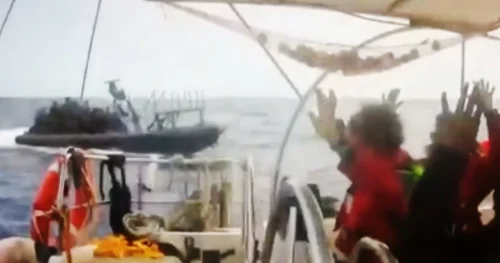
A maritime operation in international waters has left dozens of aid activists detained and reportedly on hunger strike, after Israeli forces intercepted a Gaza-bound flotilla carrying humanitarian supplies.
The incident is now drawing renewed attention to the enforcement of the blockade on the Gaza Strip, and the growing friction between activist-led aid missions and Israeli naval operations.
According to reporting from Al Jazeera, at least 87 participants were taken into custody during the interception, an episode that is now unfolding alongside diplomatic pressure and competing legal claims over maritime access and humanitarian corridors.
What Actually Happened
The flotilla, made up of civilian activists and humanitarian organizers, was attempting to deliver aid to Gaza by sea when it was intercepted by Israeli naval forces.
The operation took place in waters where Israel has long enforced a maritime blockade linked to its ongoing conflict with Israel and governing authorities in A Gaza-bound aid flotilla was intercepted at sea, leading to dozens of detentions and a reported hunger strike. The incident has intensified debate over maritime access and humanitarian law in the region..
Israeli officials described the interception as a security measure aimed at preventing unauthorized entry into the coastal enclave. Activists aboard the vessels were detained and transported to Israeli facilities for processing.
Reports from the detained participants indicate that some have begun a hunger strike while in custody, raising concerns among legal observers and human rights groups about detention conditions and due process.
Why This Moment Matters
This is not an isolated maritime confrontation.
Aid flotillas bound for Gaza have repeatedly become flashpoints between humanitarian organizers and Israeli enforcement operations, each side framing the other’s actions through sharply different legal and security lenses.
______________________________________________
🔴 Help keep this independent voice alive and uncensored.
Support independent journalism and help keep Chris Wick News going.
👉 Support Chris Wick on GoFundMe
What makes this episode stand out is the scale of the detentions and the reported hunger strike, which adds a human pressure point to an already sensitive geopolitical dispute.
It also reopens longstanding questions about how humanitarian aid is delivered into a territory where land, air, and sea access are heavily controlled.
The Pattern Behind the Event
Over the years, flotilla interceptions have followed a consistent pattern: civilian-led missions attempt to reach Gaza by sea, Israeli forces intercept them before arrival, and the participants are detained and later deported or released.
While each incident varies in scale and international response, the underlying structure remains largely unchanged.
Observers note that these encounters tend to escalate diplomatic tension without fundamentally altering the blockade framework itself.
The latest incident fits squarely within that historical cycle, but the reported hunger strike introduces a new layer of visibility and urgency.
Where the Tensions Are Building
The maritime dimension is only one pressure point.
On land, humanitarian conditions in the Gaza Strip remain a central concern for international agencies, while at sea, enforcement actions continue to test the boundaries of international maritime law.
For Israel, the blockade is framed as a security necessity aimed at preventing weapons transfers to militant groups.
For activists and supporting organizations, the same blockade is often described as a restriction that limits civilian access to essential aid.
These opposing interpretations are unlikely to converge easily, especially as more civilian-led maritime missions attempt to challenge existing restrictions.
What This Could Signal Next
The immediate next phase will likely focus on the treatment of detainees and whether diplomatic channels are used to resolve their status.
If the hunger strike continues, it could draw additional attention from international legal bodies and humanitarian organizations, potentially increasing pressure on both sides.
More broadly, this incident may encourage further flotilla attempts or alternatively prompt tighter enforcement measures at sea.
Either outcome suggests that maritime aid routes to Gaza will remain a contested space rather than a stabilized corridor.
The underlying issue, however, remains unchanged: how humanitarian assistance is delivered into a region where security concerns and civilian needs continue to collide.
About the Author