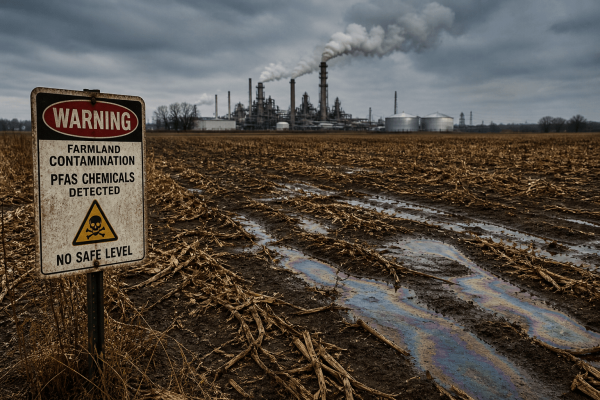
Farmland contamination warning sign in a rural agricultural field affected by PFAS chemicals, with an industrial plant visible on the horizon under a grey sky.
Something is seeping into the soil—and it’s not just water or nutrients. Across multiple regions, farmland once considered productive is now raising quiet alarms, as unseen chemical residues begin to alter what grows, what survives, and what may ultimately reach dinner tables.
What Actually Happened
Concerns around so-called “forever chemicals,” scientifically known as PFAS (per- and polyfluoroalkyl substances), have been building for years. But the issue has taken a sharper turn as agricultural land itself becomes part of the contamination story.
PFAS are widely used in industrial processes and consumer products due to their resistance to heat, water, and oil. That same durability, however, means they do not break down naturally. Once they enter soil or water systems, they persist indefinitely.
Recent reporting has highlighted how these chemicals are entering farmland through multiple pathways—biosolid fertilizers, contaminated irrigation water, and industrial runoff. In some documented cases, farms have been forced to halt operations entirely after testing revealed unsafe PFAS levels in soil and livestock.
According to a Reuters investigation, farmers in several regions have already faced devastating consequences after discovering PFAS contamination in their land and products, leading to lost income and long-term uncertainty
https://www.reuters.com/investigates/special-report/chemicals-pfas-farmers/
Why This Moment Matters
This isn’t just an environmental issue—it’s an agricultural one with direct implications for food systems.
When soil becomes contaminated, it affects everything grown within it. Crops can absorb PFAS through their roots, while livestock may ingest contaminated feed or water. Over time, this creates a pathway from industrial pollution to human consumption.
The broader concern is scale. PFAS contamination isn’t isolated to one region or country. It has been detected globally, including in North America, Europe, and parts of Asia.
The BBC has reported growing concern among scientists and regulators about how widespread PFAS exposure has become, with mounting evidence linking long-term exposure to health risks such as hormonal disruption and certain cancers
https://www.bbc.com/news/science-environment-65178927
The Pattern Behind the Event
______________________________________________
🔴 Help keep this independent voice alive and uncensored -> Buy us a Coffee <-
There is a recurring pattern in how these situations unfold.
First, contamination goes unnoticed. PFAS are invisible, odorless, and require specialized testing to detect.
Then, exposure accumulates quietly—through soil, water, and food systems—often over years or decades.
Only later does the impact become visible, usually when testing reveals elevated levels or when health concerns begin to surface.
What makes PFAS different from many past contaminants is their persistence. Unlike chemicals that degrade over time, PFAS remain embedded in ecosystems, effectively locking in long-term consequences.
Al Jazeera has reported that regulatory frameworks are struggling to keep pace with the scale of contamination, leaving gaps in oversight and delayed responses in affected areas
https://www.aljazeera.com/news/2024/1/15/pfas-contamination-global-response
Where the Tensions Are Building
Pressure is now forming along multiple fault lines.
Farmers are caught in the middle—facing financial ruin despite having no direct role in the contamination. Many relied on approved fertilizers or water sources, only to later discover they were compromised.
Governments are grappling with how to regulate PFAS without disrupting industries that rely on them. Cleanup efforts are complex and expensive, with no easy or fast solutions.
Consumers, meanwhile, are becoming increasingly aware of what may be entering the food supply, raising questions about transparency, labeling, and long-term safety.
At the same time, legal battles are beginning to emerge, with affected communities seeking accountability from manufacturers and regulators.
What This Could Signal Next
What’s unfolding may represent an early stage of a much larger shift.
If PFAS contamination continues to spread across agricultural land, it could force changes in how food is produced, tested, and regulated. Entire regions may face restrictions, while new standards for soil and water safety could reshape farming practices.
There is also the possibility of increased monitoring and stricter limits on PFAS use, though such measures may take years to implement effectively.
In the meantime, the issue sits in a difficult space—visible enough to raise concern, but complex enough to resist quick resolution.
And as more land is tested, one question continues to surface quietly beneath the data: how much of this has already gone unnoticed?
About the Author