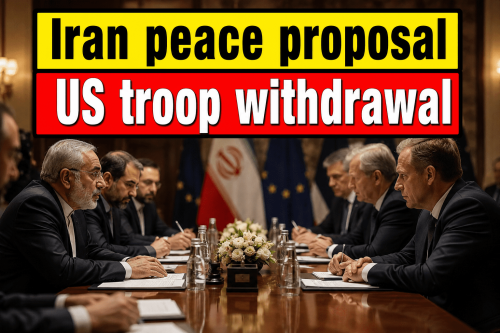
A quiet but significant diplomatic signal has emerged from Tehran, where Iranian officials say a peace framework is being discussed that ties compensation for past war damage to a broader regional reset. The most striking element is not just the idea of negotiations—but the conditions being placed on the table, including the withdrawal of US forces from the region.
According to reporting from Reuters, Iranian representatives describe the proposal as part of a wider attempt to reshape long-standing security tensions and redefine foreign military presence in the Middle East:
https://www.reuters.com/world/asia-pacific/iran-says-peace-proposal-includes-reparations-war-damage-us-troop-withdrawal-2026-05-19/
The details remain fluid, but the framing itself signals a shift in tone that could ripple far beyond bilateral diplomacy.
What Actually Happened
Iranian officials say they have outlined or received a peace-related proposal that includes two major conditions: financial reparations for war-related damage and a reduction—or full withdrawal—of US troops from certain regional deployments.
While no formal agreement has been confirmed, the messaging marks a notable escalation in how Tehran is positioning its negotiating stance.
The proposal appears to be framed not as isolated demands, but as part of a broader security recalibration across the region, where military presence, sanctions pressure, and proxy conflicts have long overlapped.
Why This Moment Matters
On the surface, this is another round of diplomatic positioning. But the timing carries weight.
The Middle East has been navigating overlapping conflicts, shifting alliances, and renewed debates over foreign military basing. Any suggestion that troop presence could be part of a negotiated settlement introduces a sensitive variable into already unstable dynamics.
Reparations, meanwhile, move the discussion beyond security and into accountability—an area that historically stalls negotiations due to legal and political complexity.
______________________________________________
🔴 Help keep this independent voice alive and uncensored.
Support independent journalism and help keep Chris Wick News going.
👉 Support Chris Wick on GoFundMe
Even the language of the proposal suggests an attempt to widen the negotiating table rather than narrow it.
The Pattern Behind the Event
This is not the first time Iran has linked security talks with broader structural demands.
Over the past decade, negotiations involving Tehran have repeatedly expanded from nuclear issues into sanctions relief, regional influence, and military presence. What is different now is the explicit pairing of compensation with troop withdrawal.
That combination reflects a broader pattern seen in modern geopolitical bargaining: issues once treated separately are now being bundled into single negotiation frameworks.
It also reflects a shifting reality where regional conflicts are no longer isolated but interconnected across multiple theaters.
Where the Tensions Are Building
The most sensitive pressure point remains the presence of US forces in the Middle East and how that presence is interpreted by regional actors.
For Iran, foreign military bases are consistently framed as a central driver of instability. For the United States and its partners, those deployments are positioned as deterrence and security assurance.
This fundamental disagreement is what makes any proposal involving withdrawal particularly difficult to translate into policy.
At the same time, ongoing regional volatility means even exploratory diplomacy is being watched closely by neighboring states that could be affected by any change in force posture.
What This Could Signal Next
At this stage, the proposal is better understood as a signal than a finalized diplomatic path.
It suggests that backchannel discussions—or at least strategic messaging—are active, and that Iran is attempting to redefine the terms of engagement beyond traditional sanction-and-security frameworks.
Whether this leads to structured talks, stalled rhetoric, or renewed escalation will depend on how other global actors respond to the framing of withdrawal and reparations as linked conditions.
For now, the situation remains open-ended, with diplomatic language doing most of the signaling work rather than formal agreements.
A reflective silence tends to follow announcements like this—where the details are less important than the direction being implied. What happens next depends less on the wording of proposals and more on whether any side is willing to treat those words as a starting point rather than a boundary.
About the Author