The surface message from Washington and Beijing sounds familiar: stability, managed competition, and cautious dialogue.
But behind the formal language, the timing of renewed Trump–Xi summit discussions is drawing attention in diplomatic circles, where even small signals are often read as indicators of larger strategic recalibration.
What is being framed publicly as routine engagement is increasingly being interpreted as something more delicate — a controlled attempt to slow escalation in a relationship defined by economic friction, security competition, and global influence battles.
What Actually Happened
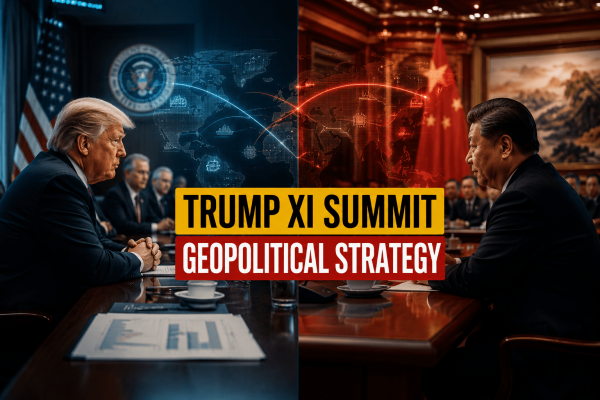
Recent diplomatic reporting indicates renewed attention on high-level engagement between former President Donald Trump and Chinese President Xi Jinping, particularly as both sides navigate shifting global economic pressure and regional security concerns.
While no single confirmed summit outcome has been finalized, discussions around potential meetings reflect a broader trend in U.S.–China diplomacy: direct leader-to-leader communication is being re-elevated as tensions persist across trade, technology, and military posture in the Indo-Pacific.
A Reuters report on U.S.–China engagement dynamics during prior high-level meetings in San Francisco highlighted how both sides have repeatedly attempted to stabilize communication channels even during periods of strategic disagreement
https://www.reuters.com/world/us/biden-xi-meeting-apec-san-francisco-2023-11-16/
This context matters because the current Trump–Xi discussion narrative is emerging against the backdrop of those earlier stabilization efforts — not in isolation.
Why This Moment Matters
The significance is less about whether a summit happens and more about what its consideration reveals.
U.S.–China relations have entered a phase where economic interdependence and geopolitical rivalry exist simultaneously, creating a constant balancing act. Even when official rhetoric emphasizes “guardrails,” both sides continue to expand competitive positioning in semiconductors, AI infrastructure, energy supply chains, and military deterrence.
In this environment, summit talk functions as a pressure valve. It signals willingness to manage escalation without resolving underlying disputes.
______________________________________________
🔴 Help keep this independent voice alive and uncensored.
Support independent journalism and help keep Chris Wick News going.
👉 Support Chris Wick on GoFundMe
Diplomatic analysts note that these engagements often serve three functions:
- Preventing miscalculation during high tension periods
- Maintaining economic predictability for global markets
- Reasserting control over narrative during political transitions
The timing of renewed discussion suggests all three pressures are active at once.
The Pattern Behind the Event
This is not the first time high-level Trump–Xi engagement has been floated during moments of global uncertainty.
Historically, summit discussions tend to intensify during periods of:
- Trade disruption or tariff escalation
- Military activity in the South China Sea or Taiwan Strait
- Domestic political transitions in either country
- Global economic slowdown concerns
What makes the current cycle notable is the layering of all four conditions simultaneously.
Instead of a single trigger event, the system is reacting to sustained pressure across multiple domains — economic, technological, and military.
This pattern suggests diplomacy is no longer reactive in isolated bursts. It is becoming continuous background management of tension rather than resolution of it.
Where the Tensions Are Building
Even as summit rhetoric circulates, underlying friction points remain structurally unchanged.
Trade policy disputes continue to revolve around industrial subsidies and market access restrictions. Technology competition is accelerating through export controls and domestic supply chain restructuring. Meanwhile, military signaling in the Indo-Pacific remains persistent, with both sides expanding presence and exercises in contested zones.
Each of these domains operates independently, but collectively they reinforce a broader strategic competition that neither side appears willing to fully de-escalate.
What changes is not the conflict itself — but the language used to contain it.
What This Could Signal Next
If summit discussions advance, the most immediate outcome is unlikely to be major policy breakthroughs. Instead, the more realistic expectation is procedural stabilization: communication channels, deconfliction mechanisms, and limited economic understandings designed to prevent shocks.
However, the deeper signal may be more important.
A renewed Trump–Xi engagement framework would suggest that both Washington and Beijing are preparing for a longer period of managed rivalry rather than resolution. In other words, diplomacy is shifting from problem-solving toward containment architecture.
That shift is subtle, but it reshapes expectations across global markets and allied governments that depend on predictable U.S.–China dynamics.
The question now is not whether engagement happens, but what kind of stability it is meant to produce — and how long that stability can hold under increasing structural pressure.
The system is still talking about cooperation.
But it is increasingly built around managing competition that neither side can fully step away from.