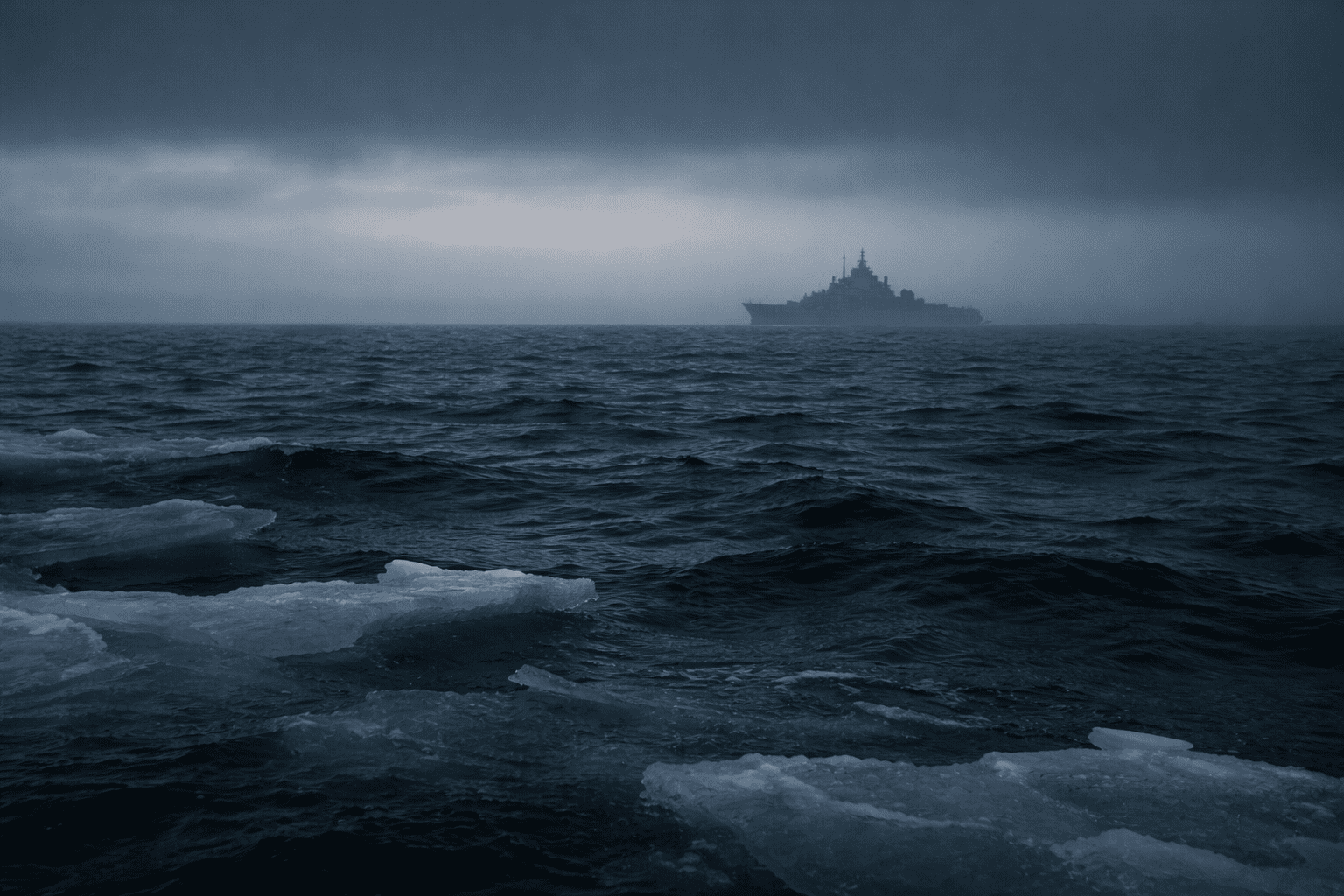
There is a point in northern waters where shipping lanes thin out, maps turn sparse, and most public attention disappears. That is where new reporting suggests something is shifting again — not loudly, not with headlines designed for mass attention, but through technical designations and restricted zones that rarely get questioned outside defense circles.
Early signals point to Russia expanding or formally adjusting rocket testing corridors in the Barents Sea region, an area already layered with military history and Cold War remnants. The change itself is not necessarily unusual in isolation. What makes it notable is the timing, the geography, and the pattern it appears to follow.
Reports from international monitoring coverage describe increased military structuring in Arctic maritime zones, including areas used for missile testing and naval drills.
That shift sits inside a broader Arctic recalibration that has been unfolding quietly for years. What used to be treated as an extreme environment for occasional testing is increasingly being folded into routine strategic planning. The Barents Sea, in particular, has long functioned as a pressure point between Russian naval capacity and NATO monitoring systems, making any adjustment there less about geography and more about signaling.
Russia Barents Sea rocket test zones 2026 and the pattern beneath the policy
The phrase Russia Barents Sea rocket 2026 is beginning to appear in discussions among analysts tracking Arctic defense posture. But the real story is less about a single designation and more about accumulation — the steady layering of restricted corridors, expanded exclusion zones, and updated naval exercise maps that collectively reshape how the region is used.
At surface level, this looks procedural: updates to testing schedules, maritime safety notices, and controlled access areas. But when placed alongside similar developments across the Arctic circle, a pattern begins to form. It is not just about weapons testing. It is about normalization of military infrastructure in spaces that were once treated as environmentally extreme buffers rather than strategic corridors.
The institutional response from Western defense observers has been cautious rather than alarmed. Part of that is because Arctic militarization is not new. Another part is because verifying intent from designations alone is difficult without accompanying deployments or public exercises. Still, intelligence communities tend to treat these updates as early indicators rather than isolated administrative acts.
Midway through this shift, analysts point to a broader structural reality: climate change is slowly reshaping Arctic accessibility. As ice coverage changes, so does the economic and strategic value of shipping routes and seabed access. That creates a dual pressure — economic opportunity on one side, and military competition on the other.
A similar framing has been reflected in coverage of northern defense postures across multiple agencies.
https://apnews.com/hub/russia
______________________________________________
🔴 Help keep this independent voice alive and uncensored.
Support independent journalism and help keep Chris Wick News going.
👉 Support Chris Wick on GoFundMe
What makes the Barents Sea particularly sensitive is its proximity to established naval infrastructure and long-range deterrence systems. That proximity turns even administrative changes into potential indicators of future operational behavior. It is not always about immediate action, but about where the boundaries of action are being redrawn.
From a governance perspective, these developments sit in a grey zone. There is no single international mechanism that fully regulates how Arctic military testing zones evolve in real time. Instead, updates are communicated through maritime notices, defense briefings, and selective disclosures. That fragmented transparency creates space for interpretation — and sometimes misinterpretation.
The media framing of these updates tends to oscillate between routine reporting and strategic alarmism. Neither fully captures the underlying reality, which is more incremental. The Arctic is not shifting through one dramatic event, but through a series of small administrative decisions that gradually reshape operational geography.
That broader shift has also been noted in geopolitical analysis circles tracking global power projection trends.
https://www.axios.com/world
As the Arctic becomes more navigable and more contested, the Barents Sea remains one of its most historically loaded zones. It is where legacy Cold War infrastructure intersects with modern precision systems, and where environmental change is quietly intersecting with defense planning.
What remains unclear is whether these new designations signal preparation for increased testing tempo, or whether they are primarily precautionary adjustments in anticipation of future activity. The distinction matters, but it is rarely visible in official language.
For now, what can be observed is not escalation in the dramatic sense, but refinement — tighter mapping, clearer exclusion zones, and more frequent updates to maritime boundaries. Each change is small enough to avoid attention on its own. Together, they form a map that looks increasingly less civilian and more strategic.
And that is where the uncertainty settles: not in what has already been declared, but in what these quiet lines on maritime charts might be preparing for next.