Something didn’t sit right about how fast it escalated.
Tens of thousands of people were told to leave—almost overnight—after a single industrial tank in Southern California was flagged as unstable. No explosion yet. No disaster confirmed. Just the possibility… and that was enough.
What Actually Happened
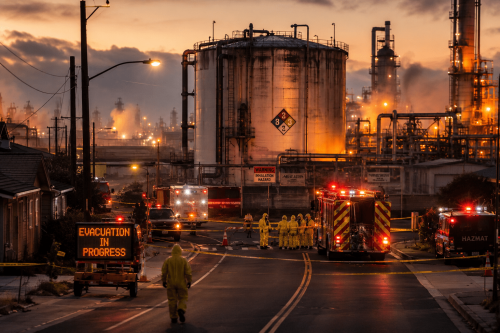
Authorities in Southern California ordered the evacuation of roughly 40,000 residents after a large chemical storage tank showed signs of instability, raising fears it could rupture or explode.
The tank reportedly contained materials linked to industrial and aerospace processes, making the situation especially sensitive due to the potential for toxic exposure.
Emergency crews moved quickly to secure the site while monitoring pressure levels and structural integrity. Schools were closed, roads were blocked, and entire neighborhoods were cleared as a precaution.
According to reporting from CTV News coverage of the evacuation, officials described the situation as unpredictable, with changing conditions inside the tank complicating response efforts.
Why This Moment Matters
Mass evacuations tied to industrial threats are not new—but the speed and scale of this response stands out.
There was no confirmed leak. No explosion. Just risk.
That alone was enough to displace tens of thousands of people, raising questions about how close such facilities operate to residential zones—and how often similar risks exist without public awareness.
______________________________________________
🔴 Help keep this independent voice alive and uncensored.
Support independent journalism and help keep Chris Wick News going.
👉 Support Chris Wick on GoFundMe
Moments like this reveal something deeper: how thin the margin can be between routine operations and large-scale disruption.
The Pattern Behind the Event
This incident fits into a broader pattern that rarely gets sustained attention.
Across North America, industrial storage sites—especially those tied to chemicals, fuel, or manufacturing—often sit within or near expanding population centers.
Over time, cities grow outward. Infrastructure remains where it was originally built. The gap between “industrial zone” and “residential life” quietly disappears.
What was once considered a safe distance becomes a shared boundary.
And when something goes wrong—or almost goes wrong—the scale of impact multiplies instantly.
Where the Tensions Are Building
The real tension isn’t just inside the tank.
It’s in the growing overlap between industrial systems and everyday life.
Residents often don’t know what’s stored nearby. Emergency planning exists, but it’s rarely front-of-mind until something triggers it.
In this case, evacuation orders moved faster than public understanding. People were told to leave before many fully understood why.
That gap—between action and explanation—is where uncertainty grows.
What This Could Signal Next
Situations like this tend to fade quickly once the immediate risk passes.
If the tank stabilizes, coverage slows. People return home. The system resets.
But the underlying conditions don’t change.
The infrastructure remains. The proximity remains. The risk—however small or controlled—remains.
And next time, it may not be a warning.
It may be something less predictable.