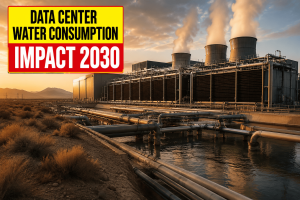
A vast modern data center complex operating at sunset, where industrial cooling towers release steam into the air—highlighting the hidden environmental cost of digital infrastructure in a changing world.
The modern internet feels weightless—streaming, cloud storage, AI queries—but beneath that invisible layer sits something very physical: water.
A new 2026 analysis suggests that by the end of this decade, the systems powering artificial intelligence and cloud computing could place demand on public water supplies on a scale comparable to major metropolitan regions.
The question emerging quietly among researchers is not just how much computing power we can build—but how much water the real world can afford to lose in the process.
What Actually Happened
A March 2026 research paper led by Yeulin Han at the University of California, Riverside, in collaboration with Caltech, attempts to quantify the water demands tied to U.S. data center expansion. The study—published as an arXiv preprint titled Small Bottle, Big Pipe: Quantifying and Addressing the Impact of Data Centers on Public Water Systems—projects steep increases in both water withdrawal and consumption tied to cooling infrastructure.
By 2030, the model estimates U.S. data centers could withdraw roughly 80 to 150 billion gallons of water annually, with 60 to 110 billion gallons not returned to the watershed due to evaporation and cooling loss. The paper also outlines a peak daily demand range of 697 to 1,451 million gallons per day, a figure the authors note is comparable to the total daily water supply of New York City.
The study further estimates that meeting this demand could require $10 to $58 billion in new water infrastructure investment, depending on regional growth patterns and cooling technology choices.
Source: https://arxiv.org/abs/2603.02705
Why This Moment Matters
What makes these figures notable is not only their scale, but their timing. Data center growth is accelerating alongside artificial intelligence deployment, cloud storage expansion, and high-performance computing demand.
Unlike electricity usage, which is often publicly tracked and debated, water use in data infrastructure remains less visible to consumers. Much of it is tied to cooling systems that rely on evaporation or water-intensive heat exchange processes.
The implication is subtle but significant: digital expansion is increasingly tied to local water resilience, especially in regions already facing drought stress or competing agricultural demand.
The Pattern Behind the Event
This is not the first time infrastructure growth has collided with resource constraints. Historically, industrial expansion has often shifted pressure onto one invisible system while solving another.
In this case, the digital economy’s physical footprint is becoming harder to ignore. Each increase in computing demand—particularly from AI model training and inference—requires more densely packed hardware, which generates more heat, and therefore more cooling demand.
______________________________________________
🔴 Help keep this independent voice alive and uncensored.
Support independent journalism and help keep Chris Wick News going.
👉 Support Chris Wick on GoFundMe
What stands out in the research is not just total consumption, but concentration. Large clusters of data centers can place localized strain on municipal water systems that were not designed for industrial-scale evaporation losses.
Where the Tensions Are Building
Several regions in the United States have already begun to feel friction between data infrastructure expansion and local resource planning. Communities near fast-growing technology corridors are increasingly weighing economic benefits against long-term environmental capacity.
The challenge is structural: data centers are often sited based on energy availability, tax incentives, and land cost—not necessarily water abundance.
This mismatch creates a growing policy tension. Water utilities, typically designed for population growth and agriculture, are now being asked to support industrial-scale digital infrastructure without equivalent upgrades in planning frameworks.
What This Could Signal Next
If the projections in the 2026 study prove directionally accurate, the next phase of digital infrastructure expansion may shift from purely energy-focused debates to water-constrained planning.
That could influence where new data centers are built, how they are cooled, and whether alternative technologies—such as closed-loop cooling systems or non-evaporative designs—become standard rather than experimental.
It also raises a quieter but more complex question: whether the physical limits of water availability will begin shaping the growth curve of artificial intelligence itself.
A digital world often feels detached from geography, but its infrastructure is still bound by it. Water does not disappear from the equation simply because computation is invisible. It moves, evaporates, and ultimately reappears in the balance sheets of cities, utilities, and ecosystems still trying to keep pace with demand.
What happens next may depend less on how fast AI grows—and more on how long physical systems can quietly keep up.
About the Author