








The United States is preparing to do something that could fundamentally change how the country views capital punishment.
Not simply execute a convicted mass murderer.
Broadcast the execution for the public to watch.
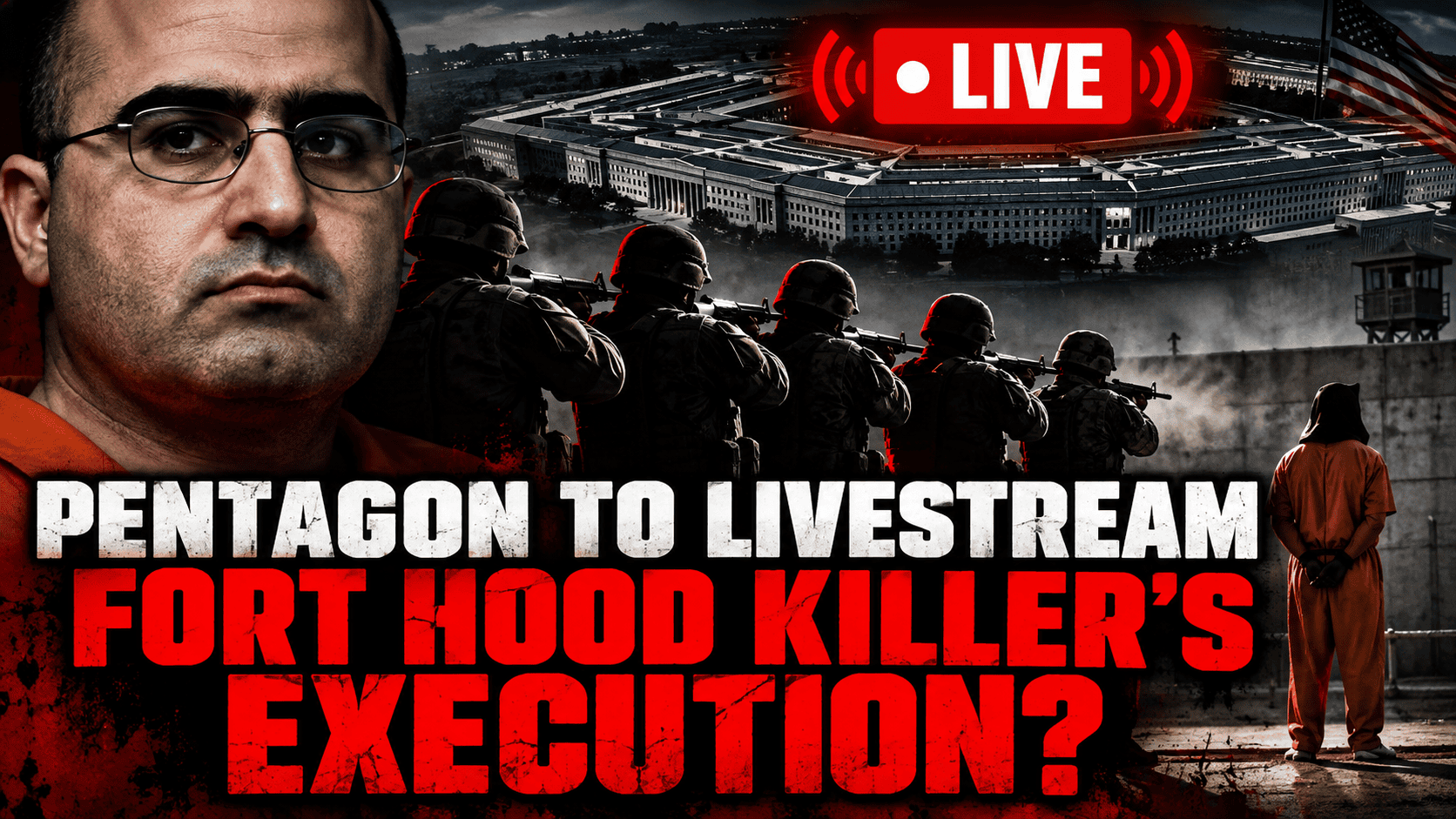
According to Reuters, the Pentagon plans to livestream the December 3, 2026, execution of Nidal Hasan, the former U.S. Army psychiatrist convicted of murdering 13 people during the 2009 Fort Hood massacre in Texas.
Hasan is scheduled to face a military firing squad at the same installation where he carried out the attack nearly 17 years ago.
The decision raises a question that goes far beyond one convicted killer.
When a government turns an execution into a public broadcast, where does justice end and spectacle begin?
The Fort Hood Massacre That Killed 13 People
On November 5, 2009, Major Nidal Malik Hasan opened fire inside a soldier processing facility at Fort Hood, Texas.
Thirteen people were killed, including a pregnant soldier, and more than 30 others were wounded.
______________________________________________
🔴 Help keep this independent voice alive and uncensored -> Buy us a Coffee <-
The shooting became one of the deadliest attacks ever carried out on an American military installation.
Hasan, an Army psychiatrist, later acknowledged responsibility for the killings. During his 2013 military trial, he said his actions were connected to his opposition to American military operations in Muslim countries.
A military jury convicted him and sentenced him to death.
For years, Hasan remained on military death row at Fort Leavenworth, Kansas.
Now the Pentagon intends to carry out that sentence in a manner not seen in the American military for generations.
Pete Hegseth Wants the Execution Made Public
Defense Secretary Pete Hegseth has openly supported making Hasan’s execution visible to the public.
Speaking during an interview with Human Events, Hegseth argued that people should witness the consequences of such crimes.
The execution is scheduled for December 3 at 1 p.m. Central Time, deliberately reflecting the approximate time, weekday and location of the original attack.
President Donald Trump approved the execution decision following Hegseth’s recommendation.
A Pentagon official subsequently confirmed to Reuters that the execution would be livestreamed, although details about the broadcast platform and public access had not yet been announced.
This is not simply a return to an older execution method.
It represents a proposed transformation of a military punishment into a publicly broadcast event.
And that distinction matters.
America Has Not Executed a Military Prisoner Since 1961
The United States military has not carried out an execution since 1961.
The last military execution by firing squad occurred in 1945, when Private Eddie Slovik was executed for desertion during World War II.
Hasan’s scheduled execution would therefore mark two historic developments: the return of military executions after more than six decades and the return of the military firing squad after more than 80 years.
But the livestream proposal introduces something different.
America largely abandoned public executions during the twentieth century.
The last widely recognized public execution in the United States occurred in Kentucky in 1936, when thousands gathered to witness the hanging of Rainey Bethea.
Over time, executions moved behind prison walls, away from crowds and public spectacle.
Now modern technology could reverse that separation without requiring anyone to leave their living room.
Justice, Deterrence or a Government-Produced Spectacle?
Supporters of public executions argue that making punishment visible demonstrates accountability and reinforces the consequences of violent crimes.
Families of victims have every reason to demand that the justice system take the murders of their loved ones seriously.
Thirteen people lost their lives at Fort Hood. Their deaths should never become a footnote in a political argument.
But another question deserves equal scrutiny.
Does broadcasting an execution strengthen justice, or does it risk turning the death penalty into entertainment?
A livestream is not the same as allowing journalists or designated witnesses to observe an execution.
It potentially places the final moments of a condemned person’s life before an unlimited audience.
The footage could be recorded, redistributed, edited and circulated indefinitely.
Once released onto the internet, the government would have little practical control over how those images were used.
That raises uncomfortable questions about the responsibilities of the state, the rights of victims’ families and the dignity of the justice system itself.
The Legal Questions Have Not Disappeared
There are also unresolved procedural concerns.
Associated Press reporting has highlighted questions about the military’s firing squad procedures and the possibility of additional legal challenges.
Hasan may still seek federal court review, potentially affecting the scheduled execution date.
Questions have also emerged about the rules governing witnesses and whether existing military regulations accommodate a public broadcast.
An announcement from the Pentagon does not automatically resolve those legal issues.
The distinction is important: the execution has been scheduled, but its completion on December 3 is not guaranteed.
Nor have officials fully explained how the livestream would operate.
A Dangerous Precedent for the Digital Age?
The broader implications extend beyond Hasan.
Governments have always understood the symbolic power of punishment.
Historically, public executions were used to demonstrate the authority of the state and warn others about the consequences of defying its laws.
Modern democracies largely moved away from that practice, in part because public executions could become spectacles rather than solemn exercises of justice.
The internet changes the equation.
A government no longer needs to assemble a crowd in a public square.
It can potentially reach millions through a single broadcast.
That creates an entirely new relationship between state power, punishment and public consumption.
It also raises questions about precedent.
If the execution of a convicted mass murderer can be livestreamed, what standards would determine whether future executions should receive the same treatment?
Who makes that decision?
And what prevents a supposedly exceptional measure from becoming normalized?
These questions deserve serious answers before the first broadcast begins.
The Victims Must Not Be Forgotten
There is a danger that the controversy surrounding the livestream could overshadow the people murdered at Fort Hood.
Thirteen lives were taken.
Families were devastated.
Survivors were left carrying physical and emotional consequences that no execution can erase.
Those facts remain central regardless of anyone’s position on capital punishment.
Justice should recognize the victims without reducing their suffering to the backdrop of a televised event.
The decision to execute Hasan and the separate decision to broadcast that execution should be examined on their own merits.
They are not the same question.
Chris Wick’s Final Take
Nidal Hasan was convicted of murdering 13 people. That is established fact, not speculation.
But the Pentagon’s decision to livestream his execution opens a debate that Americans have not seriously confronted in generations.
The government has the responsibility to enforce the law. It also has the responsibility to explain why making an execution available for public viewing serves a legitimate purpose.
Transparency is important.
Accountability is important.
But neither automatically requires transforming death into something people can watch, replay and share.
The disturbing question is not whether Hasan deserves sympathy. It is whether the American government should make killing a prisoner a public broadcast.
Because once a country starts televising executions, the debate is no longer only about the condemned.
It is also about the kind of society watching.
And what happens when the screen goes dark.
Sources
Reuters — U.S. to Livestream Army Execution of Fort Hood Shooter, Pentagon Official Says (October 8, 2026)
Associated Press — As Army Moves to Execute Fort Hood Shooter, Questions About Procedure Linger
https://apnews.com/article/5500bd39ae8beee240bd1da874b8c341
Associated Press — Public Executions in the U.S. Were Once a Community Spectacle and Then They Stopped
https://apnews.com/article/e9b41d2c6425aa75e25e65dddc91ab7b
CBS News — Fort Hood Shooter’s Execution Will Be Livestreamed, Pentagon Says
https://www.cbsnews.com/news/hegseth-fort-hood-shooter-execution-public-nidal-hasan
ABC News — Pentagon Official Says Hasan Execution Will Be Live-Streamed
https://latency.ingest.abcnews.com/Politics/hegseth-hasan-execution-public/story?id=137110734