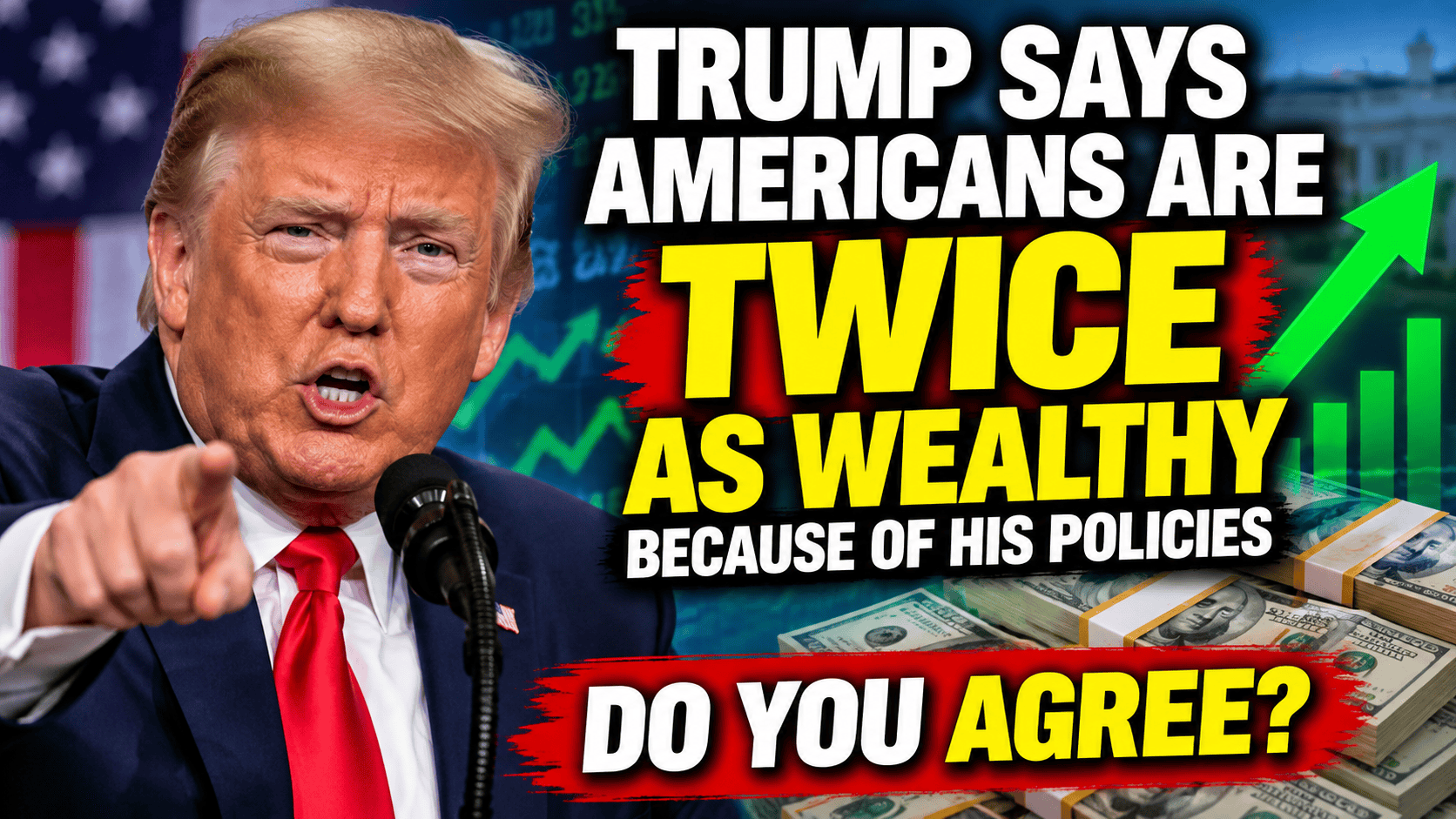
President Donald Trump just made one of his boldest economic claims of his second term.
Speaking to reporters on September 28, Trump pointed to the performance of Americans’ 401(k) retirement accounts and declared that they had doubled.
Then he went even further.
“Your 401(k) has doubled in a short period of time. It’s doubled. You’re twice as wealthy as you were a short time ago, every one of you. And that’s because of me.”
That is what Trump actually said, according to a transcript of his remarks. Roll Call
It’s certainly a statement designed to get people’s attention.
But there’s an obvious question:
Are Americans really twice as wealthy as they were before Trump returned to office?
The Stock Market Has Been Strong
There is no question that investors have seen substantial gains.
______________________________________________
🔴 Help keep this independent voice alive and uncensored.
Support independent journalism and help keep Chris Wick News going.
👉 Support Chris Wick on GoFundMe
The U.S. stock market under Trump has performed strongly overall. The S&P 500 gained roughly 29% between Trump’s January 20, 2025 inauguration and September 28, 2026. Another analysis puts the market’s increase at more than 37% when measuring from the 2024 election through September 25, 2026. StatMuse
That’s real money.
Someone with a large retirement portfolio heavily invested in equities could be substantially wealthier today than when Trump began his second term.
But there’s a big difference between saying the stock market has risen substantially and saying Americans are twice as wealthy.
A 29% increase isn’t 100%.
And not every American has a large 401(k), owns substantial stocks or participates equally in a rising market.
Even the 401(k) Numbers Don’t Show Everyone Doubling Their Money
This distinction becomes even more important because Trump’s statement specifically focused on retirement accounts.
Earlier reporting examining Trump’s claims found that average 401(k) balances had increased during much of his second term—but nowhere near enough to support a blanket claim that everyone’s account had doubled. PBS
That doesn’t mean Americans with retirement investments haven’t benefited.
Many clearly have.
It means something much simpler: a rising stock market and a doubling of every American’s wealth are not the same thing.
America’s Wealth Isn’t Distributed Equally
There is another part of this discussion that rarely fits into a political sound bite.
Who actually owns America’s financial assets?
Federal Reserve data provides some perspective.
As of the second quarter of 2026, the wealthiest 0.1% of households held about $27.87 trillion in wealth. The bottom 50% held about $4.28 trillion combined. Federal Reserve
The difference becomes even more striking when looking specifically at stocks and mutual funds.
The top 0.1% held roughly $16.15 trillion in corporate equities and mutual-fund shares, while the entire bottom 50% held about $370 billion. Federal Reserve
So when the stock market explodes higher, everybody does not benefit equally.
That doesn’t erase the gains.
It does put them into perspective.
Wall Street and Main Street Can Experience Two Different Economies
This may be the real story behind Trump’s claim.
The stock market can be near record levels while millions of people are still worried about groceries, gasoline, rent, mortgages and credit-card payments.
In fact, recent economic reporting describes exactly that tension.
Consumer confidence has fallen sharply amid concerns about high energy prices, borrowing costs and the labor market, even while major stock indexes remain substantially higher for the year. The Wall Street Journal
That creates an unusual situation.
An American with $500,000 invested in stocks might look at the last year and feel significantly wealthier.
Someone living primarily from wages and carrying a mortgage, car loan and credit-card debt might look at the same economy and wonder what everyone is celebrating.
Both people are living in the same country.
But financially, they may be experiencing completely different Americas.
Trump Deserves to Point to the Market — But the Bigger Claim Is Something Else
Presidents routinely take credit when markets rise and distance themselves from the market when it falls.
Trump is certainly entitled to argue that his tax, regulatory, trade and economic policies helped produce stronger investment, corporate profits and market confidence.
People can debate how much credit any president deserves.
Markets are influenced by presidential policies, but also by corporate earnings, Federal Reserve policy, technological investment, global capital flows, geopolitical events and expectations about the future.
The important distinction is between saying:
“The stock market has performed strongly under my administration.”
and saying:
“You’re twice as wealthy.”
Those aren’t the same claim.
Maybe the Best Test Isn’t Washington or Wall Street
Forget Democrats.
Forget Republicans.
Forget economists for a moment.
Look at your own finances.
Compare where you were when Trump returned to office in January 2025 with where you are today.
Your retirement account.
Your savings.
Your investments.
Your debt.
Your mortgage or rent.
Your grocery bill.
Your gasoline bill.
Your disposable income.
Your overall net worth.
Are you twice as wealthy?
Because ultimately, that may be the most interesting part of Trump’s statement.
The president says Americans are wealthier because of what his administration has accomplished.
The markets certainly provide him with something to point toward.
But whether that prosperity has reached the average household—and whether Americans themselves actually feel twice as wealthy—is another question entirely.
So forget the political talking points for a minute. Look at your own financial situation.


Washington is going after the money behind the shadows.
The US Treasury says a Russia-linked financial network called A7 helped Iran evade sanctions by disguising restricted payments as ordinary business transactions.
Think about what that means.
Behind the wars, sanctions and diplomatic speeches, there’s another battlefield most people never see: hidden financial networks moving money across borders.
And every time Washington closes one door, the question becomes whether another opens somewhere else.
Are sanctions actually cutting off these networks, or pushing more of the global financial system underground?