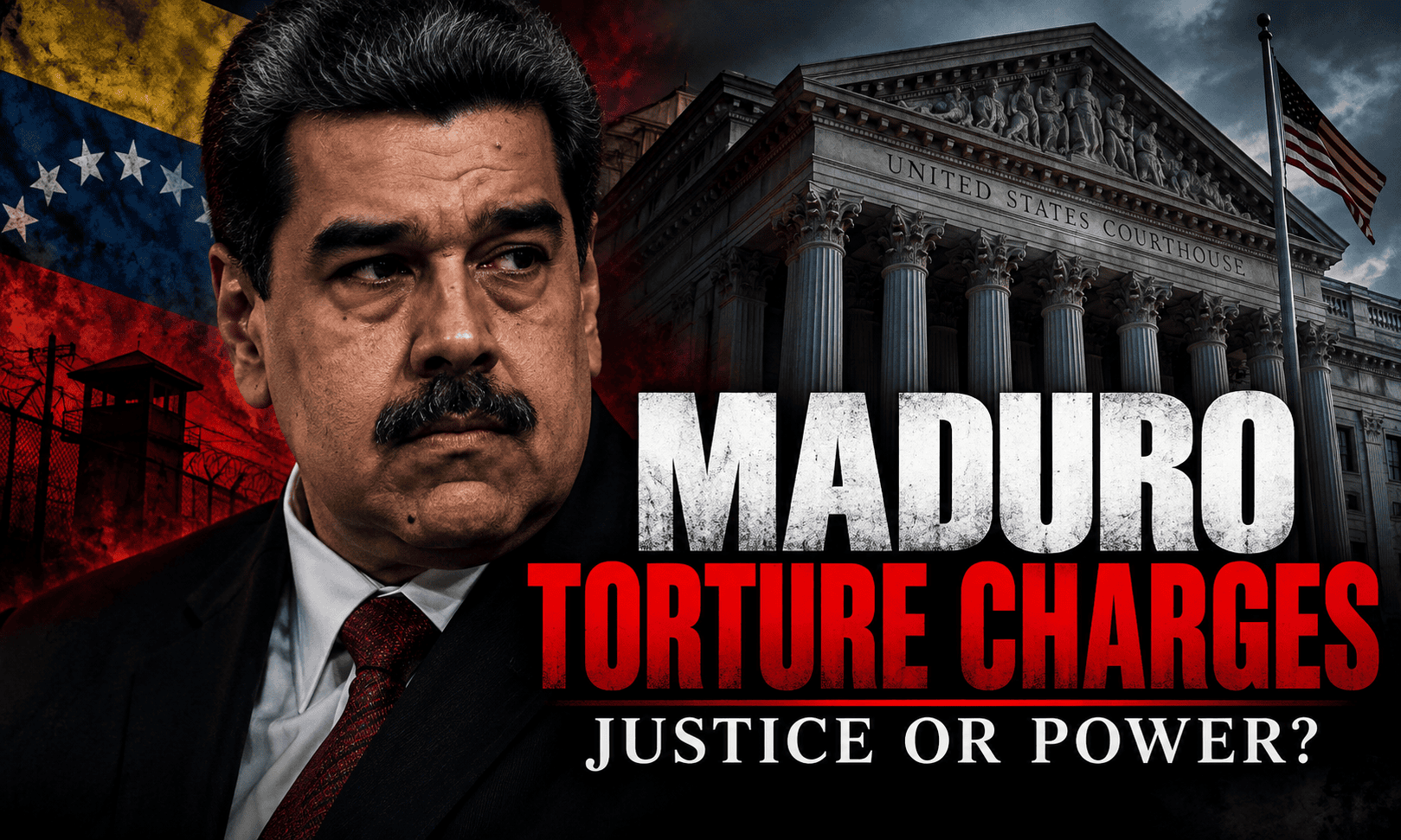
Nicolás Maduro faces new U.S. torture allegations as questions grow over political repression, international law and government accountability. Editorial illustration.
The man who once controlled Venezuela’s military, intelligence services and prisons is now sitting in an American detention centre, accused of overseeing a system of torture that allegedly turned political opponents into targets of state-sponsored brutality.
Former Venezuelan President Nicolás Maduro and his wife, Cilia Flores, face new federal charges in the United States, with prosecutors alleging that torture was not simply the work of rogue security officers but part of a deliberate strategy to preserve political power.
The accusations are disturbing. Electric shocks, beatings, suffocation, psychological intimidation and threats against prisoners’ families are among the abuses described by federal authorities.
But behind the allegations lies a much larger question.
When a government uses fear to maintain control, who holds its leaders accountable — and who holds the governments pursuing them to the same legal standards?
According to October 8 reporting by NPR and the Associated Press, a revised federal indictment filed in Manhattan accuses Maduro and Flores of conspiring to commit torture. The allegations add a new dimension to the drug-related criminal case the couple already faces following their capture by American forces in January.
The charges are allegations, not convictions. Both defendants previously pleaded not guilty to the drug-related charges, and the new torture allegations remain to be tested in court.
A Prison System Allegedly Used to Silence Opposition
The latest indictment describes a system in which Venezuelan security institutions allegedly detained, intimidated and tortured individuals considered threats to Maduro’s government.
The prosecution’s central accusation is not merely that abuses occurred. It is that senior political leaders allegedly directed and maintained the machinery responsible.
______________________________________________
🔴 Help keep this independent voice alive and uncensored -> Buy us a Coffee <-
According to CBS News’ coverage of the superseding indictment, prosecutors accuse Maduro of ordering the detention and torture of political opponents, receiving updates about interrogations and instructing officials to intensify their treatment of prisoners.
Flores is accused of helping develop the repressive system and participating in decisions involving the mistreatment of detainees.
The distinction matters.
An isolated act of brutality by a prison guard is a serious crime. A system of abuse allegedly authorized by a country’s leadership raises questions about institutional responsibility, command structures and the deliberate use of state power against citizens.
In the prosecution’s account, detention was not always about investigating criminal conduct. It allegedly became a means of intimidating political opponents and extracting information through coercion.
That is a fundamentally different accusation from ordinary corruption or political misconduct.
It concerns whether the institutions supposedly responsible for protecting the public were instead used to frighten it into submission.
Americans Allegedly Caught Inside the Machinery
The indictment also describes the alleged mistreatment of American citizens held in Venezuelan custody.
Associated Press reporting describes three unnamed Americans whose alleged experiences included electric shocks, prolonged beatings, threats and severe physical injuries.
One detainee was allegedly beaten and subjected to electric shocks during months of imprisonment. Another reportedly required extensive hospital treatment after abuse. A third allegedly suffered permanent damage to an eye following repeated beatings.
These descriptions come from the prosecution’s allegations and should not be confused with findings reached after a criminal trial.
Nevertheless, they illustrate what federal prosecutors are attempting to establish: that torture was allegedly used against both Venezuelan citizens and foreigners.
One particularly troubling accusation concerns the use of threats against prisoners’ family members.
Physical violence is one means of breaking resistance. Threatening a detainee’s children or relatives introduces another form of coercion, exploiting the fear that loved ones could suffer consequences for someone else’s suspected political activities.
If proven, these actions would demonstrate a calculated use of psychological pressure alongside physical abuse.
The Allegations Did Not Begin in October
The new charges may be making headlines now, but accusations of torture and political repression in Venezuela have circulated for years.
Reuters’ October 8 reporting describes allegations dating back to 2013, when Venezuelan military counterintelligence officers allegedly tortured an officer suspected of plotting against Maduro.
Prosecutors say the officer was subjected to repeated electric shocks and suspended by his limbs during interrogation.
These allegations are significant because they place the alleged abuse within a much longer period of political rule.
The question becomes whether investigators can demonstrate an organized pattern connecting individual incidents to instructions from senior officials.
That requires more than showing that abuse occurred in Venezuelan detention facilities.
It requires establishing criminal responsibility under the relevant legal standards, including the defendants’ alleged participation, knowledge or direction.
The difference between a political accusation and a criminal conviction is evidence tested through legal proceedings.
And that distinction must remain central, regardless of how unpopular the accused may be.
Maduro’s Capture Raises Another Uncomfortable Question
There is a second controversy surrounding this prosecution that deserves serious attention.
Maduro and Flores were captured by American military forces in Caracas on January 3, 2026, and transported to the United States.
The operation dramatically changed Venezuela’s political leadership and placed the former president directly within reach of American prosecutors.
But it also triggered questions about sovereignty, international law and the limits of American power.
According to reporting by The Washington Post, Maduro’s lawyers have challenged the legitimacy of the military operation and raised arguments concerning immunity for actions taken while he was president.
Those arguments do not disprove the torture allegations.
But neither do the allegations automatically settle the legality of the operation that brought Maduro to an American courtroom.
These are separate legal questions.
A government cannot claim that legal accountability matters only when it is prosecuting someone else.
If the United States intends to demonstrate that political leaders are not above the law, the methods used to bring those leaders before a court must also withstand legal scrutiny.
Otherwise, justice risks becoming entangled with the exercise of geopolitical power.
Flores Remains Behind Bars as Trial Approaches
The legal pressure intensified Thursday when U.S. District Judge Alvin Hellerstein denied Flores’ request for pretrial release.
Her attorneys argued that she required medical treatment for a heart condition and proposed that she remain at a residence in the New York area under round-the-clock private security.
Prosecutors opposed the request, arguing that Flores presented a serious flight risk and could potentially interfere with witnesses.
According to Reuters’ coverage of the bail hearing, the judge rejected the application, leaving Flores in federal detention.
The decision concerns her custody while awaiting trial, not a determination of guilt.
The criminal trial is scheduled for June 1, 2027.
Until then, the prosecution must establish its case through evidence, while the defendants retain the opportunity to challenge the charges and the legal basis for the proceedings.
The Difference Between Accountability and Political Convenience
Venezuela’s history of confrontation with Washington complicates the broader political picture.
The country possesses enormous oil reserves, has faced years of American sanctions and has been a focal point of international disputes over elections, democracy and foreign influence.
None of that excuses torture.
But it does mean the prosecution will unfold against a backdrop of geopolitical interests that cannot simply be ignored.
A serious examination of the case must consider both the alleged victims and the legal mechanisms used to pursue those accused of harming them.
There is also a wider question about consistency.
When powerful governments condemn torture abroad, how consistently do they demand transparency and accountability from their own institutions and allies?
That is not an argument for dismissing the case against Maduro.
It is an argument for applying the same standards of evidence, due process and human rights regardless of political alignment.
A legal system becomes more credible when its principles do not change depending on who stands accused.
What Happens Next?
The latest indictment adds serious allegations to an already extraordinary criminal case.
Prosecutors must demonstrate whether Maduro and Flores participated in the alleged torture conspiracy. The defense can contest the evidence, challenge the court’s authority and argue against the prosecution’s interpretation of events.
For alleged victims, the proceedings may offer an opportunity for accountability that seemed remote while Maduro controlled Venezuela’s government.
For the international community, the case raises difficult questions about the prosecution of former national leaders, the boundaries of sovereignty and the reach of American criminal law.
And for ordinary citizens, the underlying warning is broader than Venezuela.
Institutions created to protect public security can become instruments of intimidation when concentrated power operates without meaningful oversight.
The challenge is ensuring that efforts to confront such abuses do not abandon the legal principles they claim to defend.
Maduro’s future will be decided through the courts. But the larger question will remain long after the verdict: Is justice a universal standard, or does its reach depend on who holds the power?
Sources
1. NPR / Associated Press — October 8 report on new federal torture charges
https://www.npr.org/2026/10/08/nx-s1-5995360/venezuela-nicolas-maduro-torture-charges
2. Associated Press — Revised indictment and allegations involving detainees
https://apnews.com/article/da82df35aab0f02e344d1c3de0ed31d7
3. Reuters — New charges and Cilia Flores’ bail hearing
4. CBS News — Federal torture conspiracy charges
https://www.cbsnews.com/news/nicolas-maduro-cilia-flores-new-torture-charge
5. The Washington Post — Maduro’s prosecution and legal challenges
About the Author