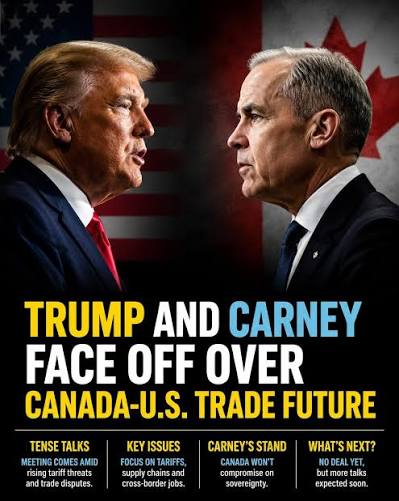
Canada and the United States Face a Critical Trade Moment
The latest Canada-U.S. tariff dispute is entering another potentially decisive phase, and Canadian businesses are watching Washington closely as negotiators attempt to prevent a new escalation in trade tensions.
Canadian officials are reportedly dissatisfied with the latest American proposal aimed at reducing some tariffs, arguing that the relief being offered does not go far enough. At the same time, the Trump administration is continuing to push Canada for concessions involving American goods and market access.
The negotiations are particularly significant because the United States has threatened to introduce additional tariffs on Canadian goods if an agreement is not reached by August 19, 2026.
That deadline is now only days away.
For Canadians, this is no longer simply a diplomatic dispute being conducted behind closed doors in Washington.
The outcome could affect Canadian exporters, manufacturers, workers, supply chains and ultimately consumers.
The Latest U.S. Offer Has Left Ottawa Unhappy
The latest American proposal reportedly includes reductions to some existing tariffs, but Canadian officials believe the offer falls short of what Ottawa wants in return for concessions.
According to Reuters reporting on Wednesday, the American proposal was presented to Canadian officials on Tuesday. Canada is seeking greater tariff relief than the United States has so far offered.
That disagreement leaves negotiators facing a difficult balancing act.
______________________________________________
🔴 Help keep this independent voice alive and uncensored.
Support independent journalism and help keep Chris Wick News going.
👉 Support Chris Wick on GoFundMe
Canada wants to preserve access to its most important export market while avoiding concessions that could damage politically sensitive Canadian industries.
The United States, meanwhile, is attempting to use tariff policy as leverage to obtain changes it considers necessary to improve access for American products.
With the deadline approaching, every negotiating session becomes increasingly important.
Why This Matters to Ordinary Canadians
Trade negotiations can sound distant from everyday life, but tariffs can eventually reach consumers.
When a tariff increases the cost of moving a product across a border, companies have several choices.
They can absorb the additional cost.
They can reduce their profit margin.
They can find another supplier.
They can change where a product is manufactured.
Or they can pass some or all of the increased cost to customers.
That means a prolonged tariff dispute can affect prices even when consumers have never purchased the specific Canadian product being targeted.
The consequences can also spread through interconnected supply chains.
A Canadian manufacturer may depend on American components. An American company may depend on Canadian raw materials. A finished product can cross the border multiple times before reaching the customer.
This makes the Canada-U.S. relationship unusually sensitive to changes in tariff policy.
Canada’s Exporters Are Facing Another Wave of Uncertainty
Canadian exporters have already spent years adjusting to an increasingly unpredictable North American trade environment.
Businesses need certainty when making long-term decisions.
A company considering a new factory cannot easily calculate future costs if tariff rates could change within weeks.
A manufacturer deciding whether to hire additional workers needs to know whether its products will remain competitive in the American market.
A retailer importing goods needs to understand what those products will cost once they cross the border.
The longer uncertainty continues, the more difficult those decisions become.
Global News reported Wednesday that a survey of Canadian exporters found significant exposure to the incoming tariff measures, with many businesses saying products they export to the United States could fall within the scope of the new tariffs.
That is one reason the August 19 deadline is attracting so much attention.
The Automobile Industry Is Particularly Vulnerable
The automotive sector represents one of the clearest examples of how deeply Canada and the United States are economically connected.
Canadian and American vehicle manufacturing is not divided neatly along the border.
Parts and components routinely move between facilities in both countries.
A vehicle assembled in one country may contain components manufactured in several locations across North America.
Tariffs can therefore create costs at multiple stages of production.
The Trump administration has specifically raised concerns involving automobiles, along with other American products such as alcohol and dairy.
For Canadian manufacturers, the concern is not merely the tariff applied to a finished vehicle.
The larger issue is whether changing trade rules make Canadian production less competitive.
The Canada-U.S. Relationship Is Too Large to Ignore
Canada and the United States have one of the world’s most integrated economies.
Millions of jobs depend directly or indirectly on cross-border commerce.
Energy, automobiles, agriculture, manufactured products, natural resources and consumer goods all move between the two countries.
That economic integration creates enormous benefits, but it also creates vulnerability.
When one government changes the rules, the effects can move rapidly through the other country’s economy.
This is why neither Ottawa nor Washington can easily treat the current dispute as a minor disagreement.
There is simply too much economic activity at stake.
A New Trade War Would Be Expensive for Both Sides
The political rhetoric surrounding tariffs can sometimes make them sound like a simple weapon.
In reality, tariffs can create costs on both sides of a border.
Canadian exporters can lose competitiveness in the American market.
American companies that depend on Canadian materials can face higher input costs.
Consumers can ultimately encounter higher prices.
Businesses can delay investment.
Supply chains can become less efficient.
And governments can be forced to spend additional resources supporting industries affected by trade restrictions.
That creates an important question for both countries:
How much economic disruption is acceptable in pursuit of negotiating leverage?
The answer will help determine what happens after August 19.
Canada Has More Options Than Simply Waiting for Washington
While the United States remains Canada’s largest trading partner, the tariff dispute has intensified conversations about Canadian economic diversification.
Canada has increasingly emphasized the importance of developing relationships with other international markets and strengthening domestic supply chains.
That does not mean Canada can quickly replace the American market.
Geography matters.
The United States shares the world’s longest international border with Canada, and the two economies have spent generations building integrated industries.
Replacing that relationship would be extraordinarily difficult.
But diversification could reduce Canada’s vulnerability over the longer term.
The current dispute may therefore have consequences that extend well beyond the immediate tariff deadline.
The Political Stakes Are Also Rising
Trade negotiations are never purely economic.
Governments must consider domestic political pressure.
Canadian officials face pressure to protect Canadian businesses and workers while demonstrating that Ottawa will not simply accept every demand coming from Washington.
The Trump administration faces its own political considerations, including its broader emphasis on tariffs, American manufacturing and reducing trade imbalances.
That makes compromise difficult.
A deal that looks reasonable to economists may be politically unpopular.
A deal that satisfies political supporters may impose significant economic costs.
Negotiators therefore have to find a narrow path between economic reality and political expectations.
What Could Happen Before August 19?
There are several possible outcomes.
Canada and the United States could reach a broader agreement before the deadline.
They could reach a limited agreement covering some sectors while continuing negotiations on others.
The deadline could arrive without a complete deal, potentially triggering additional tariffs or further negotiations.
Or the two governments could find another temporary arrangement that prevents an immediate escalation.
At this stage, the exact outcome remains uncertain.
What is clear is that Canada is not satisfied with the current U.S. offer, and Washington continues to seek concessions from Ottawa.
That leaves only a short window for the two sides to close their differences.
Why the Next Few Days Could Be Crucial
The coming days will likely be watched closely by Canadian manufacturers, exporters, investors and consumers.
Markets generally dislike uncertainty.
Businesses dislike uncertainty even more.
A company can plan around a known tariff rate.
It is much harder to plan around the possibility that the rate could change again next week.
That is why a negotiated agreement could provide value beyond simply lowering a tariff.
Predictability itself has economic value.
Companies can make investment decisions when they understand the rules.
Workers can have greater confidence when production plans are stable.
Consumers can make purchasing decisions when prices are less vulnerable to sudden changes in supply costs.
The Bigger Question: Where Does North American Trade Go From Here?
The August 19 deadline is only one moment in a much larger transformation of North American trade.
For decades, Canada, the United States and Mexico built increasingly integrated supply chains under continental trade agreements.
Companies came to expect relatively predictable movement of goods across borders.
The recent tariff disputes have challenged that assumption.
Businesses are now being forced to consider questions that would have seemed unlikely only a few years ago.
Should production remain in Canada?
Should companies move more manufacturing into the United States?
Should suppliers be diversified?
Should Canadian businesses seek new international customers?
Those decisions could reshape North American manufacturing for years.
Canada Is Watching Washington — and the Clock Is Ticking
The immediate issue is straightforward.
Canada wants greater tariff relief. The United States wants additional concessions. And August 19 is approaching.
The latest American proposal has not satisfied Canadian officials, leaving negotiators with significant work to complete before the deadline.
For Canadian businesses, the stakes are substantial.
For workers, the outcome could influence investment and production decisions.
For consumers, the consequences could eventually appear in prices.
And for the broader Canada-U.S. relationship, the negotiations could determine whether the two countries move toward another period of economic stability or another escalation in the trade conflict.
The clock is running.
And this time, the next move from Washington could have consequences far beyond the negotiating table.
About the Author