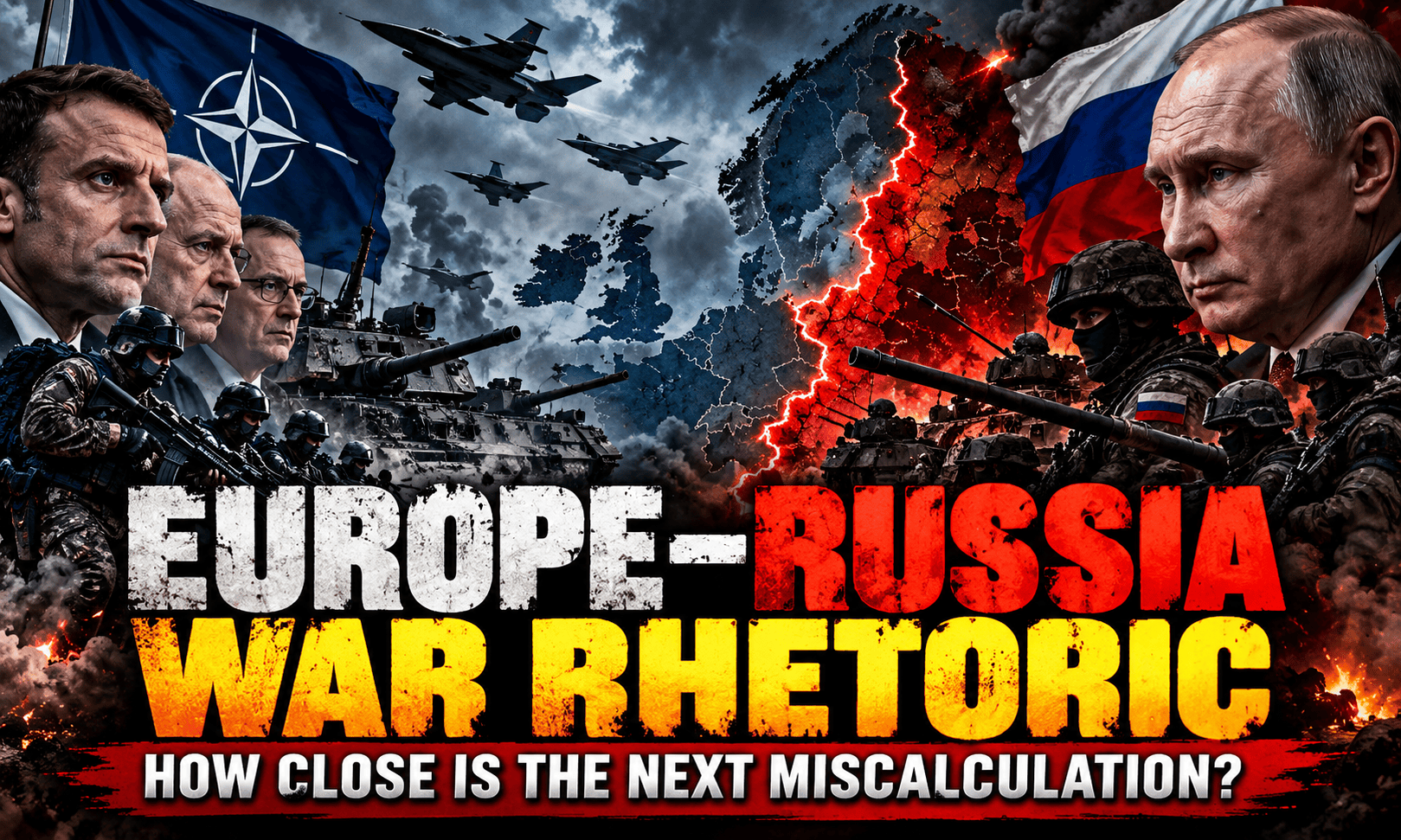
Europe is talking about war again.
Not a distant conflict. Not a theoretical confrontation decades from now. Senior officials across Western Europe are increasingly using language that places the possibility of a direct confrontation with Russia into mainstream political discussion.
And that may be the most dangerous part of the story.
According to RT’s latest “Escalation Watch” report, Germany’s foreign intelligence chief has warned about the possibility of a “violent conflict with Russia,” while political rhetoric elsewhere in Europe continues to harden.
The question is no longer simply whether Russia and NATO distrust each other.
They clearly do.
The bigger question is what happens when repeated warnings, military preparations, intelligence claims and political rhetoric begin feeding one another — until escalation starts developing its own momentum.
Germany Sounds the Alarm
RT reports that BND chief Martin Jaeger warned of a potentially “violent conflict” with Russia while accusing Moscow of conducting a “shadow war” against Germany.
But there is an important tension inside that warning.
______________________________________________
🔴 Help keep this independent voice alive and uncensored -> Buy us a Coffee <-
According to RT, Jaeger also acknowledged there was “no indication” of an actual Russian military attack.
That distinction matters.
There is an enormous difference between hostile activity, intelligence operations or suspected hybrid warfare and an imminent conventional military attack.
Yet increasingly, the political language surrounding Russia appears to blur those lines.
And once governments begin preparing their populations psychologically for war, the rhetoric itself becomes part of the geopolitical environment.
Moscow Sees the Threat Coming From the Other Direction
Russia, unsurprisingly, tells the story very differently.
RT says Moscow views recent Western actions as evidence that the pressure is coming toward Russia rather than outward from it.
The report points specifically to Polish Foreign Minister Radoslaw Sikorski calling for a NATO troop buildup near Kaliningrad.
From Moscow’s perspective, such moves are not defensive reassurance.
They look like military pressure around one of Russia’s most strategically sensitive territories.
That is the fundamental problem now developing across Europe.
NATO governments can describe their moves as deterrence.
Russia can interpret those same moves as preparation for aggression.
Russia can then respond militarily.
NATO can interpret that response as confirmation that its original fears were justified.
The cycle feeds itself.
Then Came the Drone Claims
The atmosphere became even murkier after another allegation surfaced.
RT reported that Spain’s El Mundo claimed the CIA had obtained intelligence concerning a possible Russian plan to launch drones against France, Italy or Spain from ships operating in the Mediterranean.
The allegation was reportedly linked to Lithuanian intelligence.
But according to RT, Paris and Rome quickly pushed back against the claim.
That matters because intelligence-based allegations can travel around the world before the underlying evidence becomes publicly available — if it ever does.
A frightening headline can become political reality long before anyone establishes exactly what happened.
Finnish President Alexander Stubb, according to the report, appealed for calm.
It is difficult to argue against that approach.
Because the danger isn’t simply that somebody deliberately chooses war.
The darker possibility is that nobody intends to start one — but competing governments repeatedly interpret ambiguous events through the worst possible lens until somebody makes a catastrophic mistake.
Britain Adds Another Layer
The UK has its own security controversy.
RT highlighted British Foreign Secretary Ed Miliband’s response to a suspected bomb plot involving RAF Fairford, a British airbase used by the United States.
Miliband reportedly described the episode as an example of “the threats our country faces” and said Britain must “fight for our values.”
Security threats obviously deserve investigation.
But sweeping political language during uncertain situations deserves scrutiny too.
Who exactly is the enemy?
What specific threat is being described?
What evidence has been established?
Those questions become even more important when public rhetoric begins shifting from investigating individual incidents toward preparing entire populations for confrontation.
The Most Dangerous Word Is “Miscalculation”
Europe has lived through this before.
Major confrontations do not always begin because one side wakes up one morning determined to launch a continent-wide war.
Sometimes governments mobilize because they fear another government is mobilizing.
Military deployments trigger counter-deployments.
Warnings produce counter-warnings.
Intelligence agencies identify threats.
Politicians repeat those threats.
Media coverage amplifies them.
Public fear increases.
Eventually, backing down becomes politically harder than escalating.
That is why the current rhetoric deserves attention regardless of whether someone believes Moscow or Western governments carry greater responsibility for the deterioration in relations.
You do not have to trust Russia to question escalation.
You do not have to distrust NATO to demand evidence.
And you certainly do not have to support Vladimir Putin to recognize the danger of two heavily armed nuclear blocs gradually convincing themselves that confrontation may be unavoidable.
Europe Should Be Asking Harder Questions
There is another uncomfortable issue buried underneath all of this.
Where does escalation end?
If NATO moves more troops toward Russia because Russia represents a threat, and Russia deploys more forces because NATO represents a threat, what mechanism eventually reverses the process?
More weapons?
More troops?
More warnings?
More intelligence allegations?
At some point diplomacy has to re-enter the equation.
Otherwise every new incident risks becoming evidence supporting whatever each side already believes.
That is not security.
That is a geopolitical feedback loop.
And when nuclear powers are involved, feedback loops can become extraordinarily dangerous.
The Public Deserves Evidence, Not Fear
Governments have legitimate responsibilities to warn citizens about credible national-security threats.
But those responsibilities should come with another obligation: clarity.
Extraordinary allegations deserve extraordinary scrutiny.
If intelligence demonstrates that Russia intends to attack NATO territory, governments should explain as much evidence as security considerations reasonably permit.
If evidence remains uncertain, officials should say that too.
Because fear is easy to generate.
Undoing it is much harder.
Europe may indeed face serious security threats. Russia and Western governments have spent years accusing one another of aggression, interference and escalation.
But there is one possibility nobody should dismiss.
The greatest immediate danger may not be a carefully planned war.
It may be governments becoming so convinced that war is coming that their preparations help bring it closer.
And once that line is crossed, arguments over who escalated first will not matter nearly as much as they do today.
About the Author