For decades, Republican support for Israel was one of the safest assumptions in American politics.
That certainty may no longer be quite so certain.
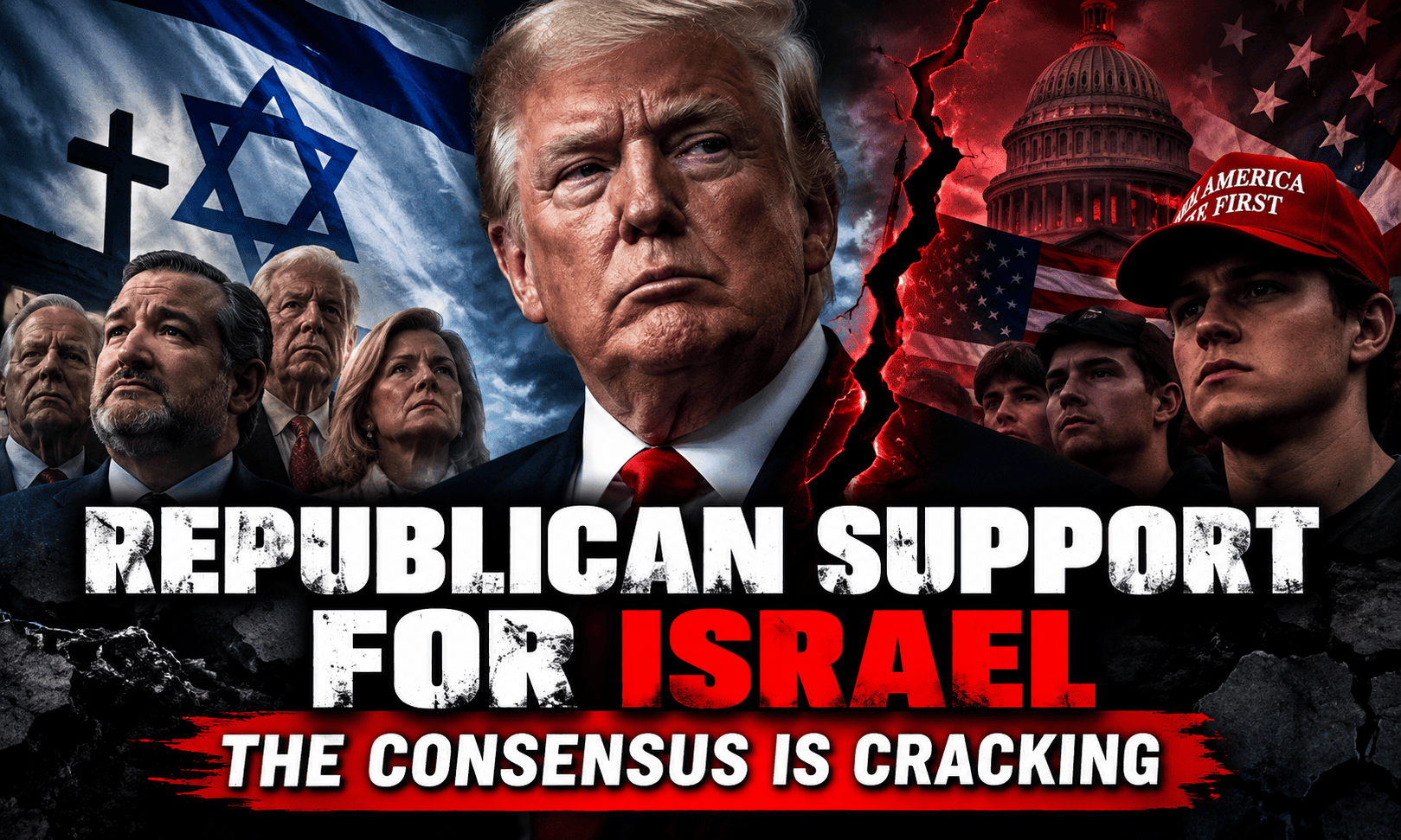
A political divide is emerging inside the Republican coalition, where traditional evangelical support for Israel is increasingly colliding with another powerful conservative principle: America First.
And beneath that argument is an even more consequential shift — younger Republican voters appear considerably less enthusiastic about Israel than the generations that built the modern conservative movement.
The result is a political fault line that could eventually force Republicans to answer a question the party rarely had to confront in previous decades:
When America’s interests and America’s foreign alliances appear to conflict, which comes first?
Israel Became More Than Foreign Policy for Republicans
The modern Republican relationship with Israel cannot be understood simply through military alliances, intelligence cooperation or Middle East strategy.
Religion became deeply intertwined with the issue.
Evangelical Christianity developed into a major political force within the Republican coalition during the second half of the 20th century. Over time, support for Israel became particularly important among Christian Zionists, many of whom view the Jewish state through biblical prophecy as well as geopolitics.
______________________________________________
🔴 Help keep this independent voice alive and uncensored -> Buy us a Coffee <-
That transformed Israel from another American ally into something considerably more powerful politically.
For millions of conservative Christians, supporting Israel became intertwined with faith.
That distinction matters today because another Republican movement has grown around a very different principle.
America First asks a simpler question:
What does the United States gain from its foreign commitments?
An October 5 Al Jazeera opinion analysis by Washington-based journalist Said Arikat argues that these two Republican traditions are increasingly coming into conflict.
The disagreement is not necessarily between Republicans who support Israel and Republicans who oppose it.
It is increasingly about why America supports Israel, how far that support should extend, and what price Americans should be expected to pay for it.
Trump Helped Strengthen Both Sides of the Argument
Donald Trump presents an unusual contradiction inside this debate.
His political rise dramatically strengthened America First nationalism, with its suspicion of prolonged foreign wars, overseas commitments and interventions that do not produce obvious benefits for Americans.
Yet Trump also delivered some of the most important victories sought by Israel’s conservative American supporters.
His administration recognized Jerusalem as Israel’s capital and moved the US embassy there — a major priority for Christian Zionists.
Those positions could coexist when supporting Israel did not appear to require substantial new American military involvement.
The calculation becomes more complicated when the Middle East threatens to pull Washington deeper into conflict.
That is where the ideological lines begin separating.
An evangelical Republican may regard support for Israel as a moral or biblical obligation.
An America First Republican can look at precisely the same situation and ask whether American soldiers, taxpayers and military resources should be committed to another country’s security.
Both can vote Republican.
Both can support Trump.
But those principles do not necessarily produce the same foreign policy.
The Iran War Exposes the Contradiction
The widening confrontation involving Iran makes that contradiction much harder to ignore.
America First gained much of its political strength from exhaustion with the long wars that followed September 11.
Iraq and Afghanistan left generations of Americans deeply skeptical of arguments that another overseas military commitment would be limited, inexpensive or quickly resolved.
That history hangs over the current Republican debate.
Supporting Israel diplomatically is one thing.
Providing weapons is another.
Entering or expanding a regional war is something else entirely.
The further Washington moves along that spectrum, the more difficult it becomes to maintain a coalition containing both interventionist conservatives and voters whose political identity was partially built around opposition to foreign entanglements.
This is not necessarily a rebellion against Israel.
It is a dispute over the limits of American responsibility.
And that distinction could become increasingly important.
Then Comes the Generational Divide
Perhaps the biggest threat to the old Republican consensus is not coming from Washington politicians at all.
It is coming from younger voters.
Polling cited in the source reveals a striking age divide.
A March Pew Research Center survey found Republicans overall viewed Israel more favorably than unfavorably, 58 percent to 41 percent.
But among Republicans between 18 and 49, 57 percent held an unfavorable view of Israel.
Another Pew survey conducted in May produced another dramatic age gap. Among Republican-leaning Americans between 18 and 29, 42 percent viewed Israelis favorably.
Among those 65 and older, the figure was 83 percent.
The surveys measured different questions and populations, so they should not be treated as directly interchangeable.
But the broader pattern is difficult to overlook.
Young Republicans are not approaching Israel in exactly the same way as their parents and grandparents.
A Generation That Didn’t Grow Up With the Same Political Story
That generational shift has enormous implications.
Older conservative Americans lived through periods when Israel was frequently portrayed as a small democratic ally surrounded by hostile states, while evangelical Christianity became increasingly influential within Republican politics.
Younger conservatives inherited a very different world.
They grew up with Iraq.
Afghanistan.
The financial cost of America’s post-9/11 wars.
Social media.
Images from Gaza delivered directly to their phones.
And a Republican president who popularized the idea that American leaders should stop putting foreign interests ahead of their own citizens.
Those experiences inevitably change the questions being asked.
Younger Republicans do not necessarily have to oppose Israel to question unlimited American support.
They can simultaneously believe Israel has a right to exist, reject anti-Semitism and still demand to know why American money, weapons or troops should be committed to particular Israeli policies or conflicts.
That distinction could reshape Republican foreign policy.
The Republican Establishment Still Strongly Supports Israel
None of this means Republican support for Israel is about to disappear.
Far from it.
Powerful Republican figures continue to champion the relationship.
House Speaker Mike Johnson has connected American support for Israel with biblical themes.
Texas Senator Ted Cruz has similarly discussed Israel through his Christian faith.
Arkansas Senator Tom Cotton represents another strongly pro-Israel wing of Republican foreign policy.
And Mike Huckabee, Trump’s ambassador to Israel, has long represented the intersection between evangelical Christianity and political support for the Jewish state.
Beyond individual politicians stands an established network of evangelical organizations, churches, activists and political groups capable of mobilizing voters and influencing Washington.
That infrastructure took decades to build.
A few opinion polls will not dismantle it.
But political coalitions rarely collapse overnight.
They weaken as the assumptions holding them together stop being universally accepted.
The Question Is Changing
For decades, Republican politicians could often defend Israel using several arguments simultaneously.
Israel was a strategic ally.
Israel was a democratic partner.
Supporting Israel was morally correct.
And for millions of evangelical voters, supporting Israel reflected biblical conviction.
America First complicates that formula.
Its central political instinct is transactional: Show Americans how this benefits America.
That means appeals based primarily on religious obligation may become less persuasive to a generation of Republicans whose political worldview was formed by skepticism toward Washington’s foreign-policy establishment.
That doesn’t automatically produce an anti-Israel Republican Party.
It could instead produce something much more nuanced — and politically disruptive.
A Republican Party that supports Israel but refuses to guarantee unconditional support.
A party that differentiates between defending Israel and participating in Israel’s wars.
A party that demands measurable American benefits before approving military assistance.
Or a party divided internally between those positions.
This Could Become a Fight Over What “America First” Actually Means
That may ultimately be the bigger political story.
America First was relatively easy to define when Republicans were attacking Democrats over immigration, trade, NATO spending or the economic consequences of globalization.
Israel creates a far more difficult test.
What happens when two deeply rooted conservative beliefs collide?
One says America has a unique moral relationship with Israel.
The other says Washington’s first obligation must always be to Americans.
For years, Republicans rarely had to choose between them.
The Middle East may eventually force that choice.
And if younger Republicans continue moving away from the overwhelmingly favorable attitudes toward Israel found among older conservatives, Washington’s current assumptions could face pressure well beyond the present conflict.
Politicians can preserve policies for years.
They cannot indefinitely preserve a political consensus after the voters sustaining it have changed.
The Republican-Israel alliance remains powerful.
But something important is happening underneath it.
The question inside the American right is slowly moving away from “Do you support Israel?”
The emerging question is much harder:
“What exactly does supporting Israel require America to do — and where does America First draw the line?”
The answer could help determine what Republican foreign policy looks like long after today’s political leaders are gone.
About the Author