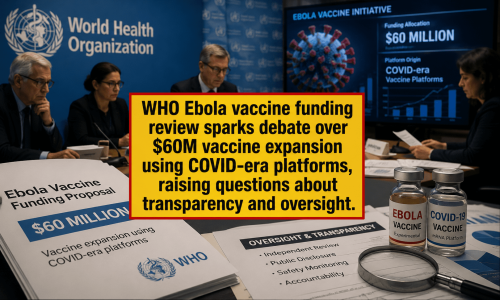
A new wave of scrutiny has emerged around the WHO Ebola vaccine funding review, as critics question how roughly $60 million in additional support for Ebola vaccine development is being allocated and whether it relies heavily on technology platforms originally expanded during the COVID-19 response. The discussion has gained traction across health policy circles, where the speed of vaccine platform reuse is being weighed against transparency in funding decisions and long-term safety validation frameworks.
At the centre of the debate is the World Health Organization’s role in coordinating global outbreak preparedness, alongside researchers and commentators examining how rapidly adaptable vaccine systems are being deployed beyond their original pandemic context. Figures such as medical commentator John Campbell have amplified public discussion around these concerns, while organizations like Children’s Health Defense have highlighted what they describe as gaps in public communication and oversight.
What remains unresolved is whether the accelerated reuse of COVID-era vaccine platforms represents efficient preparedness—or a structural shift in how global vaccine programs are developed and funded without full public visibility into the trade-offs involved.
What Actually Happened
The WHO Ebola vaccine funding review has been triggered by reports that additional financing—estimated at around $60 million—has been directed toward expanding Ebola vaccine capacity using platforms initially scaled during the COVID-19 pandemic response.
The World Health Organization (WHO) has long supported vaccine development for viral hemorrhagic fevers, particularly Ebola, which has caused repeated outbreaks in parts of West and Central Africa. The current discussion focuses less on Ebola itself and more on the infrastructure used to accelerate vaccine production.
Observers note that much of the modern vaccine pipeline relies on modular technology systems, allowing rapid adaptation to new pathogens. Critics argue that this adaptability, while efficient, reduces the time available for independent review and public transparency.
The debate intensified after commentary from public health analysts, including John Campbell, raised concerns about how these funding pathways are communicated to the public and whether oversight mechanisms have kept pace with technological change.
Why This Moment Matters
The significance of the WHO Ebola vaccine funding review lies in how global health institutions are now balancing urgency with transparency.
The World Health Organization is positioned as the central coordinating body for outbreak response, meaning its funding decisions often set the tone for national health agencies and research institutions worldwide. When vaccine platforms developed during COVID-19 are reused for other diseases, it signals a shift toward permanent rapid-response infrastructure.
______________________________________________
🔴 Help keep this independent voice alive and uncensored.
Support independent journalism and help keep Chris Wick News going.
👉 Support Chris Wick on GoFundMe
This shift is not inherently new, but the scale of investment—combined with its reuse across multiple disease categories—has prompted renewed scrutiny.
Public debate has also expanded beyond technical vaccine science into governance. Groups such as Children’s Health Defense argue that oversight frameworks have not evolved as quickly as the technologies they are meant to regulate, while health authorities maintain that streamlined systems are essential for future outbreak readiness.
The tension sits between speed and scrutiny, with both considered essential but not always aligned.
The Pattern Behind the Event
The WHO Ebola vaccine funding review fits into a broader pattern of post-pandemic health system transformation.
Since COVID-19, vaccine development has increasingly relied on platform-based systems rather than single-pathogen design. This allows manufacturers to adapt existing frameworks to new threats without rebuilding infrastructure from scratch.
John Campbell and other commentators have pointed to this shift as evidence of a long-term restructuring of vaccine strategy, while global health institutions describe it as modernization.
The World Health Organization has previously emphasized the importance of preparedness infrastructure, particularly in regions where Ebola outbreaks remain a recurring risk. However, critics argue that the speed of platform expansion has outpaced public understanding of how these systems are tested and validated across different diseases.
The pattern now emerging is one where emergency systems gradually become permanent structures, raising questions about how “temporary response tools” evolve into baseline global health architecture.
Where the Tensions Are Building
Tensions surrounding the WHO Ebola vaccine funding review are building across multiple layers of public health governance.
On one side, institutional health agencies argue that platform-based vaccine systems reduce response time during outbreaks, potentially saving lives in early containment phases. On the other side, critics question whether this efficiency comes at the cost of reduced transparency in funding allocation and long-term safety evaluation processes.
The role of the World Health Organization remains central, as it coordinates international responses and sets technical guidance that influences national policy decisions.
At the same time, public-facing commentary from analysts like John Campbell has amplified broader skepticism about how funding decisions are communicated, especially when complex vaccine technologies are involved.
An internal analysis page on /global-vaccine-platform-shifts is increasingly referenced in discussions about how these systems are evolving, though consensus remains fragmented.
What is not yet clear is whether the current funding expansion represents a routine update to existing Ebola preparedness systems—or a deeper structural shift in how global vaccine infrastructure is governed.
What This Could Signal Next
If current trends continue, the WHO Ebola vaccine funding review may become part of a wider reassessment of how global vaccine platforms are funded, validated, and publicly explained.
The World Health Organization is expected to continue prioritizing rapid deployment capabilities, especially for diseases with known outbreak histories like Ebola. However, pressure is increasing for more detailed disclosure around how reused vaccine technologies are assessed across different applications.
Public debate driven by commentators such as John Campbell, alongside advocacy organizations including Children’s Health Defense, suggests that scrutiny is unlikely to fade. Instead, it may intensify as more vaccine programs adopt shared technological frameworks originally expanded during COVID-19.
What remains uncertain is whether governance structures will adapt at the same pace as the technologies they oversee, or whether a widening gap between innovation and oversight will continue to define the next phase of global health strategy.