It doesn’t feel like a crisis yet. Not fully. But there’s a rhythm to what’s happening—one most people miss.
For 47 years, the U.S. and Iran have been entangled. Not in a simple war. Not a story of heroes and villains. Something more complicated. Something quieter. Something that shapes the lives of millions without headlines catching up.
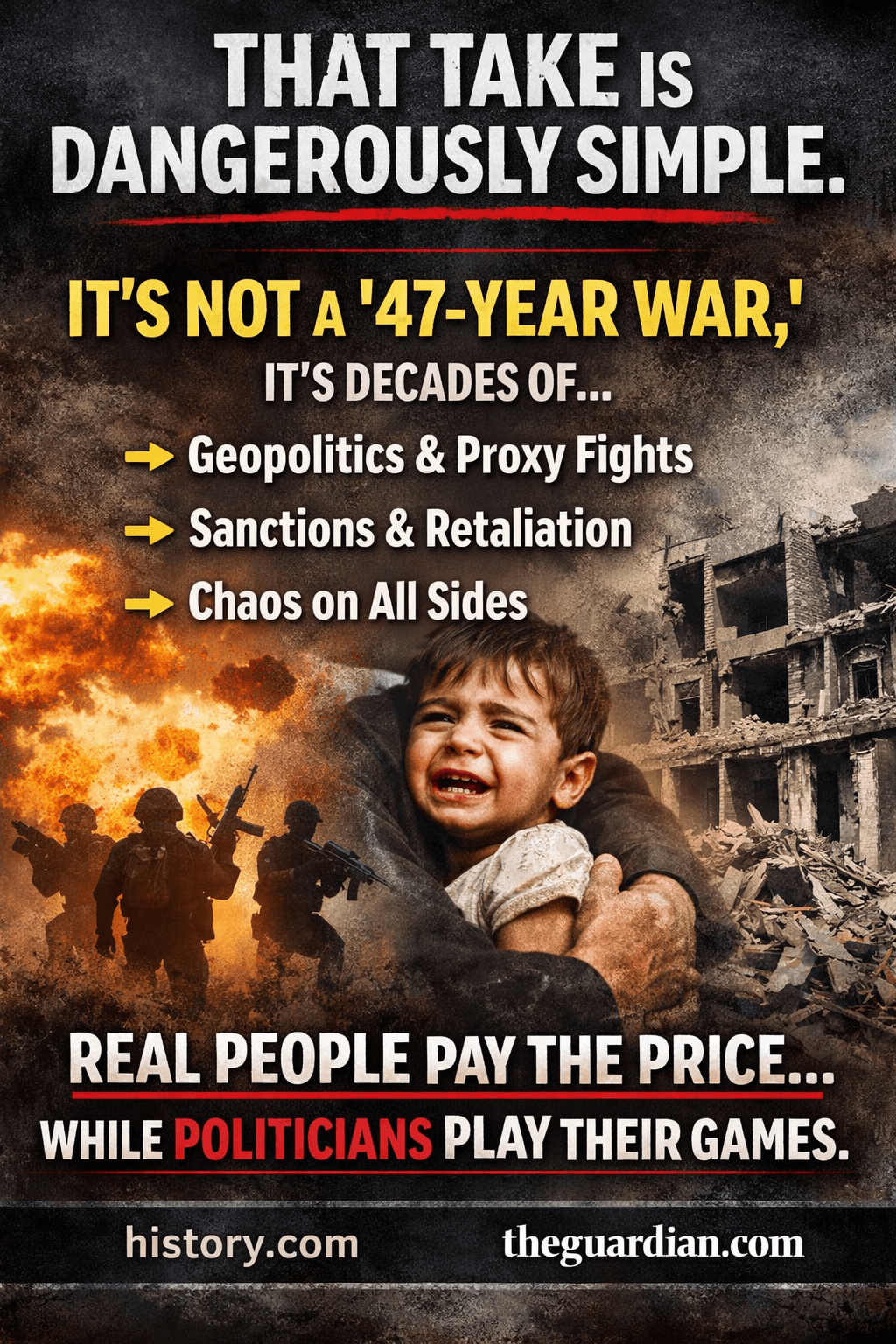
What many call “standing up to barbarians” misses the point entirely. This isn’t a battle of good versus evil. It’s a chain of actions and reactions, of proxy conflicts, sanctions, and carefully measured responses that ripple far beyond the capitals. Civilians, trapped in the middle, bear the invisible weight.
History shows us patterns, subtle but persistent. A drone strike here. A sanction there. Each move connects to an earlier one, sometimes across decades. And while politicians posture, the human cost quietly mounts. This becomes clearer when looking at recent civilian reports from the border provinces, where infrastructure is collapsing and daily life is grinding under pressure.
It raises a question few are asking: who actually benefits from the tension? Not the populations. Not the neighborhoods rebuilt after airstrikes. The gains are often political, financial, strategic—hidden in plain sight, reinforced by the narratives that dominate media coverage.
A similar pattern appeared in other regions where long-standing conflicts have become “normalized.” The outward chaos masks controlled interests behind the scenes, shaping outcomes while the public argues over morality rather than mechanics.
This connects to a broader shift in how international conflicts are managed. Wars are no longer just fought on battlefields—they unfold in the background of economics, cyber operations, and public perception. By the time it feels real, it may already be too late to fully understand the scale.
What happened next raises more questions. The cycle of retaliation doesn’t have a clear start or finish. It feeds on itself. Each escalation provides a pretext for the next. And while the rhetoric is loud, the mechanisms are subtle.
Maybe the better question isn’t whether to “stand up.” Maybe it’s understanding why the cycle exists at all—and who is quietly ensuring it continues.
______________________________________________
🔴 Help keep this independent voice alive and uncensored.
Support independent journalism and help keep Chris Wick News going.
👉 Support Chris Wick on GoFundMe
What just happened in U.S.–Iran policy may change how this is understood
A deeper look at these patterns reveals something unexpected
This may connect to a broader shift that’s quietly underway
Sources used for this article:
History of U.S.–Iran Relations
https://www.history.com/topics/middle-east/us-iran-relations
Proxy Conflicts and Regional Tensions
https://www.cfr.org/backgrounder/iran-middle-east-proxy-conflicts
Sanctions and Economic Impact on Iran
https://www.brookings.edu/research/impact-of-sanctions-on-iran/
Civilian Costs of Conflicts
https://www.theguardian.com/world/iran-civilians-impact-conflict