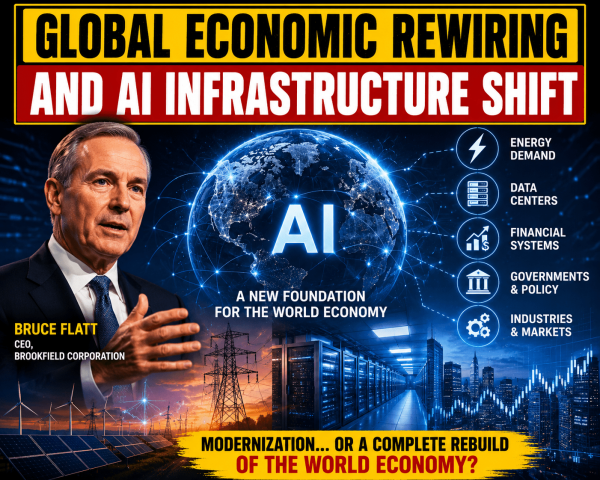
There’s a quiet but powerful message coming from one of Canada’s most influential financial leaders. Bruce Flatt, CEO of Brookfield Corporation, has pointed to what he describes as a sweeping transformation already underway — a global rewiring of the economy driven by artificial intelligence and next-generation data infrastructure.
This isn’t being presented as a normal cycle of growth or technological improvement. It’s being framed instead as something far more structural — a shift in how the global system is built, powered, and controlled.
A System Being Rebuilt From the Ground Up
Across energy markets, data centers, and financial infrastructure, major capital is being redirected into the foundations of the AI era.
Massive investment flows are not just chasing innovation — they are reshaping the backbone of global industry. Energy demand is rising, data storage is expanding at unprecedented speed, and entire financial frameworks are adapting to support AI-scale computing.
What makes this moment different is the scale. It is not one sector changing. It is multiple core systems evolving at the same time.
AI at the Center of the Shift
Artificial intelligence is no longer just a technology layer on top of the economy. It is becoming the organizing force beneath it.
From logistics to banking to industrial production, AI is increasingly influencing decision-making, efficiency models, and resource allocation. That shift is forcing governments and corporations to rethink long-term planning in real time.
______________________________________________
🔴 Help keep this independent voice alive and uncensored -> Buy us a Coffee <-
The result is a new kind of infrastructure race — not just for chips and software, but for electricity, land, cooling systems, and global data capacity.
Energy and Data Become Strategic Assets
One of the clearest signals of this transformation is the growing importance of energy and data infrastructure.
Data centers are now treated as critical national assets in many regions. Energy grids are being expanded and upgraded to meet AI-driven demand. Investment strategies are shifting toward long-term infrastructure dominance rather than short-term financial returns.
This suggests a deeper transition: the economy is becoming more physically grounded even as it becomes more digitally driven.
Modernization or Structural Reset
The big question emerging from this shift is whether this is simply modernization — or something more fundamental.
Is the world economy just upgrading its tools?
Or is it being rebuilt into a completely new system where AI, data, and energy form the core pillars of global power?
What is unfolding suggests a transformation that may not be temporary or incremental, but structural and long-term in nature.
Final Thought
When major financial leaders begin describing the global economy in terms of rewiring and structural change, it signals more than innovation. It signals transition.
And the scale of that transition may only become clear in hindsight.
About the Author