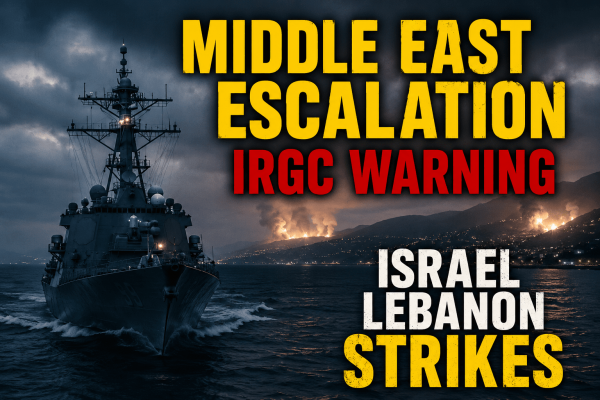
A new wave of warnings from Iran’s Islamic Revolutionary Guard Corps and renewed Israeli air operations in Lebanon are adding fresh pressure to an already volatile regional standoff. The developments are unfolding in real time, with military signals, diplomatic messaging, and cross-border activity all intensifying within a narrow window of days.
What stands out is not just the escalation itself, but how quickly multiple fronts are beginning to overlap again after weeks of relative containment.
Source coverage: https://www.aljazeera.com/news/liveblog/2026/5/10/iran-war-live-irgc-warns-us-against-attacks-on-ships-israel-bombs-lebanon?update=4560391
What Actually Happened
Recent reporting from Al Jazeera’s live coverage indicates that Iran’s IRGC issued a direct warning to the United States, cautioning against any attacks on Iranian-linked vessels in regional waters. The message comes amid heightened maritime tensions and ongoing concerns about naval movements in strategic waterways.
At the same time, Israeli forces have continued air operations in parts of Lebanon, targeting areas associated with armed groups. These strikes add another layer to an already complex security environment along Israel’s northern border.
Taken together, the developments point to simultaneous pressure points forming across land and sea, rather than a single isolated escalation.
Why This Moment Matters
The significance of this moment lies in timing and proximity. Warnings at sea and strikes on land are not occurring in isolation; they are unfolding within the same operational window.
That overlap increases the risk of miscalculation, especially when multiple actors are communicating through both military actions and public statements.
In previous cycles of escalation, similar patterns have often preceded broader regional flashpoints. The concern now is whether this phase will remain contained or begin to expand beyond its current boundaries.
The Pattern Behind the Event
______________________________________________
🔴 Help keep this independent voice alive and uncensored.
Support independent journalism and help keep Chris Wick News going.
👉 Support Chris Wick on GoFundMe
This is not the first time maritime warnings from Iran have coincided with Israeli strikes in neighboring territories. Over the past year, there has been a recurring cycle:
- Maritime tension in the Gulf and surrounding waters
- Rapid political messaging from Tehran
- Military activity intensifying on Israel’s northern front
Each layer tends to reinforce the others, creating a feedback loop where signals and strikes escalate in parallel.
What is different in this instance is the speed at which both theaters appear to be activating at once.
Where the Tensions Are Building
Two key zones are drawing attention:
The first is the maritime corridor, where shipping routes remain sensitive to any perceived military interference. Even limited incidents in this space can have outsized economic and strategic effects.
The second is the Israel-Lebanon border region, where periodic strikes and counter-activity continue to test fragile deterrence structures.
When both areas become active simultaneously, pressure increases on regional and international actors to respond quickly, often before diplomatic channels can fully engage.
What This Could Signal Next
The next phase depends heavily on whether these events remain symbolic or begin to produce direct engagements between state and non-state actors.
If maritime warnings translate into enforcement actions, or if strikes in Lebanon expand in scope, the situation could move into a more unpredictable phase.
For now, the language from officials remains firm but controlled. However, the alignment of multiple pressure points suggests that the system is operating with less margin for error than in previous months.