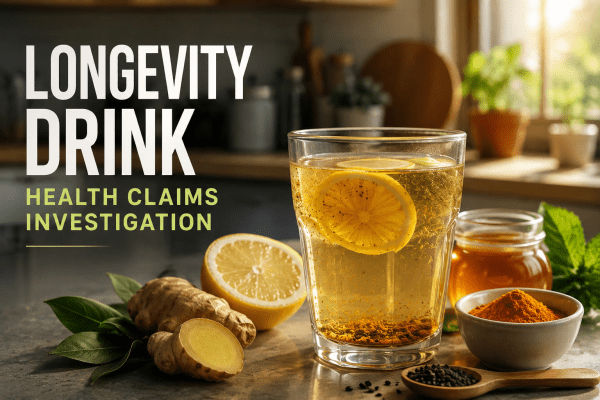
A viral “longevity drink” trend blends simple ingredients like lemon, ginger, and turmeric—but the real question is whether the health claims hold up under scrutiny.
It’s being shared like a secret formula—simple, accessible, almost too easy.
A combination of everyday ingredients, suddenly framed as a life-extending breakthrough.
But when something spreads this quickly, it usually means the story underneath hasn’t caught up yet.
What Actually Happened
A growing wave of online claims suggests that a specific drink combination—often involving common staples like coffee, tea, or citrus—can significantly extend lifespan.
These claims are not coming from a single study, but rather a patchwork of loosely connected research findings, personal anecdotes, and amplified headlines.
For example, broader research into coffee consumption has shown associations with longevity, but not in the simplified, formula-driven way these viral posts suggest. A report from BBC coverage on coffee and longevity research highlights that moderate coffee intake may correlate with reduced risk of certain diseases—but it stops far short of endorsing any “miracle combination.”
The distinction matters.
There’s a difference between long-term dietary patterns and a single drink marketed as a shortcut.
Why This Moment Matters
Health-related content spreads faster than almost anything else online—especially when it promises control over aging.
The idea that something as simple as a daily drink could add years to life taps into a deep psychological pull: accessibility. Link to analysis of viral health trends.
No prescriptions. No major lifestyle overhaul. Just a routine.
______________________________________________
🔴 Help keep this independent voice alive and uncensored -> Buy us a Coffee <-
But that simplicity is exactly what makes it vulnerable to distortion.
When complex biological processes are reduced to viral formulas, nuance disappears—and expectations become unrealistic.
The Pattern Behind the Event
This follows a familiar cycle.
A legitimate study gets published.
Key findings are simplified.
Headlines exaggerate outcomes.
Social media compresses everything into a “hack.”
Eventually, the original context is lost.
Nutrition science is particularly prone to this pattern because results often show correlations, not direct causation. What appears to be a “life-extending ingredient” may actually be one small part of a much larger lifestyle picture.
The viral drink narrative fits neatly into this cycle—offering clarity where the science remains complex.
Where the Tensions Are Building
There’s a widening gap between scientific research and public interpretation.
On one side, researchers emphasize balance, moderation, and long-term habits.
On the other, viral content pushes quick fixes and definitive claims. Nutrition myths and misinformation.
That gap creates confusion.
It also fuels a constant stream of competing advice—each new trend replacing the last before it’s fully understood.
As more people look for simple answers to complex health questions, this tension is likely to grow.
What This Could Signal Next
Expect more “formula-style” health trends.
As attention spans shorten and algorithms reward clarity over accuracy, simplified health claims will continue to dominate.
Some may be rooted in real science.
Others may stretch it beyond recognition.
The challenge isn’t identifying individual ingredients—it’s understanding the broader system they operate within.
What’s being shared right now feels convincing because it’s easy to follow.
But the human body rarely responds to shortcuts the way headlines suggest—and the real story tends to unfold more slowly, in layers that don’t fit neatly into a single glass. Link to research-based diet and longevity insights.
About the Author