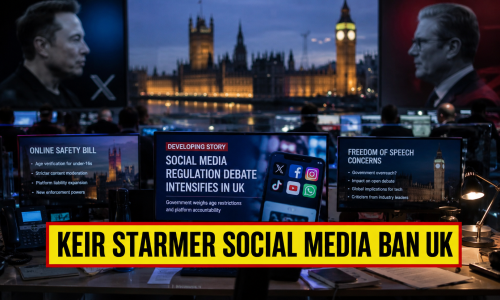
In the United Kingdom, a growing political debate is forming around the Keir Starmer social media ban UK, after reports and commentary around proposed restrictions affecting users under 16 on major platforms. The discussion intensified further after public remarks from Elon Musk, who has repeatedly positioned himself against government-driven content restrictions on platforms such as X, the social media company he now owns.
What is unfolding is not just a policy disagreement, but a widening divide between institutional regulation and digital platform control, where the UK government, led by Prime Minister Keir Starmer, is being pulled into a broader global argument over online speech boundaries.
At the center of the tension is a question that has not yet been clearly answered: how far should a democratic government go in restricting access to social media for minors before it begins reshaping how information itself flows?
What Actually Happened
The discussion around the Keir Starmer social media ban UK gained momentum after renewed attention to proposals targeting under-16 access to high-risk social media platforms in the UK.
The policy direction, associated with broader online safety measures, has been linked to concerns over youth exposure to harmful content, algorithmic recommendation systems, and platform accountability. The UK government has positioned these measures as part of a wider institutional effort to regulate digital environments rather than restrict expression outright.
Elon Musk publicly reacted to these developments, criticizing what he views as expanding government influence over online platforms, particularly those operating under global reach such as X.
An internal analysis of digital governance trends can be found here: /uk-policy/social-media-regulation-analysis
Why This Moment Matters (Keir Starmer social media ban UK)
The significance of the Keir Starmer social media ban UK debate extends beyond immediate policy framing. It sits at the intersection of youth protection laws, digital platform governance, and political control over communication channels.
For the UK government, the policy is being framed through institutional responsibility—protecting minors from content deemed harmful or addictive. For critics like Elon Musk, however, it raises concerns about the gradual expansion of state influence over what can be accessed and shared online.
______________________________________________
🔴 Help keep this independent voice alive and uncensored.
Support independent journalism and help keep Chris Wick News going.
👉 Support Chris Wick on GoFundMe
The tension becomes more complex when considering that platforms like X are not merely social tools, but major information distribution systems. Any restriction affecting them carries implications for public discourse itself, not just individual users.
The Pattern Behind the Event
This is not the first time the UK government has moved toward stricter online regulation. Previous frameworks such as the Online Safety Act established a precedent for platform accountability and content moderation requirements.
What is different now is the visibility of opposition from high-profile technology figures like Elon Musk, who are directly tied to the platforms being regulated. This creates a new type of policy friction—where regulatory decisions are instantly amplified and contested in real time on the same platforms they affect.
The pattern suggests an emerging global split between state-led digital governance models and platform-led free expression models, with the UK positioned in a sensitive middle ground.
Where the Tensions Are Building
The most immediate tension is between regulatory enforcement and platform autonomy. The UK government, through agencies responsible for online safety, is expected to continue refining enforcement mechanisms.
At the same time, platform owners and executives argue that such measures risk overreach, particularly when applied broadly to algorithm-driven systems that operate across multiple jurisdictions.
The presence of global platforms like X complicates enforcement boundaries, as decisions made in Westminster can quickly echo across international digital ecosystems, raising questions about jurisdiction and influence.
What This Could Signal Next
The ongoing debate around the Keir Starmer social media ban UK may signal a broader phase of digital governance tightening across Western democracies.
If current proposals expand, future regulation could move beyond age-based restrictions into algorithm transparency requirements, content visibility controls, or platform design limitations.
What remains uncertain is how platforms like X will respond if regulatory frameworks begin to directly affect core recommendation systems or access structures. That response could define the next stage of government-platform relations in the digital era.
For now, the situation remains fluid, with political pressure, public concern, and platform resistance all developing at the same time.