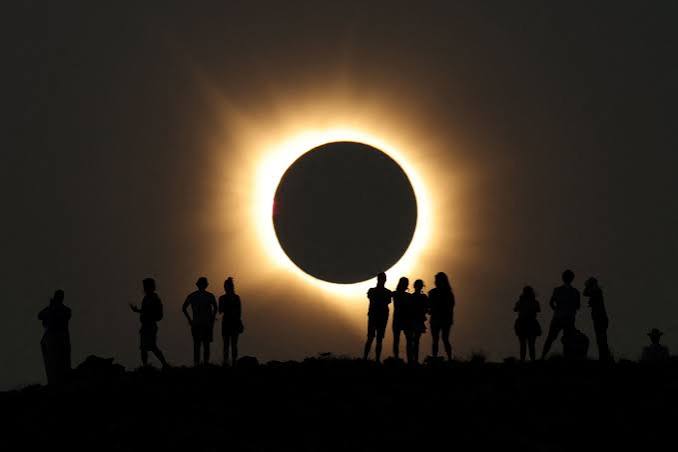
Solar Eclipse August 12, 2026: A Major Celestial Event Captivates the World
Millions of people are turning their eyes toward the sky on Wednesday, August 12, 2026, as one of the most anticipated astronomical events of the year unfolds across parts of the Northern Hemisphere.
The August 12, 2026 solar eclipse is drawing international attention because observers in a narrow path will experience a total solar eclipse, while a much larger portion of the world will be able to witness the Moon partially covering the Sun.
For skywatchers, photographers and astronomy enthusiasts, the event represents one of those rare moments when an ordinary day can suddenly become an extraordinary experience.
Across parts of Europe, the eclipse is producing dramatic changes in daylight as the Moon moves directly between Earth and the Sun. Millions of people in northern and central Spain are among those positioned to experience some of the best views of totality.
The event is also significant for Canadians. While Canada is not experiencing totality across most populated areas, portions of the country are seeing a partial solar eclipse, giving Canadians an opportunity to watch the Moon pass across the face of the Sun.
What Makes the August 12, 2026 Solar Eclipse So Special?
A solar eclipse occurs when the Moon passes between Earth and the Sun, temporarily blocking some or all of the Sun’s light.
A total solar eclipse is particularly spectacular because the Moon appears large enough in the sky to completely cover the bright surface of the Sun. During the brief period of totality, the normally invisible outer atmosphere of the Sun, known as the solar corona, becomes visible.
The experience can be dramatically different from an ordinary partial eclipse.
______________________________________________
🔴 Help keep this independent voice alive and uncensored.
Support independent journalism and help keep Chris Wick News going.
👉 Support Chris Wick on GoFundMe
As totality approaches, daylight can fade rapidly. Temperatures can drop, shadows can behave strangely, and the surrounding environment can take on an unusual twilight appearance.
The sky does not necessarily become completely dark everywhere, but the dramatic reduction in sunlight can make the event feel almost surreal.
For people outside the path of totality, the experience is different. During a partial solar eclipse, only a portion of the Sun is covered by the Moon.
That still creates an impressive astronomical event, but the visual effect depends heavily on how much of the Sun is obscured from a particular location.
Where Can the Total Solar Eclipse Be Seen?
The narrow path of totality crosses portions of the North Atlantic and Europe, with Spain among the most prominent locations for totality.
That has made Spain a major destination for eclipse watchers who planned months or even years in advance to experience the event.
For observers inside the path, the Moon completely covers the Sun for a short period. Outside that narrow corridor, the eclipse becomes partial.
The distinction between totality and a partial eclipse is important.
A location only a relatively short distance outside the path of totality can experience a dramatically different event from a location inside it. This is why eclipse enthusiasts carefully study maps and travel significant distances to position themselves within the zone where totality occurs.
What Will Canadians See During the Eclipse?
For Canadians, the August 12 solar eclipse is primarily a partial eclipse.
That means the Moon will cover part of the Sun, but observers in most Canadian locations will not see the Sun completely disappear behind the Moon.
The exact appearance and timing depend on location.
People across different parts of Canada will therefore experience different degrees of partial coverage. Weather conditions will also play a major role.
Even when an eclipse is theoretically visible, clouds can completely obscure the event.
This makes local weather one of the most important factors for anyone hoping to watch the eclipse.
For Canadians fortunate enough to have clear skies, however, Wednesday provides an opportunity to witness a genuine astronomical event without travelling overseas.
A Rare Double Treat for Skywatchers
The solar eclipse is not the only reason astronomy enthusiasts are looking upward this week.
The Perseid meteor shower is also active during this period, creating another opportunity for people to observe the night sky.
The Perseids are among the best-known annual meteor showers, and their activity overlaps with the timing of the August solar eclipse.
That combination has created an unusually exciting period for skywatchers.
During the daytime, observers can watch the Moon pass in front of the Sun. After darkness returns, observers can look toward the night sky for meteors.
The two events are completely different astronomical phenomena, but together they make August 2026 an especially interesting month for amateur astronomy.
How to Watch the Solar Eclipse Safely
There is one rule that should never be ignored during a solar eclipse: do not look directly at the Sun without proper eye protection.
Ordinary sunglasses are not sufficient.
The Sun remains capable of causing serious eye damage even when a significant portion of its surface is covered by the Moon. Because the brightness can make the eclipse seem less intense, people may underestimate the danger.
Properly manufactured solar eclipse glasses or certified solar viewing filters should be used when viewing the partially eclipsed Sun.
Cameras, binoculars and telescopes also require appropriate solar filters. Looking through an optical device at the Sun without a suitable filter can cause severe and permanent damage to the eyes.
Parents should take particular care when children are watching the eclipse because young observers may be tempted to look directly at the Sun.
Safety should remain the first priority throughout the event.
Why Solar Eclipses Capture So Much Public Attention
Solar eclipses have fascinated humanity for thousands of years.
Before modern astronomy explained the mechanics of eclipses, civilizations often interpreted them through mythology, religion and superstition.
Today, scientists understand precisely why eclipses occur, but that scientific knowledge has not eliminated their ability to inspire awe.
There is something inherently unusual about watching the Moon pass directly in front of the Sun.
The Sun is vastly larger than the Moon, yet the two objects appear remarkably similar in size from Earth’s perspective because of their enormous differences in distance.
That unusual alignment allows the Moon to temporarily cover the Sun and produce total solar eclipses.
It is a remarkable example of geometry operating on an astronomical scale.
The Scientific Importance of a Total Solar Eclipse
Solar eclipses are more than spectacular public events.
They also provide scientists with opportunities to study the Sun’s corona, the outer atmosphere surrounding the solar surface.
The corona is normally difficult to observe because the bright surface of the Sun overwhelms it. During totality, however, the Moon blocks the Sun’s visible disk, allowing scientists and specialized instruments to study the corona more clearly.
Researchers can investigate structures, magnetic fields and other features associated with the Sun’s atmosphere.
Understanding solar activity is particularly important because powerful solar events can affect satellites, communications systems, navigation technology and electrical infrastructure on Earth.
The Sun may be approximately 150 million kilometres away, but its activity can have very real consequences for modern civilization.
Millions of People Experience a Moment of Global Connection
Perhaps one of the most remarkable aspects of a major solar eclipse is its ability to bring people together.
People who otherwise have nothing in common can spend the same day watching the same astronomical event.
In Spain, large crowds are gathering in anticipation of totality. Across Canada and other parts of North America, observers are preparing solar viewing equipment. Online viewers around the world are following live coverage.
The event demonstrates how astronomy can transcend borders.
There are no political boundaries in the path of an eclipse. The Moon’s movement is governed by the same physical laws everywhere on Earth.
For a brief period, millions of people can look toward the same celestial alignment and experience the same sense of wonder.
What Happens After the August 12 Eclipse?
The eclipse will pass, but the astronomical calendar continues.
The Perseid meteor shower remains active, giving skywatchers another reason to spend time outdoors after sunset.
For people who have never seriously explored astronomy, events such as the August 12 eclipse can also become an introduction to observing the night sky.
A pair of binoculars, a simple star map and an interest in what is overhead can reveal an enormous amount.
The eclipse is therefore more than a single afternoon event. It is an opportunity to remind people that Earth is part of a much larger cosmic system.
A Day Worth Remembering
The August 12, 2026 solar eclipse is one of the defining astronomical events of the year.
While the exact experience varies dramatically depending on location, millions of people are witnessing some portion of the Moon’s journey across the Sun.
For those in the path of totality, the event offers the extraordinary sight of the Sun’s brilliant surface disappearing behind the Moon.
For Canadians and others outside the path, the partial eclipse still provides an opportunity to witness the precise movement of the solar system unfolding overhead.
With the Perseid meteor shower also active, August 2026 offers skywatchers an especially memorable period.
For a few minutes, the normal rhythm of the day changes.
The Sun becomes partially or completely obscured.
Daylight transforms.
The sky takes on an unusual appearance.
And millions of people stop what they are doing, look upward and remember that the world above us is every bit as extraordinary as the world beneath our feet.