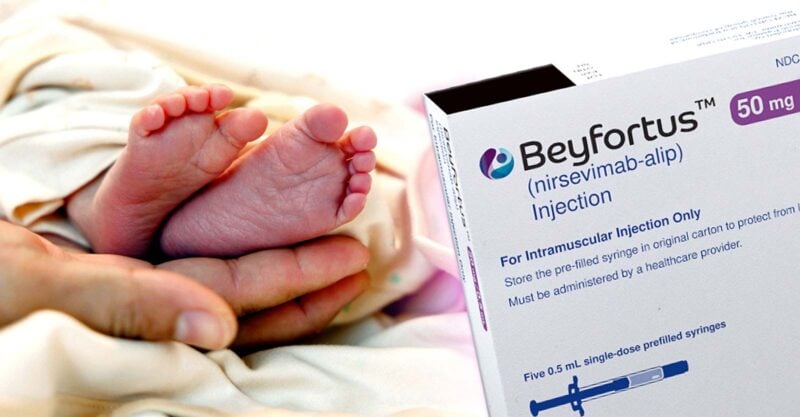
It was supposed to be a breakthrough in protecting infants. The monoclonal antibody nirsevimab—marketed as Beyfortus by Sanofi and AstraZeneca—was hailed as a game-changer in preventing RSV, a virus that fills children’s hospitals every winter. But now, a French study is raising alarms that could leave parents deeply unsettled: the very shot meant to shield babies may be spawning drug-resistant strains of RSV.
Researchers found that over 12.5% of infants who received nirsevimab but still caught RSV developed resistant strains—mutations strong enough to dodge the antibody entirely. Even more troubling, these strains were concentrated in RSV subtype B, which has now become the dominant form in circulation. Scientists warned that this could give resistant variants a survival advantage, allowing them to spread more widely.
Children’s Health Defense Senior Scientist Karl Jablonowski called the findings “simply incredible,” pointing out that resistance usually takes years, not months, to appear. “The most reasonable explanation we are left with is that we are observing the genesis of RSV-resistance in nirsevimab-treated infants,” he said.
The study, conducted across France and posted on The Lancet’s preprint server, follows earlier data hinting at resistance. This new evidence shows it’s not rare—and it’s evolving fast. One resistant strain was detected nearly a year after a child was immunized, proving the mutation wasn’t just a fleeting glitch.
Worryingly, none of the RSV-infected infants who hadn’t received the shot showed resistant strains, suggesting the mutations are emerging specifically under the selective pressure of nirsevimab. Yet researchers with financial ties to Sanofi and AstraZeneca still insisted the antibody remains “highly effective at the population level.” Critics say that’s spin—and that if industry-linked scientists are acknowledging resistance, the problem may be worse than they admit.
Adding another wrinkle, babies whose mothers were vaccinated during pregnancy did not show resistant infections—leading some experts to wonder whether maternal vaccination might be safer than dosing newborns directly. Still, both approaches carry risks, leaving parents in a fog of uncertainty.
As RSV subtype B gains dominance, independent scientists warn the situation “could become very worrying,” with resistant mutants whose long-term danger remains unknown. If true, what began as a medical breakthrough could end up backfiring—arming the virus with new tools to outsmart medicine itself.
So parents are left with a chilling question: did Big Pharma’s rush to market a miracle RSV shot accidentally set the stage for a more dangerous, drug-resistant future?