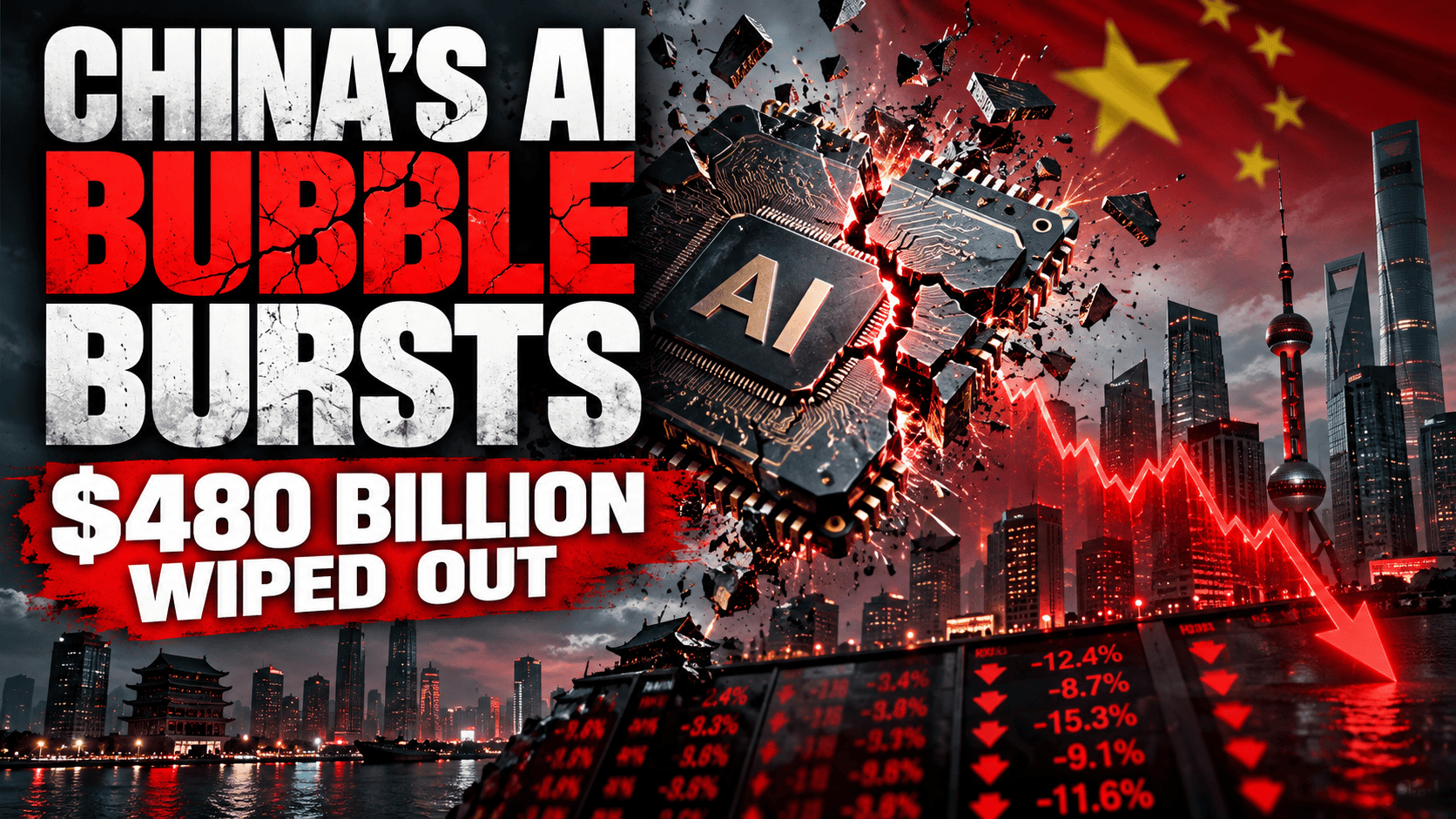
Nearly half a trillion dollars in market value has vanished from China’s artificial intelligence sector. The technology that promised to revolutionize the global economy is now delivering a brutal lesson in financial reality. And the rest of the world should be paying attention.
The artificial intelligence gold rush has hit a wall in China.
Not a minor correction. Not another temporary market tantrum.
A financial reckoning.
China’s AI and semiconductor stocks have suffered a devastating collapse, with the country’s STAR50 index plunging approximately 40% in less than four months.
The damage? Roughly $480 billion in market value erased.
For years, investors were sold a breathtaking vision of the future. Artificial intelligence would transform industries, generate enormous profits, and create an entirely new economic order.
Money poured into anything remotely connected to AI.
Now, the uncomfortable question is becoming impossible to ignore.
______________________________________________
🔴 Help keep this independent voice alive and uncensored.
Support independent journalism and help keep Chris Wick News going.
👉 Support Chris Wick on GoFundMe
What happens when the promises become more expensive than the profits?
China’s AI Stock Market Crash Exposes a Dangerous Reality
According to Reuters reporting published October 26, China’s technology selloff has devastated companies once celebrated as the future of the country’s economic dominance.
The broader CSI300 blue-chip index has also fallen approximately 20% from its June highs.
But the most revealing numbers concern how deeply artificial intelligence speculation had penetrated China’s financial markets.
Goldman Sachs data cited by Reuters indicates AI-related stocks accounted for approximately:
- 42% of market capitalization across mainland Chinese and Hong Kong equities.
- 57% of trading turnover in those markets.
Think about those figures.
An extraordinary amount of market activity had become concentrated around one technological investment theme.
That creates an obvious vulnerability.
When investors begin questioning valuations, the selling pressure can spread far beyond individual companies.
And when enthusiasm disappears, yesterday’s supposedly unstoppable investments can suddenly become tomorrow’s financial liabilities.
The Companies That Were Supposed to Lead the Future
Some of China’s most celebrated technology companies have experienced staggering share-price declines.
Robotics manufacturer Unitree, whose public offering attracted extraordinary investor demand, has lost roughly half its share value since beginning trading in August.
Semiconductor companies MetaX Integrated Circuits and Moore Threads Technology have also seen their shares fall approximately 50% since July.
Optical technology suppliers Zhongji Innolight and Eoptolink Technology have declined roughly 60% from their summer highs.
These are not obscure businesses operating on the fringes of the technology industry.
They represent sectors considered essential to the future of artificial intelligence infrastructure.
Yet even companies operating in strategically important industries are not immune to collapsing investor confidence.
A promising technology does not automatically make every company developing it a good investment.
That distinction gets lost whenever markets become obsessed with the next technological revolution.
The Most Frightening Number Is Not the $480 Billion
The headline losses are enormous.
But another figure deserves closer examination.
Despite the collapse, China’s STAR50 index was still trading at approximately 100 times trailing earnings, according to Reuters.
For comparison, the Nasdaq 100 was trading at roughly 30 times earnings.
That does not automatically mean Chinese technology shares must fall further. Different companies and indexes can justify different valuations because of growth expectations, profitability, and business composition.
But it illustrates how much future success investors may still be pricing into China’s technology sector.
The danger is straightforward.
When investors pay extraordinary prices for anticipated future profits, even modest disappointments can produce severe financial consequences.
Companies must eventually demonstrate that their earnings can support their valuations.
Hype cannot replace revenue forever.
And investor enthusiasm cannot indefinitely substitute for sustainable profits.
Beijing Wanted a Technology Boom. It Got a Financial Warning.
China has spent years encouraging technological independence, particularly in semiconductors, robotics, and artificial intelligence.
The strategic reasoning is understandable.
Advanced computing increasingly influences economic competitiveness, national security, industrial productivity, and technological independence.
But government encouragement creates another potential problem.
Investors can begin confusing strategic importance with financial certainty.
A government may consider an industry essential to national development without guaranteeing that every company operating within it will succeed.
Reuters described retail investors who were encouraged by perceived official support for technology businesses, only to suffer significant losses when share prices collapsed.
This raises a question worth asking.
When governments encourage investment in strategically important industries, who ultimately carries the financial risk when valuations collapse?
In many cases, ordinary shareholders.
The institutions promoting industrial development may have long-term objectives.
Individual investors, meanwhile, can lose substantial portions of their savings long before those objectives materialize.
That difference matters.
Is America’s AI Bubble Next?
China’s collapse does not prove that American artificial intelligence stocks are about to experience the same fate.
But it does provide a warning about what can happen when expectations outrun financial fundamentals.
The United States remains home to some of the world’s most influential AI companies and infrastructure providers.
American technology firms have committed enormous resources to data centres, advanced processors, cloud computing, and AI development.
Much of that investment supports genuine products and rapidly expanding technological capabilities.
The unanswered question is whether future profits will justify the enormous amounts being spent.
In October, the International Monetary Fund warned that a severe reduction in AI investment could trigger broader financial instability.
Its downside scenario suggested that a sharp AI investment correction could reduce global economic output by approximately 1.1% by 2028.
That was a hypothetical risk scenario, not a prediction that a crash was inevitable.
Nevertheless, the warning deserves attention.
Artificial intelligence investment has become important enough that a serious reversal could affect far more than technology shareholders.
It could influence employment, corporate spending, financial markets, and broader economic confidence.
The implications extend well beyond Silicon Valley.
The AI Revolution Can Be Real While the Investment Bubble Is Real Too
There is an important distinction that deserves more attention.
Artificial intelligence can transform the world while investors simultaneously lose enormous amounts of money betting on it.
History offers a useful comparison.
The internet fundamentally changed commerce, communication, media, and everyday life.
Yet the dot-com crash destroyed countless businesses and wiped out vast amounts of shareholder wealth.
The technology survived.
Many investments did not.
Artificial intelligence could follow a similar pattern.
Successful companies may emerge stronger, while weaker competitors disappear or struggle to obtain financing.
The critical issue is not whether AI has practical value.
It clearly does.
The issue is whether investors have assigned realistic prices to the companies developing and supplying it.
Those are two very different questions.
What China’s AI Collapse Means for Canada
Canada is not isolated from global technology markets.
Canadian pension funds, institutional investors, businesses, and individual shareholders participate in financial markets influenced by American and international technology companies.
A major AI market correction could therefore affect Canadian investment portfolios, retirement savings, and business confidence.
Canadian companies adopting artificial intelligence could also face changing technology costs, financing conditions, and supplier relationships.
However, falling AI share prices would not necessarily be bad for every Canadian business.
Lower technology costs, increased competition, and more affordable AI services could benefit companies using these tools rather than selling them.
The consequences would depend on how widely financial stress spreads and whether investment losses begin affecting the broader economy.
That uncertainty is precisely why China’s experience deserves scrutiny.
The Chris Wick News Perspective: Follow the Money, Not the Hype
There is something deeply revealing about financial bubbles.
They rarely begin with entirely imaginary ideas.
More often, they begin with something genuinely promising.
A new technology.
A new industry.
A revolutionary opportunity.
Then expectations accelerate.
Investment money floods in.
Valuations climb.
And eventually, financial speculation becomes difficult to separate from legitimate economic progress.
Artificial intelligence is no exception.
The technology has extraordinary potential.
But potential is not profit.
And a revolutionary product is not a guarantee of a revolutionary investment return.
China’s technology collapse demonstrates what can happen when financial markets begin reassessing promises that once seemed unstoppable.
That does not mean the global AI industry is finished.
It means investors are being reminded of something financial markets repeatedly teach, often at tremendous expense.
There is a difference between believing in the future and paying absolutely any price to own a piece of it.
For now, Wall Street has avoided a collapse comparable to China’s.
Whether that continues depends on corporate earnings, investor expectations, financing conditions, and the ability of AI businesses to generate sustainable returns.
The next chapter remains unwritten.
But China’s markets have already delivered a warning.
When the excitement disappears, the numbers are all that remain.
And sometimes those numbers are devastating.
Chris Wick News | Independent News. Unfiltered Perspective.
Source
Reuters — IMF flags risks to global economy from AI market correction, war and debt (October 13, 2026)