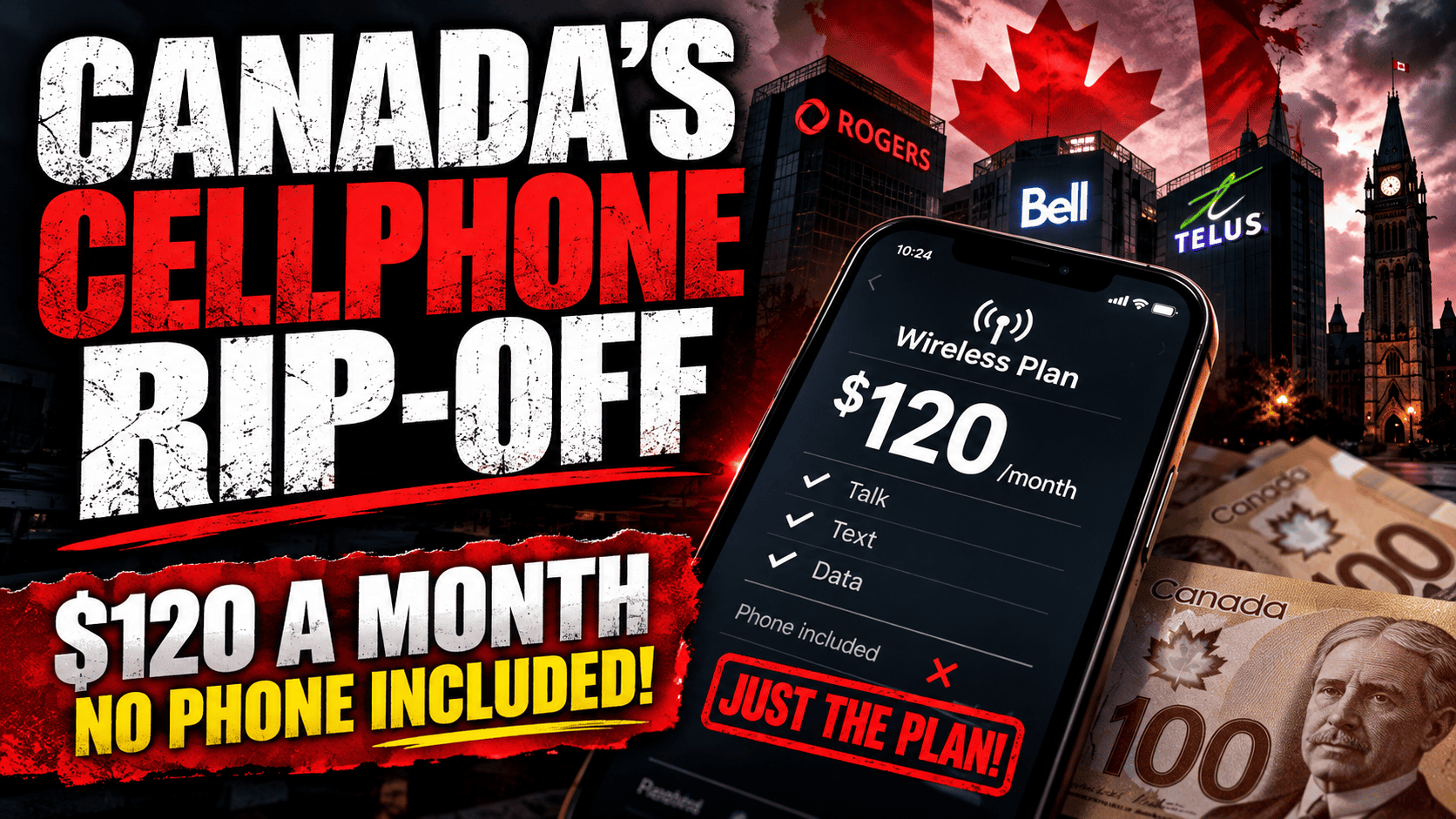
Welcome to Canada, where staying connected can feel less like a modern necessity and more like a monthly financial punishment.
Imagine walking into a cellphone store to renew a basic wireless plan, only to discover you’re being asked to hand over $120 every single month.
Not for a brand-new smartphone.
Not for some extravagant package loaded with premium extras.
Just the cellphone service itself.
That’s $1,440 a year before you’ve even purchased a phone.
And somewhere in the corporate boardrooms of Canada’s telecommunications industry, executives are probably wondering why consumers keep complaining.
Here’s a better question.
When did staying connected become another luxury Canadians are expected to struggle to afford?
The $120 Question: What Exactly Are Canadians Paying For?
______________________________________________
🔴 Help keep this independent voice alive and uncensored.
Support independent journalism and help keep Chris Wick News going.
👉 Support Chris Wick on GoFundMe
Let’s put that monthly bill into perspective.
At $120 a month, a Canadian consumer pays:
- $1,440 annually for wireless service.
- $2,880 over two years.
- $7,200 over five years.
- $14,400 over a decade.
And that’s before taxes, additional charges, or the cost of purchasing a smartphone.
Think about that.
Fourteen thousand dollars over ten years simply to maintain a cellphone connection.
For many Canadians, that’s a substantial amount of money that could otherwise go toward groceries, transportation, housing, or savings.
Of course, not every Canadian pays $120 monthly. Lower-cost plans exist, including offerings from discount brands and smaller competitors.
But that raises an uncomfortable question.
Why can one Canadian obtain wireless service for a fraction of what another is being charged?
The answer involves competition, consumer choices, legacy plans, and a telecommunications market that remains heavily concentrated.
Canada’s Telecom Giants Have a Comfortable Position
Canada’s wireless market is dominated by three major national telecommunications groups:
Rogers, Bell, and Telus.
Their networks and associated brands serve much of the Canadian wireless market.
While Canadians have access to competing plans, discount brands, and regional providers, the country’s wireless infrastructure remains concentrated among relatively few major companies.
That concentration matters.
When a handful of corporations control much of the infrastructure that keeps a country connected, meaningful competition becomes especially important.
Consumers should be able to switch providers easily, compare transparent prices, and obtain affordable service without spending hours navigating promotional offers and complicated conditions.
Yet many Canadians still encounter confusing discounts, changing plan structures, and offers that seem more attractive to new customers than to people who have paid their bills faithfully for years.
Loyalty should be rewarded, not treated as an opportunity to charge more.
A Cellphone Is No Longer a Luxury
There was a time when owning a cellphone was considered optional.
Those days are gone.
Today, Canadians depend on mobile connectivity for banking, medical appointments, employment, emergency communications, government services, and staying connected with family.
For seniors, people living alone, and Canadians with mobility challenges, reliable phone service can be particularly important.
When something becomes essential to everyday life, affordability becomes more than a consumer preference.
It becomes a legitimate public-policy concern.
That doesn’t mean telecommunications companies shouldn’t earn profits.
It means Canadians deserve a competitive marketplace where essential connectivity doesn’t come with an unreasonable financial burden.
And a $120 monthly service bill deserves serious scrutiny.
The Competition Question Ottawa Cannot Ignore
For years, federal governments have promised to improve wireless affordability and encourage greater competition.
Regulators have introduced measures intended to expand consumer choice, while the federal government has promoted policies designed to reduce telecommunications costs.
But Canadians should judge these efforts by their actual bills, not political announcements.
A government press release doesn’t pay someone’s monthly cellphone charges.
Neither does a corporate advertising campaign promising unbeatable value.
The real test is whether ordinary Canadians can obtain reliable service at a reasonable price without navigating endless promotions, restrictions, and hidden conditions.
Canada’s geography and infrastructure requirements do create legitimate operating costs.
Building networks across a vast country isn’t cheap.
But geography alone cannot explain every expensive wireless plan, particularly when significantly cheaper alternatives are available within Canada itself.
The issue isn’t simply whether telecommunications companies face costs.
It’s whether consumers are receiving fair value for what they’re paying.
Government Numbers Reveal an Uncomfortable Truth
Here’s where the argument gets interesting.
According to a federal telecommunications pricing study released in May 2026, Canada’s average wireless prices remained among the highest internationally for several categories of service.
The study found that in 2025:
- A Canadian plan with at least 5 GB of data averaged approximately $70.63 monthly.
- A plan with at least 20 GB averaged $73.51.
- A plan with at least 50 GB averaged $75.97.
- A plan with at least 100 GB averaged $87.87.
Compare that with France, where the study reported average prices of approximately $12.66 for 5 GB and $14.25 for 20 GB, expressed in Canadian dollars.
Those differences deserve attention.
However, the same study found that Canadian consumers could obtain significantly cheaper plans by shopping around. It also documented substantial wireless price declines over the preceding five years, despite increases in several categories during 2025.
That distinction matters.
Canada’s problem isn’t that every cellphone plan costs a fortune. It’s that expensive plans can coexist with much cheaper alternatives, leaving consumers to figure out whether they’re getting a fair deal.
The CRTC’s 2026 telecommunications report also found that Canada’s three largest mobile operators accounted for approximately 90% of the national market in 2024.
That’s an extraordinary concentration of market power.
It doesn’t prove illegal price-fixing or corporate collusion. But it certainly raises legitimate questions about whether competition is delivering everything Canadian consumers deserve.
Canadians Shouldn’t Need to Become Professional Bargain Hunters
There’s something deeply frustrating about a marketplace where consumers may have to threaten cancellation, switch providers, or spend hours researching promotional offers simply to avoid paying more than necessary.
Why should someone who’s remained loyal to a provider for ten years potentially pay more than a new customer receiving an introductory discount?
Why should finding a reasonable cellphone plan feel like negotiating a hostage release?
And why should Canadians accept complicated pricing structures for something as ordinary as making a phone call?
The telecommunications industry can point to genuine improvements in affordability.
Those improvements deserve recognition.
But declining average prices don’t automatically mean every customer is receiving a competitive offer.
A consumer paying $120 monthly for basic service should investigate whether that plan includes unnecessary features, outdated pricing, or services available elsewhere for considerably less.
The difference could amount to hundreds of dollars annually.
The Real Cost of Staying Connected in Canada
This isn’t simply about cellphones.
It’s about the steady accumulation of monthly expenses that increasingly define Canadian life.
Rent.
Groceries.
Electricity.
Insurance.
Internet.
And now another expensive telecommunications bill.
Each individual charge might seem manageable to someone earning a comfortable salary.
But for seniors living on fixed incomes, low-income workers, and families already struggling with rising expenses, every additional dollar matters.
The telecommunications companies aren’t responsible for Canada’s entire affordability crisis.
But they operate in a market where consumers depend on their services.
That dependence creates a responsibility to compete transparently and deliver genuine value.
A cellphone should connect Canadians to the world, not become another reason they struggle to make ends meet.
The Bottom Line: Canadians Deserve Better
A $120 monthly cellphone plan isn’t proof that every Canadian is being overcharged.
But it is a powerful reminder that consumers need to question what they’re paying and why.
Canada has made progress in reducing wireless prices, yet international comparisons suggest there is still room for improvement.
Competition must mean more than several different brand names appearing on the same shopping-mall directory.
It should mean genuine alternatives, transparent pricing, and affordable service that doesn’t require endless negotiation.
And governments should be judged on whether their telecommunications policies deliver measurable improvements for ordinary people.
Because Canadians have enough financial pressures without wondering whether their next cellphone bill is another expensive lesson in corporate pricing.
Welcome to Canada, where staying connected shouldn’t require a second mortgage.
The question is simple:
Are Canadians finally getting a fair deal on cellphone service, or have we become so accustomed to expensive bills that we’ve stopped demanding better?
Chris Wick News — Independent journalism. Unfiltered opinion.
Sources
1. Innovation, Science and Economic Development Canada — Price Comparisons of Wireline, Wireless, and Internet Services in Canada and with Foreign Jurisdictions: 2025 Edition (May 7, 2026)
2. Canadian Radio-television and Telecommunications Commission — Canadian Telecommunications Market Report 2026
https://crtc.gc.ca/eng/publications/reports/PolicyMonitoring/2026/ctmr.htm