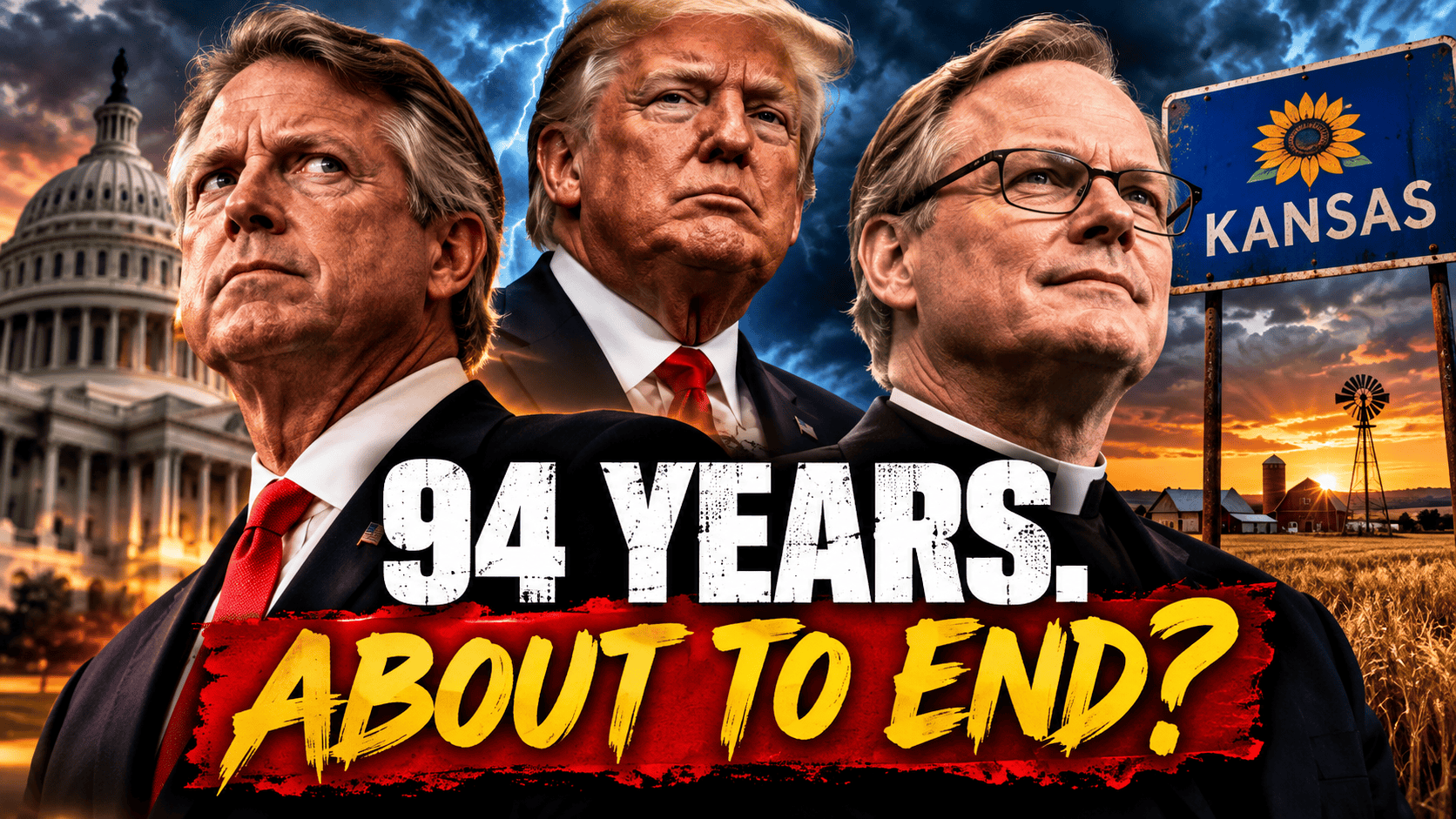
An original Chris Wick News political analysis based on verified reporting, polling and the growing battle for control of the U.S. Senate.
The Republican Heartland Is Sending Washington a Warning
For nearly a century, Kansas has been one of the Republican Party’s most dependable strongholds in the United States Senate.
Now, with the November 3 midterm elections approaching, something extraordinary is happening.
A Democratic pastor is threatening to accomplish what his party has failed to do since 1932: win a U.S. Senate election in Kansas.
And the political establishment should be asking itself one uncomfortable question.
If Republicans can no longer count on Kansas, where exactly can they count on winning?
Incumbent Republican Senator Roger Marshall is facing an unexpectedly competitive challenge from Democrat Adam Hamilton, a prominent Methodist pastor who has positioned himself as an independent-minded alternative to Washington’s increasingly bitter political culture.
This is not some predictable Democratic uprising in California or New York.
This is Kansas.
______________________________________________
🔴 Help keep this independent voice alive and uncensored.
Support independent journalism and help keep Chris Wick News going.
👉 Support Chris Wick on GoFundMe
Donald Trump carried the state by approximately 16 percentage points in 2024. Yet two years later, polling suggests a Senate race that could be decided by a relatively small number of voters.
Something has changed.
And it goes considerably deeper than party politics.
Farmers Are Feeling the Cost of Washington’s Decisions
For generations, Kansas farmers have formed part of the economic and cultural backbone of Republican politics.
But loyalty does not pay the diesel bill.
Agricultural producers are confronting rising fuel and fertilizer costs, with the U.S.-Israeli war against Iran placing additional pressure on energy markets.
According to Reuters reporting published October 20, diesel prices have risen approximately 70% since the conflict began in February.
For farmers operating equipment across thousands of acres, those increases are not minor inconveniences.
They can threaten the financial survival of an operation.
Reuters interviewed Kansas farmer Vance Ehmke, whose family has worked the land since the nineteenth century. He described approximately $50,000 in unexpected fuel expenses over the past year.
That is money unavailable for equipment repairs, debt payments, hiring or future investment.
And it raises a question politicians in both parties would rather avoid.
How long can Washington expect rural Americans to absorb the financial consequences of decisions made thousands of miles away?
Republicans argue that their broader economic and national security policies will ultimately benefit the country. Some farmers remain willing to tolerate today’s higher costs in anticipation of longer-term gains.
But other voters are questioning whether those promised benefits will ever reach their communities.
That distinction could matter enormously on Election Day.
The Immigration Crackdown Has Created Another Political Flashpoint
Kansas is also experiencing political tension surrounding federal immigration enforcement.
In September, Immigration and Customs Enforcement operations across southwestern Kansas resulted in 104 arrests, according to federal prosecutors.
The raids affected communities where meatpacking plants are major employers and where immigrant families play an important role in local economic life.
Reuters reported that operations at major meat processors were disrupted as some workers stayed home because they feared enforcement activity.
Supporters of the crackdown argue that immigration laws must be enforced consistently and that employers must comply with federal requirements.
Critics argue that large enforcement operations can destabilize families, businesses and communities, particularly when industries depend heavily on immigrant labour.
Both arguments are now colliding in a state where Republicans have traditionally enjoyed a significant electoral advantage.
Researchers at Wichita State University also identified increased voter registrations in counties affected by the raids.
That does not establish how those newly registered voters will cast their ballots.
But it suggests that federal policy is motivating political participation in places where turnout could influence a close election.
And in a contest this competitive, even relatively small changes in participation matter.
The Polling Numbers Should Concern Republicans
SEPTEMBER 15–16 EMERSON COLLEGE POLL — KANSAS SENATE
Adam Hamilton — Democrat 45%
Roger Marshall — Republican 43%
Libertarian David Graham: 4%. Undecided: 8%. Survey of 750 likely voters; credibility interval ±3.6 percentage points. The two-point difference is within polling uncertainty.
Other surveys have produced slightly different results, with some favouring Marshall and others showing Hamilton ahead.
The broader picture is unmistakable: Kansas is far more competitive than Republicans would normally expect.
A September Emerson College survey also found that Hamilton held a substantial advantage among independent voters.
That is particularly significant because winning over independents and moderate Republicans may be essential to overcoming Kansas’s historical Republican lean.
But polling is not an election result.
Marshall retains the advantages of incumbency, an established Republican organization and Trump’s endorsement. Kansas’s longstanding conservative voting patterns also remain a serious obstacle for Hamilton.
Anyone declaring a Democratic victory before ballots are counted is getting ahead of the evidence.
Still, the fact that Republicans must seriously defend this seat tells its own story.
Trump Has Entered the Fight — But Will It Be Enough?
President Trump travelled to Kansas to campaign for Marshall, underscoring the national significance of a race that might ordinarily attract relatively little attention.
At an October 19 rally near Wichita, Trump attacked Democrats and invoked the violent unrest in France as a warning about what could happen under Democratic leadership.
It was an attempt to connect the Kansas contest to a larger argument about security, political stability and the direction of the country.
But the strategy carries risks.
For committed Trump supporters, the president’s appearance may strengthen enthusiasm and turnout.
For disillusioned independents, however, another national political confrontation may do little to answer questions about fuel prices, healthcare expenses and local economic conditions.
The challenge for Republicans is not simply convincing voters that Democrats would be worse. It is convincing them that Republicans have made their own lives better.
That is a considerably harder argument when household and agricultural costs remain high.
Neither Candidate Escapes Scrutiny
The increasingly competitive campaign has also brought controversies involving both candidates into sharper focus.
Hamilton has faced questions about how leaders at his church handled allegations of sexual misconduct involving a volunteer at a church-connected camp.
The church initially investigated internally before later contacting police following additional allegations. Hamilton has acknowledged that authorities should have been notified sooner and said the church subsequently changed its procedures.
Marshall, meanwhile, has faced criticism over medical debt collection practices from his years as an obstetrician.
A New York Times investigation highlighted lawsuits involving more than 700 patients over unpaid bills. Marshall has defended those actions as consistent with ordinary collection practices.
Both matters deserve scrutiny.
Voters should be able to examine how candidates exercised responsibility before seeking or holding public office.
But political attacks are not substitutes for evidence, and allegations should not be inflated beyond what documented reporting establishes.
The real test is whether voters believe either candidate can provide competent, accountable representation.
Why Kansas Could Change the Balance of Power
Democrats need a net gain of four Senate seats to regain control of the chamber.
Kansas was not supposed to be one of their most promising opportunities.
Yet the state’s unexpected competitiveness has forced Republicans to devote attention and political resources to territory they have historically treated as secure.
Similar pressures are visible elsewhere in the Midwest, where rising costs, foreign policy disagreements and dissatisfaction with Washington are complicating Republican campaigns.
A Democratic victory in Kansas would be historic.
But its implications would extend well beyond state borders.
Control of the Senate influences federal legislation, presidential appointments, judicial confirmations and the balance of power in Washington.
A single seat can matter enormously when the chamber is closely divided.
That is why this race deserves attention far beyond Kansas.
The Bigger Story Is About Political Loyalty
There is a temptation to interpret every election as another chapter in the endless struggle between Republicans and Democrats.
But that misses something important.
Americans do not live their lives as political party statistics.
They pay mortgages. They buy groceries. They fill their vehicles with fuel. They worry about medical bills, jobs and whether their children will enjoy a better future.
And when those pressures become unbearable, party loyalty can begin to weaken.
That does not mean Kansas is suddenly becoming a Democratic state.
It does mean that even longstanding political allegiances can be tested when voters feel their concerns are being ignored.
For Republicans, Kansas offers a warning about assuming traditional supporters will remain loyal regardless of circumstances.
For Democrats, it presents an opportunity — but also an obligation to demonstrate that they can offer something more substantial than opposition to Donald Trump.
Neither party should mistake public frustration for unconditional support.
Chris Wick News Analysis: The Political Establishment Should Be Watching Kansas
The most revealing part of this election may not be whether Adam Hamilton ultimately defeats Roger Marshall.
It may be why the race became competitive in the first place.
A state that has not elected a Democratic senator since the Great Depression is now witnessing a serious challenge to an incumbent Republican.
The reasons are not mysterious.
Economic pressure. Political fatigue. Immigration disputes. Foreign wars. Growing doubts about whether elected officials understand the consequences of their decisions.
These issues do not fit neatly into campaign slogans.
And they are not going away simply because one party wins an election.
Kansas is reminding Washington of something politicians repeatedly forget: voters may remain loyal to a party for decades, but that loyalty is not a blank cheque.
On November 3, Americans will find out whether the frustration in Kansas is powerful enough to break a 94-year political streak.
Whatever the result, the warning has already been delivered.
The question is whether anyone in Washington is listening.
Sources
Reuters — Could disillusioned Kansas voters send their first Democrat to the US Senate in 94 years? https://www.reuters.com/world/us/could-disillusioned-kansas-voters-send-their-first-democrat-us-senate-94-years-2026-10-20/
Emerson College Polling — Kansas 2026: Hamilton and Marshall in Tight Senate Race https://emersoncollegepolling.com/kansas-2026/
Axios — Your Guide to Kansas’ Close Senate Race https://www.axios.com/local/kansas-city/2026/10/15/kansas-senate-voter-guide-axios
RealClearPolitics — 2026 Competitive Senate Races https://www1.realclearpolitics.com/epolls/2026/senate/tossups.html