Republicans face growing political pressure ahead of the November 2026 midterm elections as Trump reportedly questions campaign strategy and spending.
The money is flowing. The polls are slipping. And inside Trump’s political operation, the finger-pointing has begun. But there is one question nobody in Washington can escape: Who is responsible when the man at the top helped build the strategy?
The Cracks Are Showing Inside Trump’s Political Machine
Washington has a familiar smell when an election starts going wrong.
Fear. Desperation. And the unmistakable sound of powerful people looking for someone else to blame.
With the November 3, 2026, midterm elections approaching, President Donald Trump’s political operation is reportedly experiencing growing internal friction. Republicans are fighting to maintain control of Congress, and the prospect of losing the House of Representatives has become increasingly difficult to ignore.
According to an October 17 Reuters investigation, Trump has privately criticized senior advisers over campaign spending, congressional redistricting and candidate selection. Three people familiar with internal discussions described mounting frustration inside the president’s political circle.
But here’s the uncomfortable part.
Some of the very strategies Trump is reportedly questioning were strategies he personally supported.
And that raises a much bigger question than whether his advisers are doing their jobs.
What happens when a political movement built around one man’s leadership starts looking for someone else to hold responsible?
$200 Million Later, Where Are the Results?
______________________________________________
🔴 Help keep this independent voice alive and uncensored.
Support independent journalism and help keep Chris Wick News going.
👉 Support Chris Wick on GoFundMe
Money is supposed to buy political influence.
Television advertising. Digital campaigns. Political consultants. Voter outreach. A sophisticated operation designed to turn public opinion into election victories.
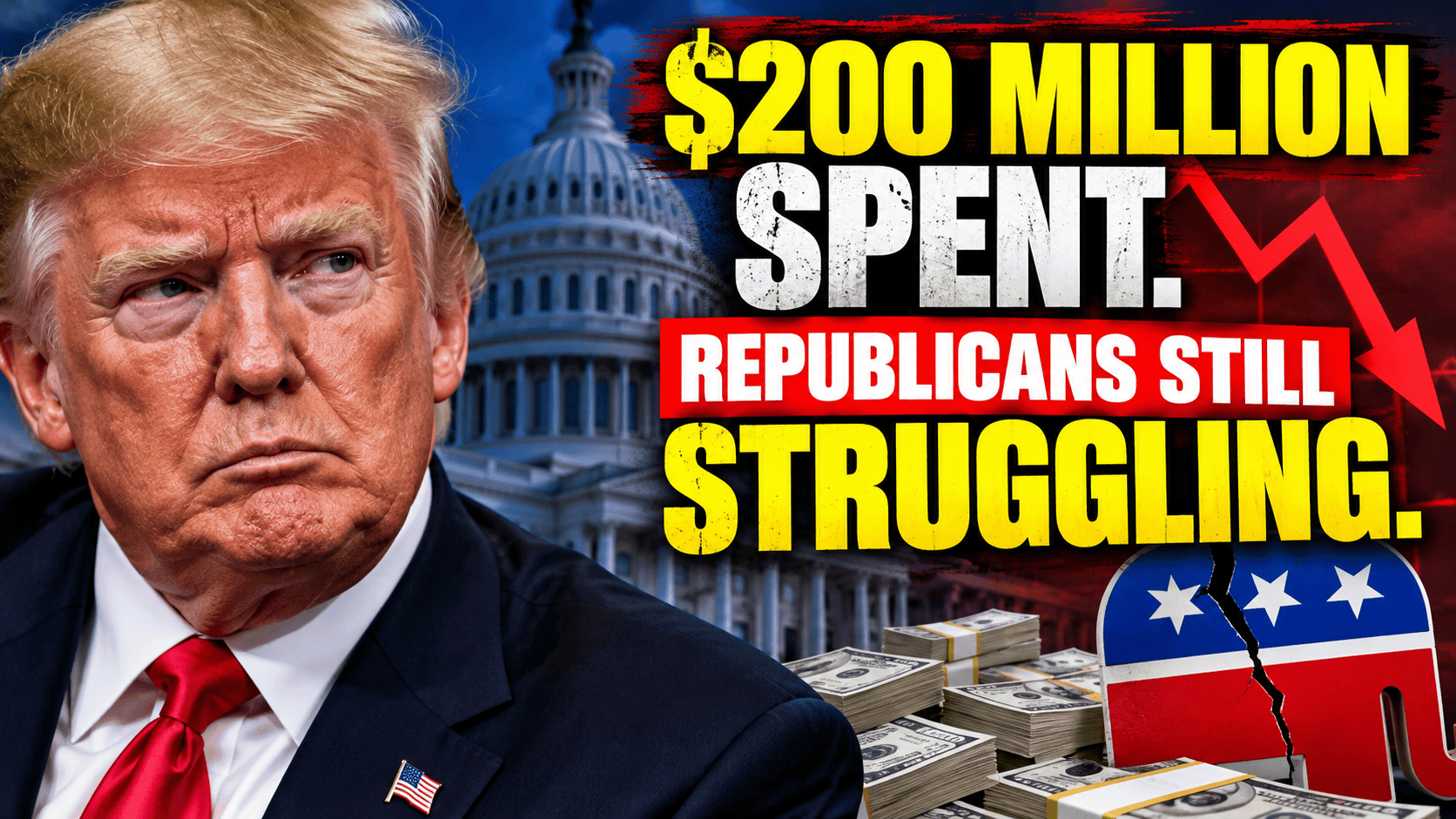
Trump’s super PAC, MAGA Inc., has already spent approximately $200 million, according to public records cited by Reuters.
Yet the spending has not produced the polling improvements Republican strategists had hoped to see in several important congressional races.
And Trump reportedly wants answers.
The frustration has focused partly on James Blair, a longtime political aide overseeing MAGA Inc., while questions have also emerged about White House Chief of Staff Susie Wiles and her supervision of the political operation.
Advisers have reportedly begun blaming one another for the campaign’s difficulties.
Blair, however, rejected the internal criticism, arguing that Republicans should focus on winning the election rather than attacking one another.
The White House has also disputed the characterization of internal dysfunction.
But the financial question remains.
If $200 million cannot convince enough Americans that their lives are improving, is another $200 million really the solution?
Perhaps the problem isn’t the advertising.
Perhaps it’s the message.
Or perhaps voters are judging the results of government rather than the promises of another campaign.
The Economy Doesn’t Care About Political Excuses
There is a problem no political consultant can easily solve.
The price of everyday life.
Americans are still concerned about grocery bills, household expenses and whether their earnings can keep up with rising costs.
An October 9 Reuters/Ipsos survey found that 78% of respondents attributed at least some responsibility for rising prices to Trump’s policies.
Even among Republicans, 57% reported that living costs were increasing faster than their earnings.
Those numbers matter.
Not because every economic problem can fairly be blamed on one president. Inflation, global supply chains, energy prices and monetary policy are complicated.
But because voters generally do not evaluate economic hardship through the same lens as politicians.
They look at their bank accounts.
They look at their grocery receipts.
They look at what remains after the bills are paid.
And then they decide whether the people running the country deserve another two years of congressional support.
Trump’s political strength has long depended partly on convincing ordinary Americans that he understands their frustrations.
The danger for Republicans is that frustrated voters may now direct some of that anger toward the administration itself.
Texas: When Political Engineering Meets Reality
One of the more revealing elements of the reported Republican anxiety involves Texas.
Trump pushed for congressional redistricting intended to improve Republican prospects.
On paper, redrawing electoral boundaries can create opportunities for a party to win additional seats.
But political maps cannot guarantee how people will vote.
The Texas strategy depends partly on maintaining support among Hispanic voters who helped Trump in 2024.
That support is not guaranteed to repeat itself in 2026.
According to Reuters, some Republican strategists are concerned that the new boundaries could actually increase vulnerability in certain districts rather than deliver the expected advantage.
Think about that.
A political strategy designed to strengthen Republican control could potentially expose Republican incumbents to greater electoral danger.
It is a reminder that voters are not chess pieces.
They do not always move where political strategists expect them to move.
And an electoral map cannot force a dissatisfied voter to support a candidate.
Trouble at the Top: The Blair and Wiles Questions
The reported tensions extend beyond campaign spending.
Blair and former Trump campaign co-manager Chris LaCivita traveled to Republika Srpska, an entity within Bosnia and Herzegovina, for outside consulting work.
That trip reportedly caused frustration among some senior White House officials, who questioned why key political figures were involved in overseas consulting during a critical election period.
Trump publicly described the men as outside consultants and warned that conflicts of interest, if established, could result in termination.
There is an important distinction here.
Questions about outside work do not automatically establish misconduct. Reuters reported concerns among officials, not a finding that the men had committed wrongdoing.
Wiles, meanwhile, has received public support from Trump despite the reported internal disagreements.
The White House rejected the anonymous sources’ account, while Blair and LaCivita defended their commitment to Republican electoral success.
Still, the broader political picture is difficult to ignore.
When a campaign begins spending as much energy defending its internal operations as explaining its policies, something has gone wrong.
The Real Nightmare: Losing the House
For Trump, losing the House of Representatives would mean far more than an embarrassing election night.
It could fundamentally change the final two years of his presidency.
A Democratic-controlled House could obstruct portions of his legislative agenda, initiate investigations and use congressional subpoena powers to scrutinize administration decisions.
That is the institutional consequence of divided government.
Republicans could still retain the Senate, where the electoral outlook remains more uncertain.
And polls are not election results. Turnout, candidate quality and late campaign developments could still change the outcome.
But the risk is real enough to explain why the president and his advisers are reportedly becoming increasingly concerned.
Trump has urged supporters to approach the midterms as though his own name were on the ballot.
Politically, the calculation makes sense.
His personal appeal has repeatedly mobilized voters who might otherwise remain at home.
Yet that strategy carries an obvious risk.
If the election is supposed to be about Trump when Republicans win, can it suddenly become someone else’s responsibility if they lose?
That contradiction sits at the centre of the current Republican dilemma.
This Is Bigger Than Trump
There is a temptation to treat this story as another episode of Washington political theatre.
Trump gets angry.
Advisers argue.
Consultants defend themselves.
Political insiders leak information.
The media reports the chaos.
And everyone moves on to the next controversy.
But that misses the larger issue.
The American political system has become extraordinarily effective at raising money, creating political enemies and selling voters promises.
It has been considerably less effective at convincing citizens that the political establishment is accountable when those promises fall short.
And that criticism should not stop with Republicans.
Democrats have their own history of failed messaging, expensive campaigns, internal divisions and attempts to shift responsibility for electoral defeats.
Neither party deserves a free pass.
The people paying the bills are entitled to expect more than another round of campaign slogans.
They deserve answers about economic policy, government spending, public accountability and the consequences of political decisions.
Not endless excuses from whichever party happens to control Washington.
The Chris Wick Take: You Can’t Outsource Accountability
There is something almost predictable about the situation developing inside Trump’s political operation.
When things go well, political leaders claim the credit.
When things go badly, the consultants, advisers and campaign managers suddenly become the problem.
Sometimes those advisers really are responsible for strategic failures.
Sometimes campaign money is wasted.
Sometimes political organizations become so insulated from ordinary voters that they stop understanding the people they are supposed to persuade.
But leadership means accepting responsibility for the decisions made under your authority.
Trump has built his political identity around strength, judgment and personal leadership.
Those claims naturally invite scrutiny when the political strategy begins to struggle.
And voters have every right to ask whether the problem is the people delivering the message or the policies behind it.
The November election will determine whether Republicans can maintain control of Congress.
It will not, by itself, answer every question about the administration’s performance.
But it will provide something political consultants cannot purchase.
A verdict from voters.
Because in the end, Washington can spend hundreds of millions of dollars selling a political story.
It cannot force Americans to believe it.
And if Republicans lose control of the House, the most important question may not be which adviser Trump fires.
It may be whether anyone at the top is prepared to accept responsibility.
Sources
Reuters — Trump faults aides as Republican midterm prospects dim (October 17, 2026) https://www.reuters.com/world/us/trump-faults-aides-republican-midterm-prospects-dim-2026-10-17/
Reuters — Bipartisan majority of Americans blame Trump policies for rising costs, Reuters/Ipsos poll finds (October 9, 2026) https://www.reuters.com/world/us/bipartisan-majority-americans-blame-trump-policies-rising-costs-reutersipsos-2026-10-09/
Reuters — Five big takeaways from Trump’s midterm convention (September 11, 2026) https://www.reuters.com/world/us/five-big-takeaways-trumps-midterm-convention-2026-09-11/
About the Author