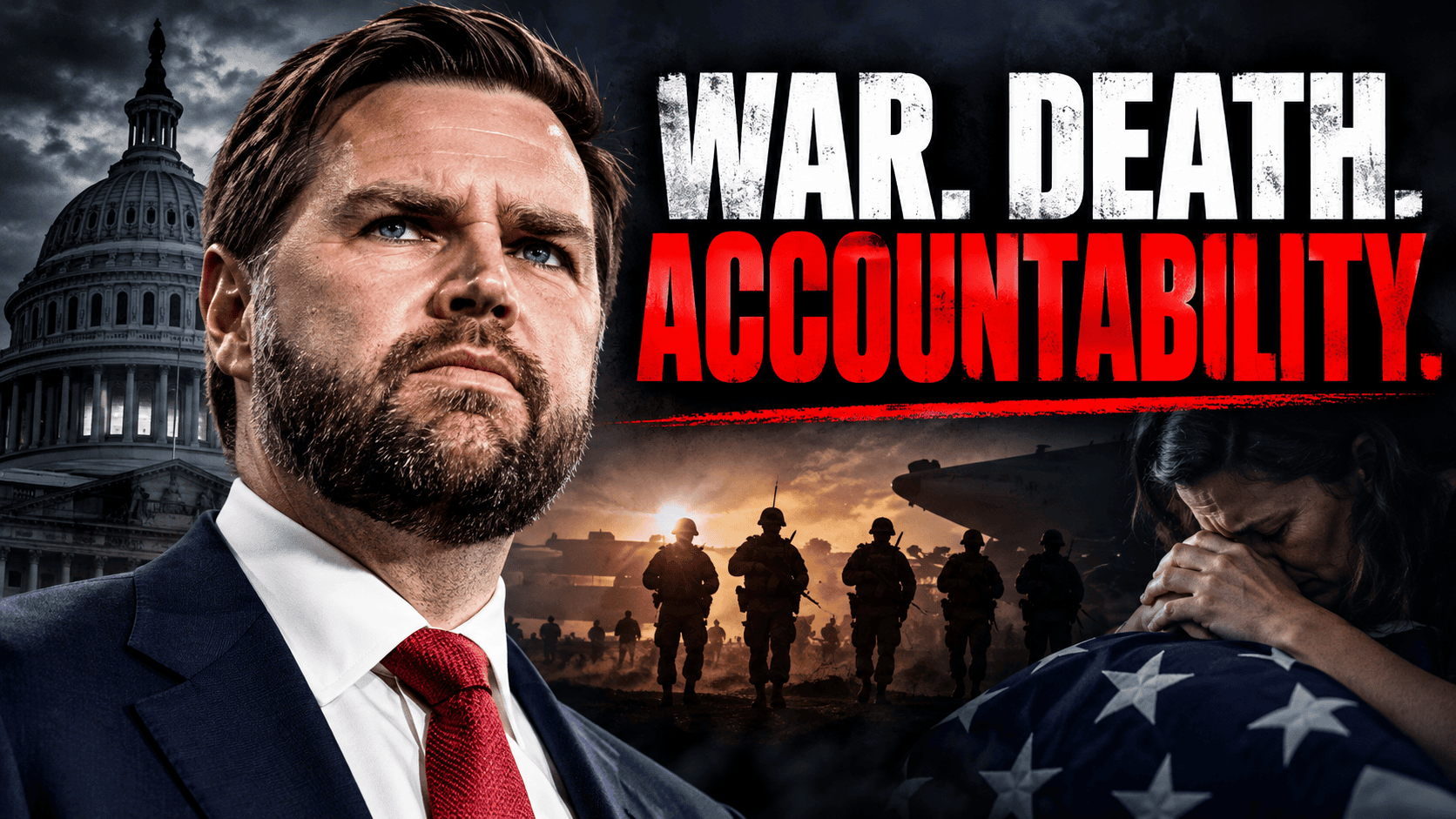
Questions about war, immigration and accountability confront Vice President JD Vance.
There is a moment when political talking points stop working.
It usually happens when someone who has paid the price for government decisions stands up and asks a question that cannot be dismissed with another campaign slogan.
That moment arrived for Vice President JD Vance during a CBS News town hall aired Saturday, October 17.
The questions came from ordinary Americans. A grieving military husband. A voter struggling with gasoline prices. A Catholic nun concerned about immigration enforcement. An immigrant who believed the administration’s rhetoric had crossed a line.
And behind those questions stood something far larger than one television appearance.
An uncomfortable question about who takes responsibility when decisions made in Washington destroy lives far beyond Washington.
A Soldier Dies. Washington Explains.
One of the most powerful moments involved Joey Amor, whose wife, Master Sgt. Nicole Amor, was among six American service members killed in an Iranian drone strike in Kuwait on March 1.
The attack occurred shortly after President Donald Trump launched the war against Iran.
Amor wanted to know what had gone wrong, why American troops had been left vulnerable, and how those responsible would be held accountable.
______________________________________________
🔴 Help keep this independent voice alive and uncensored.
Support independent journalism and help keep Chris Wick News going.
👉 Support Chris Wick on GoFundMe
These were not abstract political questions.
They came from someone whose family would never be the same.
Vance acknowledged that mistakes had been made concerning the positioning of American troops. He said the administration had identified problems and changed its deployment practices.
That acknowledgment matters.
But it also raises another question.
If military leaders discovered that troop positioning was a serious mistake only after Americans were killed, what warnings existed beforehand, and who was responsible for evaluating them?
An operational mistake does not automatically establish negligence or misconduct. Military decisions are made under uncertainty, and not every tragedy is preventable.
But admitting that something went wrong should be the beginning of public accountability, not the end of the conversation.
The families of fallen service members deserve more than an assurance that procedures have changed.
They deserve a credible explanation of what happened and whether those deaths could reasonably have been prevented.
The War Abroad Is Reaching Into American Wallets
The town hall also exposed another reality of military conflict.
Wars do not remain confined to battlefields.
They travel through energy markets, transportation costs, grocery bills and household budgets.
A Michigan voter who previously supported Trump and Vance confronted the vice president about rising gasoline prices associated with the Iran conflict.
Vance acknowledged that fuel prices were too high and pointed to instability in the Middle East. He also criticized energy policies under former President Joe Biden.
There may be legitimate arguments about America’s refining capacity and long-term energy policy.
But those arguments cannot erase the responsibility of the administration currently making decisions about the war.
When a government chooses military escalation, it must also answer for the foreseeable economic consequences of that decision.
That does not mean every increase at the gas pump can be attributed to one president or one conflict.
Energy prices are influenced by global supply, demand, refining capacity, market expectations and geopolitical instability.
Nevertheless, voters are entitled to ask whether the administration adequately considered those consequences before embarking on a war.
And they are entitled to demand a credible plan for limiting the damage.
Blaming previous administrations may satisfy partisan audiences.
It does not reduce the price Americans pay to fill their vehicles.
Immigration Enforcement Meets a Moral Question
Another revealing exchange came from a Catholic nun who challenged Vance over the treatment of immigrants and the administration’s enforcement practices.
The question was particularly pointed because Vance himself is Catholic.
How should a government reconcile aggressive immigration enforcement with religious principles emphasizing human dignity and compassion?
Vance defended the need for immigration enforcement while acknowledging that officers sometimes make mistakes.
He said some cases had resulted in additional training or disciplinary action.
That acknowledgment deserves attention.
Governments have a legitimate responsibility to enforce immigration laws. They also have an obligation to ensure those laws are administered fairly and humanely.
These responsibilities are not mutually exclusive.
A government does not have to abandon border enforcement to recognize that the people affected by it remain human beings.
And when enforcement officers abuse their authority or violate established procedures, meaningful oversight should not depend solely on internal assurances.
The public deserves to know whether misconduct is being investigated, whether corrective measures are effective, and whether vulnerable families are being protected.
Security and accountability should strengthen one another.
They should never become competing political slogans.
When Political Rhetoric Becomes a Weapon
Vance also faced criticism from a naturalized American citizen who questioned his language concerning foreign workers admitted under the H-1B visa program.
The vice president acknowledged that his rhetoric had not always been appropriate.
He explained that his criticism was intended primarily for companies that exploit foreign workers and use immigration arrangements to increase their leverage over employees.
That distinction is important.
There are legitimate concerns about employer power, wage competition and potential abuses within temporary employment programs.
But there is also a significant difference between criticizing corporate practices and creating the impression that immigrant workers themselves are responsible for America’s economic problems.
Political language has consequences.
When leaders speak carelessly about entire groups of people, their words can shape how those groups are treated.
Vance’s acknowledgment that his rhetoric had been imperfect was a welcome admission.
The more important test will be whether future rhetoric reflects that recognition.
The Question of Money and Power
The town hall eventually turned toward another uncomfortable subject: whether people connected to the presidency are benefiting financially from their positions.
CBS moderator Tony Dokoupil pressed Vance about concerns involving Trump’s cryptocurrency businesses and allegations surrounding former Ambassador to Greece Kimberly Guilfoyle, who has denied wrongdoing.
Vance rejected the suggestion that he had witnessed corruption involving the president.
He also condemned the idea of anyone selling access to the White House.
The distinction between financial success, conflicts of interest and criminal corruption must be maintained.
A politician’s business earnings do not, by themselves, establish illegal conduct.
Likewise, allegations are not proof.
But the absence of a criminal conviction does not make questions about transparency and conflicts of interest irrelevant.
Public office should never become a private marketplace where access to power is treated as a commodity.
That principle should apply equally to Republicans, Democrats and every administration that follows.
Citizens should not have to choose between supporting a political party and demanding ethical standards from its leaders.
The Bigger Problem for JD Vance
Vance may eventually seek the presidency in 2028.
During the town hall, he acknowledged that he might not run.
But whether he becomes a candidate or not, the questions raised during this appearance reveal a political challenge that will not disappear after the television cameras are switched off.
The administration must defend its decisions on war, immigration, economic hardship and ethics.
And Vance, as vice president, is one of the people expected to explain those decisions to the public.
His willingness to acknowledge some mistakes is preferable to pretending that none occurred.
Yet acknowledgment without transparent follow-through risks becoming another form of political damage control.
The test is not whether an official can survive an uncomfortable interview.
The test is whether difficult questions produce meaningful answers, documented changes and accountability where warranted.
The Real Story Is Not That Vance Was Challenged
The real story is that Americans are increasingly demanding explanations about decisions that directly affect their lives.
A military family wants answers about a preventable or potentially preventable tragedy.
A motorist wants to know why a distant conflict is making daily life more expensive.
A religious woman wants to know whether immigration enforcement reflects the moral values leaders claim to uphold.
An immigrant wants to be treated as a person rather than a political talking point.
And voters want confidence that government power is not being used for private enrichment.
These are not unreasonable demands.
They are fundamental questions in a functioning democracy.
The people who authorize wars do not personally bear every consequence. The people who design immigration policies do not necessarily experience their enforcement. And the people who make economic promises do not always suffer when those promises fail.
That distance between political power and personal consequences is precisely why scrutiny matters.
Washington has no shortage of speeches.
It has no shortage of explanations, accusations or carefully constructed defenses.
What Americans need is something more difficult to deliver.
Accountability that continues after the cameras are gone.
Because when lives are lost, families are divided and ordinary people are left paying the bill, the question should never be which politician won the argument.
The question should be who is willing to answer for the consequences.
Chris Wick News — Independent news. Uncomfortable questions. No political team gets a free pass.
Sources
Associated Press — Vance faces tough questions on Iran war, immigration and more in town hall
https://apnews.com/article/vance-town-hall-iran-immigration-8059afd7e8363df5f4f6943aadf5357f
CBS News — 7 highlights from JD Vance’s CBS News town hall: Iran, immigration, corruption and 2028 plans
https://www.cbsnews.com/news/jd-vance-cbs-town-hall-highlights-michigan/
About the Author