





Imagine being the president of the most powerful country on Earth. You’ve got nuclear weapons, aircraft carriers, intelligence agencies, an enormous military budget, and the ability to shake global markets with a single social media post.
But apparently, that’s not enough.
You also need a shiny little medal from Norway to confirm just how magnificent you are.
And when somebody else gets it?
Well, naturally, the entire Nobel Peace Prize becomes a disgrace.
Welcome to the latest episode of the Donald Trump Show, where the explosions are real, the ego appears bottomless, and the main character seems convinced the universe owes him a standing ovation.
At this point, the Nobel Peace Prize controversy is starting to resemble a dark comedy written by someone who has completely lost faith in humanity.
Unfortunately, the punchline involves actual wars.
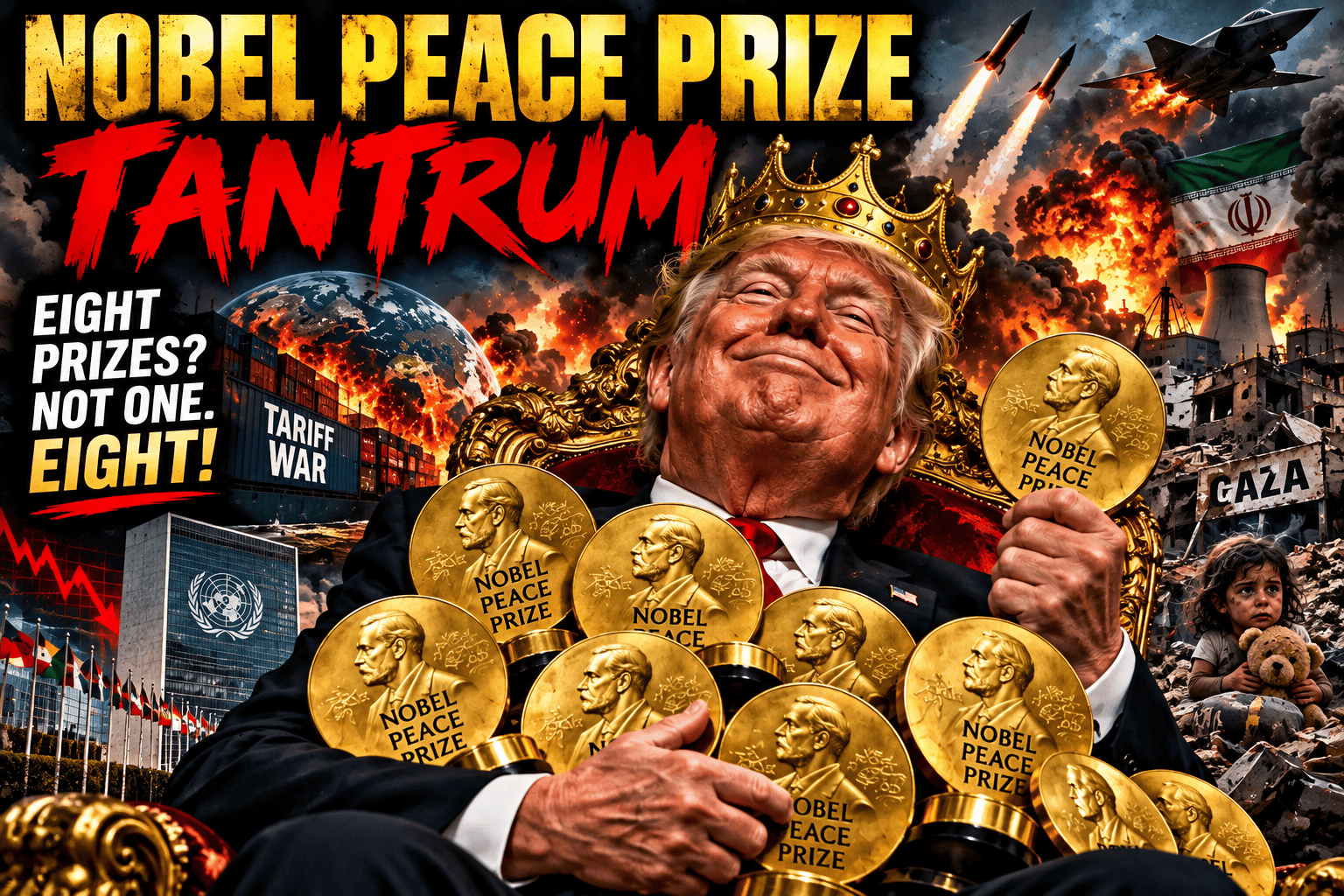
Eight Peace Prizes? Why Stop There, Donald?
On October 9, the Norwegian Nobel Committee awarded the 2026 Nobel Peace Prize to South African human rights jurist Navi Pillay.
______________________________________________
🔴 Help keep this independent voice alive and uncensored.
Support independent journalism and help keep Chris Wick News going.
👉 Support Chris Wick on GoFundMe
Trump was not impressed.
In fact, he was so unimpressed that he launched into a lengthy public complaint explaining why the award should have gone to him.
Not just once, either.
According to Trump:
“In actuality, I should have won 8 Nobel Peace Prizes, not just 1.”
Eight Nobel Peace Prizes.
For one man.
Perhaps somebody should inform the Nobel Committee that they apparently forgot to introduce a bulk-discount program.
Buy seven peace treaties, get the eighth medal free.
Throw in a complimentary golden statue, a red carpet, and a marching band playing Hail to the Chief while the entire planet chants his name.
One can almost picture the ceremony.
“Ladies and gentlemen, tonight’s Nobel Peace Prize goes to Donald Trump.”
“And the next seven Nobel Peace Prizes?”
“Also Donald Trump.”
At some point, political ambition begins to look suspiciously like an insatiable appetite for applause.
Narcissism or Just Another Presidential Power Trip?
Let’s be clear about something.
Nobody can responsibly diagnose Donald Trump with narcissistic personality disorder simply by watching his speeches, reading his social media posts, or observing his public behaviour.
That requires an appropriate clinical assessment.
But discussing narcissistic traits in political leadership is an entirely different matter.
Grandiosity. An intense appetite for admiration. A preoccupation with personal greatness. An apparent inability to accept criticism without turning it into a public confrontation.
These are recognizable patterns worth examining when they appear in anyone entrusted with extraordinary power.
And Trump’s repeated declarations about his own historic importance certainly invite that discussion.
Is this a carefully cultivated political persona?
An elaborate branding exercise?
Or could the president be so deeply invested in his own legend that he struggles to separate personal recognition from national achievement?
We cannot know his private motivations.
But we can examine what he says and does.
When the leader of a nuclear superpower publicly insists he deserves eight Nobel Peace Prizes, questioning the scale of his self-regard is hardly unreasonable.
Peace Through Strength, Preferably With Explosions
Now comes the part where the comedy takes a particularly dark turn.
Trump has repeatedly presented himself as the ultimate peacemaker.
His preferred formula is peace through strength.
And to be fair, military deterrence can sometimes help prevent conflict. Negotiations backed by credible pressure can produce real agreements.
But there is a rather uncomfortable contradiction between celebrating military destruction and demanding international recognition for peace.
In June 2025, Trump announced American strikes against Iranian nuclear facilities and declared that the targets had been “completely and totally obliterated.”
Then, in April 2026, during another confrontation with Iran, he warned:
“A whole civilization will die tonight, never to be brought back again.”
That is not a sentence anyone should hear casually from the president of the United States.
Imagine a fictional Nobel acceptance speech.
“Thank you for recognizing my commitment to peace. Nobody loves peace more than I do. I have the biggest peace. The strongest peace. The most beautiful peace. And if anyone disagrees, well, we’ve got some tremendous missiles.”
Absurd?
Certainly.
But that is precisely why the contrast between Trump’s rhetoric and his pursuit of the Nobel deserves examination.
The stakes are real even when the political performance feels ridiculous.
If threatening the destruction of civilization is now part of the peacemaking résumé, perhaps the dictionary needs an emergency update.
Gaza, Human Suffering, and the Golden Medal
Meanwhile, the humanitarian devastation in Gaza remains impossible to ignore.
Entire neighbourhoods have been destroyed. Families have lost loved ones. Civilians have endured displacement, hunger, and profound insecurity.
Pillay, the actual Nobel recipient, chaired a United Nations commission that concluded Israel had committed genocide in Gaza.
Israel rejects that finding, and the legal questions surrounding allegations of genocide remain the subject of international proceedings.
These are serious matters involving international humanitarian law and the lives of civilians.
They deserve considerably more attention than the bruised pride of powerful politicians.
Yet the Nobel controversy quickly became another argument about Trump.
His accomplishments.
His recognition.
His grievances.
His supposedly historic greatness.
It’s a strange political universe when a peace award intended to recognize international efforts toward justice becomes another stage for a president’s personal dispute with the people handing out medals.
The world is discussing war crimes, civilian suffering, and international law. Trump is discussing why he should have received eight trophies.
The contrast practically writes its own satire.
Norway, You’ve Hurt His Feelings
Trump also directed his anger toward Norway.
He described the Nobel decision as an “indelible stain on Norway” and warned that the country would not be forgotten.
There is one rather important detail.
The Norwegian Nobel Committee makes the decision independently of the Norwegian government.
Norway’s elected officials do not simply gather around a table and decide which world leader deserves a medal.
But why let institutional independence interfere with a good international grievance?
Picture the Norwegian government receiving a phone call.
“Hello, Norway? This is Washington.”
“Yes, Mr. President?”
“Where’s my Nobel?”
“Sir, that’s an independent committee.”
“Well, I’m independently furious.”
It’s funny until you remember that international relationships involve actual diplomatic interests, security commitments, and millions of ordinary citizens.
A disagreement over an award should not become a reason to threaten political retaliation against another country.
Tariff Wars, Real Wars, and the Art of Winning Everything
Trump’s approach to international affairs often emphasizes leverage, pressure, and the language of victory.
Trade tariffs become instruments of confrontation.
Diplomatic disputes become contests of strength.
Military operations are described through overwhelming displays of power.
And political achievements are frequently presented in superlatives.
The greatest.
The biggest.
The most historic.
Nobody has ever seen anything like it.
It’s an extraordinary amount of winning for a world that still seems to have so many unresolved problems.
The trouble with treating every international relationship as a contest is that peace often requires something entirely different.
Patience.
Compromise.
Restraint.
And sometimes accepting an outcome without insisting that everyone acknowledge your personal greatness.
Those qualities rarely produce the loudest headlines.
They also don’t fit particularly well on a giant golden trophy.
The Cult of Greatness and the Danger of Self-Deception
The deeper issue is not simply Trump’s disappointment.
It’s what happens when political leadership becomes inseparable from the mythology surrounding one individual.
A leader declares himself extraordinary.
Supporters repeat the declaration.
Every achievement becomes unprecedented.
Every setback becomes somebody else’s fault.
Every criticism becomes evidence of persecution.
And every institution that refuses to provide recognition becomes an enemy.
Eventually, facts risk becoming secondary to maintaining the legend.
This phenomenon is not exclusive to Trump or any political party.
History is filled with powerful leaders who surrounded themselves with praise and became increasingly insulated from uncomfortable truths.
The danger is that a government can begin operating like a permanent publicity campaign.
Instead of asking whether policies work, everyone is expected to applaud the person announcing them.
Instead of examining military consequences, attention shifts toward celebrating strength.
Instead of evaluating diplomatic agreements, the public is invited to marvel at the supposed genius of the negotiator.
And when reality refuses to cooperate?
Apparently, reality needs better public relations.
A president should not need the world to worship his achievements in order for those achievements to matter.
Even the Nobel Winner Found the Situation Funny
There was another revealing moment in this spectacle.
After receiving news of her award, Pillay jokingly told an audience:
“If you clap a little bit more, I may share this prize with Trump.”
The audience laughed.
And perhaps that was the most effective response of all.
Not an angry speech.
Not a geopolitical threat.
Not a lengthy explanation of personal greatness.
Just a joke.
It also recalled the unusual episode involving 2025 Nobel laureate María Corina Machado, who later presented her medal to Trump.
The Nobel Committee has made clear that the award itself cannot be transferred.
Apparently, even when someone hands over the hardware, the official honour doesn’t follow.
There are some things even presidential power cannot purchase, demand, or negotiate into existence.
International recognition, at least in this instance, appears to be one of them.
The Real Problem Isn’t the Missing Medal
Trump’s defenders can point to diplomatic initiatives and agreements they believe deserve recognition.
Those accomplishments should be examined fairly.
But so should the conflicts that remain unresolved, the consequences of military operations, and the humanitarian costs of international confrontation.
The question is not whether Trump has ever contributed to a diplomatic achievement.
The question is why receiving personal recognition for those achievements has become such a prominent public grievance.
Because genuine peace does not require a trophy cabinet.
A successful peace agreement does not become less valuable because its negotiator never receives a medal.
Lives saved remain lives saved.
Wars prevented remain wars prevented.
And diplomacy that produces lasting security does not require eight separate ceremonies celebrating the same politician.
The most meaningful reward for ending a war should be the fact that people stop dying in it.
The Joke of the Century
There is something deeply absurd about the entire situation.
The president of the United States possesses extraordinary political, economic, and military power.
He commands forces capable of projecting destruction across continents.
He can influence global trade, reshape diplomatic relationships, and make decisions affecting millions of people.
Yet a committee of five people in Norway has apparently managed to provoke an international spectacle simply by giving a peace prize to somebody else.
Five committee members.
One missing medal.
Eight allegedly deserved awards.
And an enormous amount of presidential outrage.
You couldn’t invent a better setup for political satire.
But underneath the laughter is a disturbing question about power, vanity, and the human appetite for admiration.
What happens when someone who already possesses extraordinary power begins treating applause as something the world owes him?
We should be careful about pretending to know Trump’s psychological condition or private motivations.
But we should be equally unwilling to ignore the public consequences of political grandiosity, entitlement, and the constant demand for recognition.
Because the real measure of leadership is not how many people are willing to praise you.
It is what happens to the people living with the consequences of your decisions.
And the real measure of peace is not the number of medals hanging around a president’s neck.
It is the absence of war.
The absence of terror.
The absence of families burying their children.
The world needs fewer bombs, fewer threats, fewer political egos demanding worship, and considerably more genuine diplomacy.
As for the Nobel Peace Prize?
Perhaps Trump should order eight replicas, have them gold-plated, and build himself a beautiful display case.
He could even put a little plaque underneath:
“World’s Greatest Peacemaker — According to Donald Trump.”
At least then everyone would know who voted.
Sources
Reuters — Former ICC Judge Navi Pillay Wins 2026 Nobel Peace Prize
https://www.reuters.com/world/navanethem-navi-pillay-wins-2026-nobel-peace-prize-2026-10-09/
Axios — Trump Reacts to the 2026 Nobel Peace Prize Decision
https://www.axios.com/2026/10/10/trump-nobel-peace-prize-reaction
The Washington Post — Trump Fumes Over Nobel Peace Prize Decision
https://www.washingtonpost.com/politics/2026/10/10/trump-fumes-norway-nobel-peace-prize-winner-navi-pillay-over-award/
Reuters — Trump’s Warning That a Whole Civilization Could Die
https://www.reuters.com/world/middle-east/trump-says-a-whole-civilization-will-die-tonight-if-iran-does-not-make-deal-2026-04-07/
International Court of Justice — South Africa v. Israel
https://www.icj-cij.org/case/192