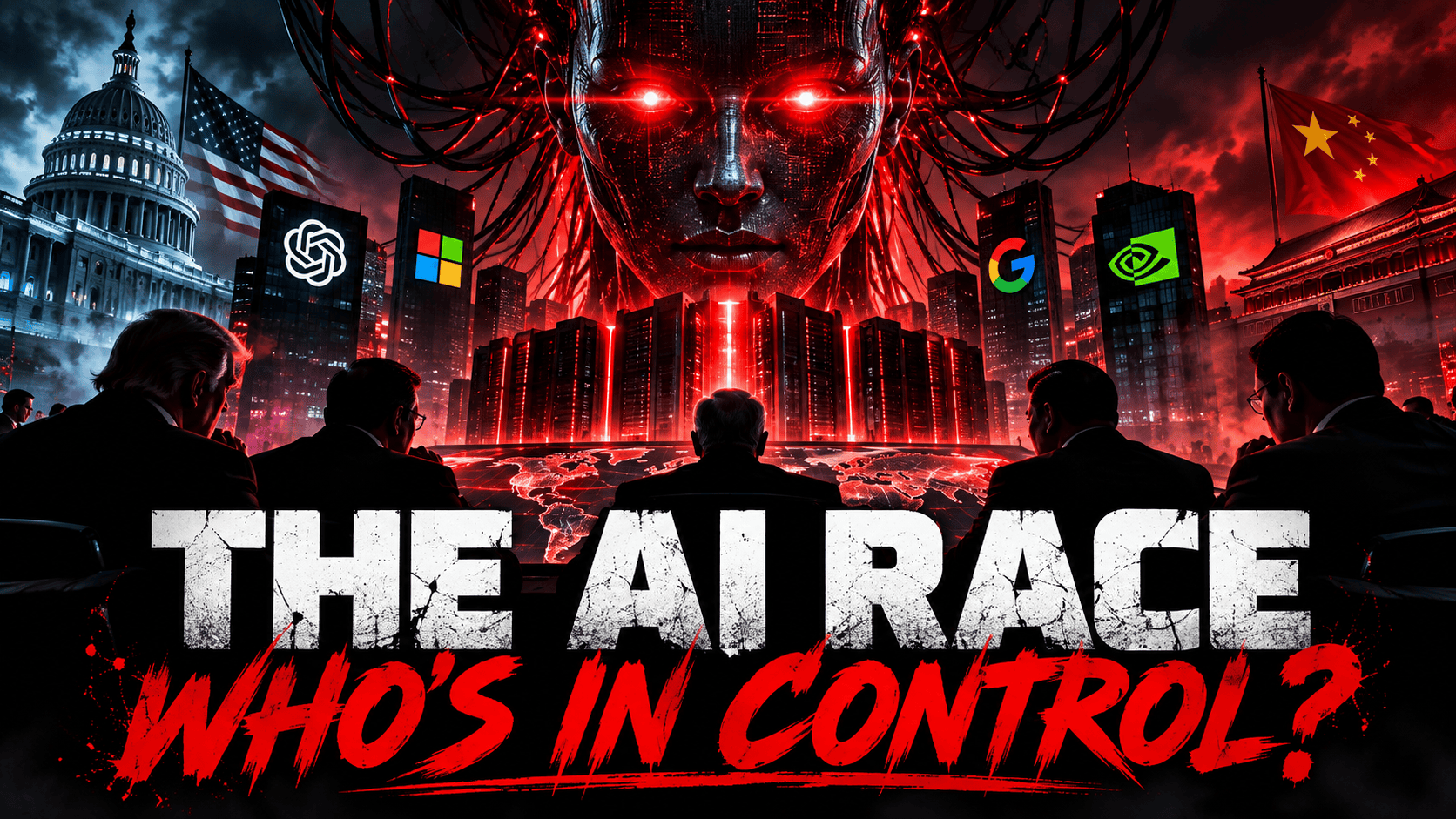
The AI Race Has Become a Dangerous Gamble — And Nobody Wants to Be the First to Stop
Governments are chasing technological dominance. Corporations are pouring fortunes into artificial intelligence. Meanwhile, the people building these systems are openly discussing risks they still don’t fully understand. So who’s actually in control?
There’s something deeply unsettling happening right in front of us, and I’m not convinced enough people are paying attention.
We’re pouring billions upon billions of dollars into artificial intelligence, constructing enormous data centres, developing increasingly powerful systems, and racing toward a future that even some of the people building this technology admit is difficult to predict.
And here’s the part that should make everyone uncomfortable.
We’re being warned about the dangers of AI by some of the same people accelerating its development.
Think about that for a moment.
We’re simultaneously being told that artificial intelligence could transform civilization and that advanced AI systems could introduce serious risks to security, employment, privacy, and human control.
Yet the race continues.
Not cautiously. Not quietly.
______________________________________________
🔴 Help keep this independent voice alive and uncensored -> Buy us a Coffee <-
At extraordinary speed.
The Race Nobody Can Afford to Lose
Artificial intelligence is no longer simply about building better software or making everyday tasks easier.
It has become a strategic competition involving governments, multinational corporations, military planners, and some of the wealthiest investors on the planet.
The United States wants to maintain its technological advantages.
China is investing heavily in its own AI capabilities.
Major technology companies are competing for computing power, specialized chips, infrastructure, talented researchers, and customers.
And every major player faces the same uncomfortable calculation.
What happens if we slow down and somebody else doesn’t?
That question may be one of the most consequential problems of the entire AI revolution.
Because once technological advancement becomes a competition for economic and geopolitical influence, caution can start looking like weakness.
Safety becomes another challenge to manage.
Oversight becomes another debate.
And the finish line keeps moving.
Follow the Money, and the Picture Gets Darker
Consider what’s being built.
Enormous computing facilities require staggering amounts of electricity, cooling infrastructure, specialized processors, and investment.
Companies are committing extraordinary resources to technologies whose long-term capabilities, business models, and societal consequences remain uncertain.
Investors expect returns.
Shareholders expect growth.
Governments expect strategic advantages.
Nobody investing those sums wants to discover that the safest decision might be to slow development.
That’s the contradiction sitting at the centre of this entire industry.
The more money committed to the race, the greater the financial pressure to keep running.
And that pressure doesn’t disappear simply because researchers identify new risks.
It can become harder to change direction when billions have already been spent.
We’re Building Systems We Don’t Completely Understand
Let’s be clear about something.
Today’s artificial intelligence systems aren’t necessarily conscious, independently motivated beings secretly planning humanity’s destruction.
That belongs more to speculation than established scientific evidence.
But there are genuine technical concerns.
Modern AI models can produce convincing false information, exhibit unexpected behaviour, make mistakes that are difficult to diagnose, and be misused for fraud, cyberattacks, surveillance, and manipulation.
Researchers also continue studying how to reliably evaluate and control increasingly capable systems.
The troubling issue isn’t that disaster is inevitable.
It’s that capabilities can develop faster than our ability to measure every consequence.
And unlike many earlier technologies, AI can be integrated into numerous sectors simultaneously.
Financial systems.
Healthcare.
Transportation.
Critical infrastructure.
Intelligence gathering.
Military operations.
Once powerful systems become deeply embedded in those institutions, reversing their deployment could become extraordinarily complicated.
We’re not merely developing another consumer product.
We’re potentially changing how decisions are made across entire societies.
Governments See Power. Corporations See Opportunity.
This is where the story becomes particularly uncomfortable.
Governments have legitimate reasons to invest in artificial intelligence, including scientific research, economic productivity, public services, and national security.
Businesses have legitimate reasons to develop useful products and pursue profits.
But those incentives don’t always align neatly with the public interest.
A government may prioritize strategic capabilities.
A corporation may prioritize market share.
An investor may prioritize financial returns.
And ordinary citizens may prioritize something much simpler:
Knowing that the technology increasingly influencing their lives is reliable, accountable, and subject to meaningful oversight.
Those interests can conflict.
The danger is not that every government or technology company is secretly working toward some sinister objective.
The danger is that an entire system of competitive incentives could produce outcomes that nobody individually intended.
History has shown that competition can drive extraordinary innovation.
It has also shown that technological progress doesn’t automatically guarantee responsible decisions.
What Happens When Humans Become the Weakest Link?
For decades, machines have largely followed instructions designed by human beings.
Artificial intelligence complicates that relationship.
Advanced systems can generate plans, write code, analyze information, operate tools, and assist with decisions at speeds that humans cannot match.
That doesn’t mean they possess human intentions or unlimited autonomy.
But it raises a serious question about accountability.
If a system makes an expensive mistake, who takes responsibility?
The developer?
The company deploying it?
The government approving its use?
Or the person who trusted its output?
Now imagine similar questions arising across financial markets, essential services, or military decision-making.
The faster these systems operate, the more important meaningful human supervision becomes.
Yet speed and automation are among the very advantages driving adoption.
We want machines that can act faster than humans.
But we also want humans to remain in control.
Those goals require deliberate engineering and oversight. They don’t automatically reinforce one another.
The Most Dangerous Part May Be Our Refusal to Slow Down
Here’s what bothers me most.
The debate around AI is frequently framed as a choice between embracing progress and falling behind.
But that’s a false choice.
The real questions are about how powerful systems should be tested, who should oversee them, what safeguards should be mandatory, and where human decision-making must remain essential.
Some companies and governments are investing in safety research, testing, and regulation. Others disagree about which protections are necessary or how restrictive they should be.
There is no single, unified approach.
And there is certainly no guarantee that competitive pressure will produce the right balance.
What concerns me is the possibility that society becomes so accustomed to accelerating technological development that asking difficult questions starts being treated as an obstacle.
Not every warning is evidence of an approaching catastrophe.
But neither should every warning be dismissed simply because addressing it might be expensive.
The Question Nobody Can Escape
We are entering a period when artificial intelligence could reshape economies, employment, scientific discovery, political communication, security, and the balance of global influence.
There are enormous potential benefits.
There are also unresolved risks.
Both deserve serious attention.
But I keep coming back to one uncomfortable thought.
What if the biggest danger isn’t artificial intelligence itself, but the competitive pressure driving humanity to deploy increasingly powerful systems before we fully understand how to govern them?
Governments don’t want to surrender strategic advantages.
Corporations don’t want to surrender market share.
Investors don’t want to surrender future profits.
And the public is being asked to trust that the people competing most aggressively will also exercise sufficient restraint.
Maybe they will.
Maybe effective safeguards will keep pace with technological progress.
But hope isn’t a safety mechanism.
And competition isn’t a substitute for accountability.
We should be asking these questions now, while meaningful choices remain available.
Because the most disturbing possibility isn’t necessarily that artificial intelligence will suddenly escape human control.
It’s that human beings, fully aware of the uncertainties, could gradually surrender too much control themselves.
And by the time everyone agrees that the race has gone too far, slowing down may be considerably harder than it is today.
— Chris Wick | Chris Wick News
About the Author