








Your ID Wasn’t Just Checked — Who Else Could Access It?
A new watchdog finding raises an uncomfortable question about the biometric future: once your identity enters the system, who controls what happens to it?
You walk into an airport.
You hand over your driver’s licence or passport.
Your identity is verified.
You continue toward your flight.
Most people probably assume that is where the story ends.
Apparently, it may not be that simple.
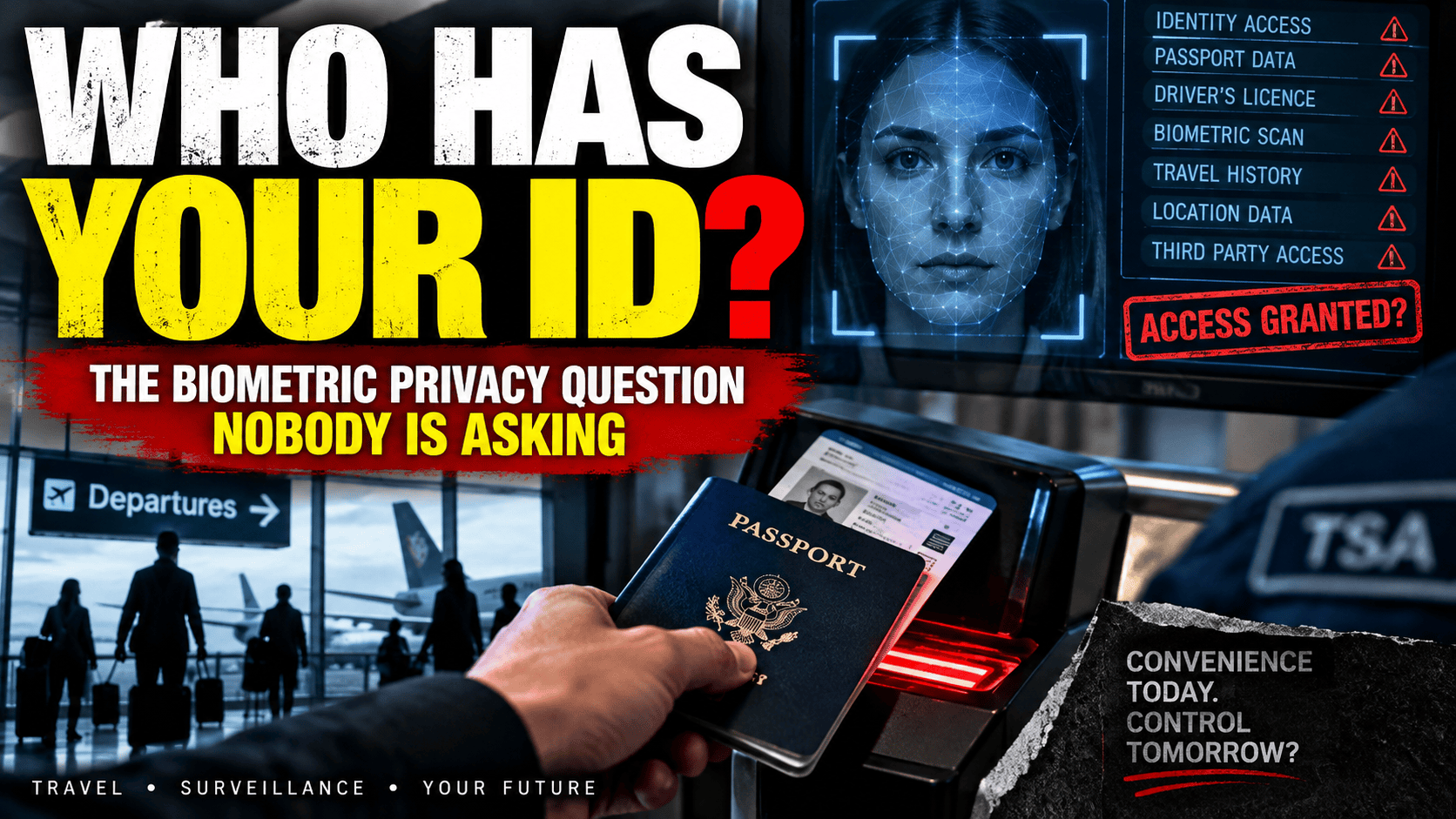
A newly reported Department of Homeland Security inspector general audit found serious oversight gaps involving a contractor supporting the Transportation Security Administration’s biometric checkpoint technology.
According to the publicly reported findings, the contractor had the technical ability to access and extract passengers’ driver’s licence and passport images while troubleshooting systems and performing upgrades.
______________________________________________
🔴 Help keep this independent voice alive and uncensored -> Buy us a Coffee <-
The disturbing part isn’t merely that a contractor could access the information.
It’s what the government reportedly wasn’t tracking.
TSA Biometric Data Privacy Raises Questions
The inspector general found that TSA lacked clear policies governing that contractor access, did not adequately track when passenger information was extracted, and could not verify that extracted information was properly deleted.
The audit also found that passengers were not notified when their biometric and biographic information might have been stored.
These findings raise broader questions about TSA biometric data privacy and biometric data security risks as identity verification technology becomes more widespread.
Read that again.
Government-issued identity documents.
Private contractors.
Extraction capability.
Inadequate tracking.
Unverified deletion.
And almost nobody boarding an airplane would have had any idea this was happening behind the screen.
The Bigger Story Isn’t the Airport
This matters because airports are only one piece of a much larger transformation.
Biometric identification is expanding.
Digital identity systems are expanding.
AI surveillance is expanding.
Facial recognition is expanding.
Connected vehicles, smart glasses, licence-plate readers and enormous databases are increasingly capable of connecting a physical person to a digital identity.
These growing facial recognition privacy concerns extend far beyond airports.
Every individual technology can be defended as convenient.
Faster airport screening.
Easier logins.
Less paperwork.
Better security.
But convenience isn’t the only question we should be asking.
The more important question may be:
What happens when all of these systems begin talking to one another?
Because the danger isn’t necessarily one giant surveillance machine appearing overnight.
It could happen one database at a time.
One camera at a time.
One digital ID at a time.
One “convenient” feature at a time.
Until eventually society discovers that an enormous infrastructure capable of identifying, tracking and profiling people was assembled in plain sight.
That is why biometric airport screening privacy risks deserve attention far beyond the airport checkpoint itself.
And This Isn’t Just Hypothetical
Another extraordinary surveillance story broke today.
Researchers studying Russia’s rapidly expanding Max “super-app” reported capabilities allowing the application to access information inside its mini-app ecosystem and take screenshots of devices without users knowing.
Max combines messaging, payments and government services, and millions of Russians have increasingly been pushed toward using it.
Researchers described the system as a potential blueprint for digital authoritarianism.
Think about that architecture for a moment.
Your communications.
Your payments.
Your government services.
Your identity.
All moving toward the same digital ecosystem.
That is precisely why debates about digital identity surveillance cannot simply be dismissed as arguments about convenience versus technology.
Architecture matters.
Who owns the system?
Who can access it?
Who audits it?
Who can connect the databases?
How long is the information retained?
Can you refuse?
And perhaps most importantly:
Can the infrastructure built today for convenience be used tomorrow for control?
Privacy May Be Becoming the Defining Issue of the AI Age
People are understandably fascinated by what artificial intelligence can create.
Images.
Videos.
Software.
Music.
Entire conversations.
But the far more consequential development may be what AI can observe.
Millions of cameras and databases existed before modern AI.
What changes when machines can analyze those enormous streams of information automatically?
That is the larger issue surrounding AI surveillance and digital identity.
A licence plate isn’t merely a licence plate anymore.
A face isn’t merely a face.
A passport isn’t merely a passport.
They become searchable data points.
Connect enough data points and you don’t merely identify someone.
You can potentially reconstruct significant pieces of their life.
Where they traveled.
Where their vehicle appeared.
What services they used.
Who they communicated with.
Where they worked.
And potentially much more.
That doesn’t mean every government or company will abuse these systems.
It means the technical capability is becoming increasingly possible.
And history tells us that whenever extraordinary power is created, society eventually has to decide what limits should surround it.
The Question Nobody Should Stop Asking
Technology isn’t automatically the enemy.
Neither is digital identification.
Neither is artificial intelligence.
The real issue is power without meaningful accountability.
If governments and corporations want citizens to surrender increasingly intimate pieces of their identities to digital systems, then citizens have every right to demand extraordinary transparency about who can access that information and what happens to it afterward.
Because once your identity becomes data, there is one question that matters enormously:
Who Controls the Data — You, or the System Holding It?
That debate is only beginning.
And by the time everyone realizes how important it is, much of the infrastructure may already be built.