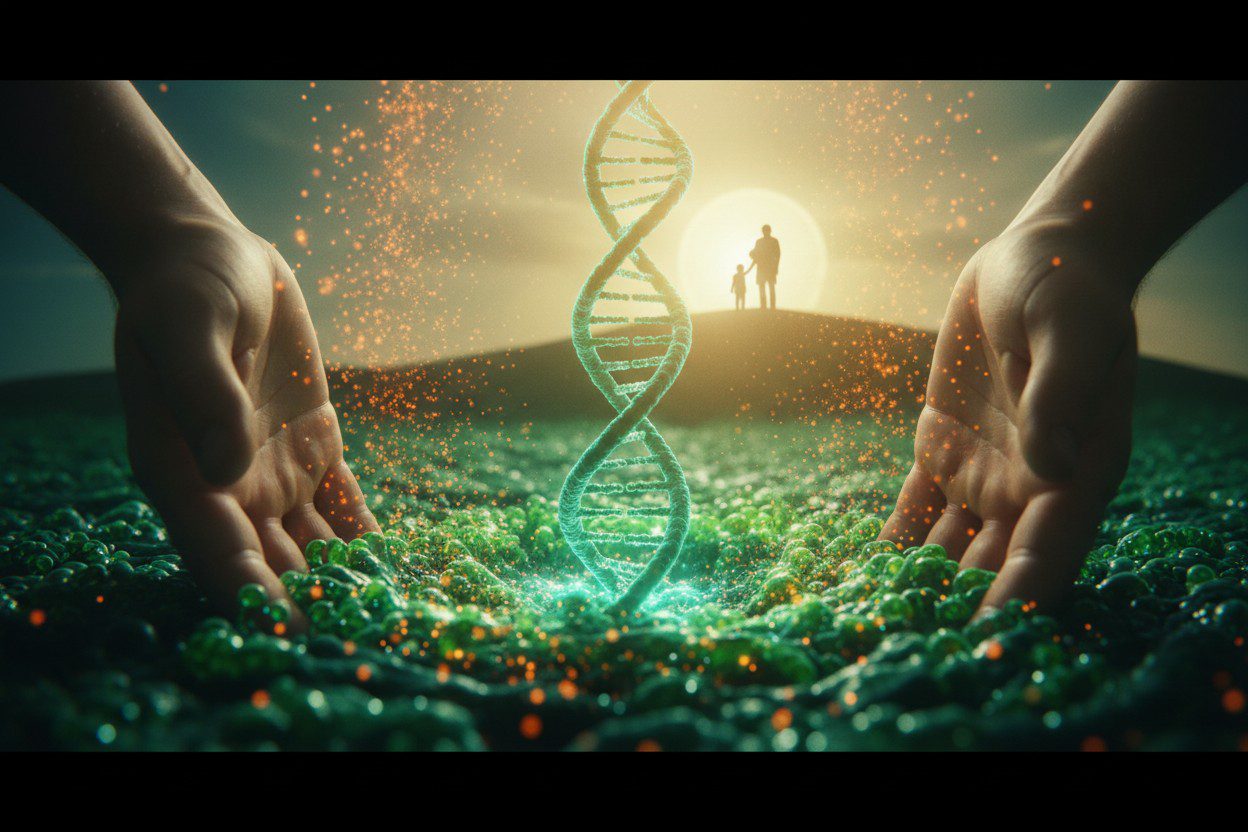
What if the greatest battle of the future isn’t over land, money or politics—but over the human genome itself?
For centuries, humanity has fought over territory.
Then came the battles over resources, ideology, power and political control.
But the next great struggle could be something far more fundamental:
Who gets to decide what the human being of the future looks like?
Advances in genetics and biotechnology are moving science into territory that previous generations could barely imagine. The ability to identify genetic traits, alter biological processes and potentially modify DNA raises extraordinary possibilities—but also questions that have no easy answers.
And that is where the conversation becomes uncomfortable.
Because when humanity gains the ability to change something fundamental about itself, the question isn’t simply “Can we do it?”
The question becomes:
______________________________________________
🔴 Help keep this independent voice alive and uncensored.
Support independent journalism and help keep Chris Wick News going.
👉 Support Chris Wick on GoFundMe
“Should we?”
The line between medicine and modification
There is an obvious argument for using genetic technology to prevent devastating inherited diseases.
If science can spare a child from suffering, few people would argue against exploring that possibility.
But technology rarely stops at its original purpose.
Once a capability exists, someone eventually asks what else it can do.
What happens when genetic intervention moves beyond preventing disease?
What about increasing certain physical characteristics?
Enhancing cognitive abilities?
Selecting traits?
Creating biological advantages that only some people can afford?
That’s where the ethical landscape becomes much darker.
Who gets to make the decision?
Imagine a future where genetic technologies become powerful enough to influence characteristics that today are simply inherited.
Who decides what is acceptable?
Scientists?
Governments?
Parents?
Corporations?
The wealthy?
Or the individual?
And what happens when different countries establish completely different rules?
One nation might prohibit a particular genetic modification while another embraces it.
Could that eventually create a world where human biology itself becomes part of an international competition?
That isn’t science fiction anymore as a question.
It’s an ethical problem we may have to confront as biotechnology continues advancing.
The danger isn’t necessarily the technology
Technology itself isn’t automatically good or evil.
The danger may be who controls it, who has access to it and what incentives drive its use.
Imagine two families.
One can afford genetic interventions that potentially reduce disease risk or provide biological advantages.
The other cannot.
If those advantages accumulate over generations, inequality could eventually become something more profound than differences in wealth.
It could become biological.
And that raises an unsettling possibility:
Could economic inequality eventually become genetic inequality?
Some changes cannot simply be taken back
This may be the darkest part of the discussion.
A financial mistake can potentially be corrected.
A bad law can be repealed.
A political leader can be replaced.
But changes to human biology—particularly changes capable of being passed from one generation to another—could raise consequences that extend far beyond the people who made the original decision.
Future generations could inherit choices they never consented to.
That doesn’t mean genetic technology should be rejected.
It means the conversation deserves far more seriousness than slogans and political tribalism.
Because this isn’t ultimately about left or right.
It isn’t about one political party.
It isn’t even simply about science.
It’s about what kind of humanity we want to become.
The question we can’t avoid forever
Humanity has spent thousands of years trying to control its environment.
Now, for the first time, we are gaining increasingly powerful tools to potentially control aspects of ourselves.
That changes everything.
The question is no longer simply whether science can unlock the human genome.
The question is whether humanity is wise enough to handle the power that comes with unlocking it.
Who gets to decide what changes are acceptable?
Who protects future generations from decisions made today?
And perhaps the most uncomfortable question of all:
If we eventually gain the power to redesign humanity, should we ever use it?
The answers may define far more than the next election or the next decade.
They could help determine what “human” even means in the centuries ahead.
About the Author