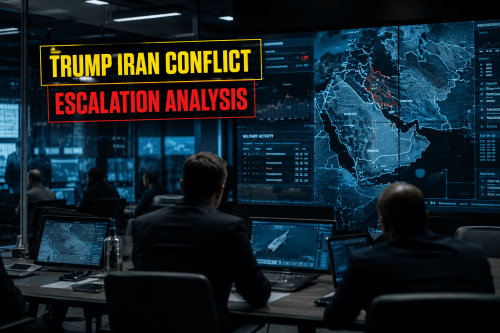
A quiet but persistent question is now circulating through diplomatic and defense circles: is the U.S. still in control of the Iran conflict’s trajectory, or is it slowly being pulled into something harder to define or contain?
Three months into the current phase of tensions, early expectations of a fast, controlled outcome are beginning to look less certain. Reuters report on Trump Iran war timeline
What is emerging instead is a more complicated picture—one where military pressure, regional responses, and political messaging are no longer moving in sync.
What Actually Happened
Over the past several months, the conflict involving the United States and Iran has continued to escalate in uneven cycles rather than a single decisive surge.
According to Reuters reporting, early strategic assumptions inside Washington suggested a shorter, more contained phase of confrontation. Instead, the situation has extended beyond initial expectations, with shifting responses from both sides and no clearly defined end-state in sight.
What stands out in the current phase is not a single turning point, but a gradual accumulation of unresolved actions—retaliatory signals, diplomatic pauses, and renewed threats that reset momentum rather than resolve it.
Why This Moment Matters
The significance of the three-month mark is not symbolic—it reflects operational strain.
Conflicts that remain open-ended beyond early planning windows tend to shift from controlled strategy to adaptive reaction. That shift often changes how decisions are made at the highest levels, especially when political messaging and battlefield reality begin to diverge.
In Washington, that divergence is becoming harder to ignore. Public messaging still emphasizes strength and containment, but behind that framing, the pace of developments suggests a more reactive posture.
The Pattern Behind the Event
______________________________________________
🔴 Help keep this independent voice alive and uncensored -> Buy us a Coffee <-
A familiar pattern is beginning to emerge—one seen in other extended military engagements.
Initial confidence in rapid leverage gives way to incremental escalation, followed by strategic recalibration that is rarely made public in real time.
What makes this phase distinct is how quickly the feedback loop is tightening. Each move appears to trigger a counter-response that requires reassessment rather than advancement.
Instead of momentum building toward resolution, it increasingly cycles through containment, response, and recalibration.
Where the Tensions Are Building
The most visible pressure points are not limited to one theater.
Regional actors are adjusting their positions cautiously, watching for shifts in U.S. intent and Iranian response thresholds. At the same time, global energy markets and shipping routes remain sensitive to even minor disruptions, adding another layer of pressure outside the military sphere.
Diplomatic channels, while still active, appear to be functioning more as risk-management tools than pathways toward immediate resolution.
What This Could Signal Next
If current conditions persist, the conflict risks settling into a longer stabilization phase rather than moving toward closure.
That does not necessarily indicate escalation into a broader war—but it does suggest a more prolonged strategic stalemate, where each side tests limits without fully crossing them.
For decision-makers, that creates a narrowing space between escalation control and strategic fatigue.
The next phase may not be defined by a single major event, but by whether either side chooses to reframe the conflict entirely—or continue managing it in its current, unresolved form.
What remains uncertain is whether this moment represents a temporary plateau or the beginning of a longer structural shift in how the conflict is being fought and understood.
About the Author