Something massive is being planned in the American West—and almost nobody is talking about it in plain terms.
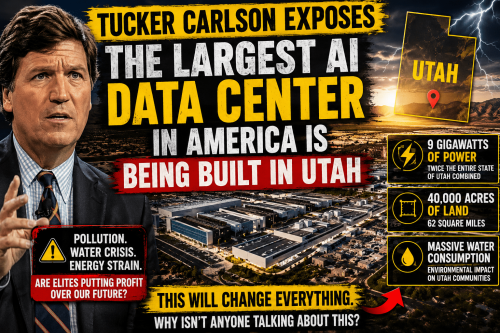
According to recent claims highlighted by Tucker Carlson, a colossal artificial intelligence data complex could soon take shape in Utah—a project so large it challenges the limits of infrastructure, energy, and environmental sustainability.
The scale alone raises eyebrows.
We’re not talking about a typical tech facility. This proposed AI hub would stretch across an estimated 40,000 acres—roughly 62 square miles—making it one of the largest concentrated technology builds ever attempted on U.S. soil.
But the real shock isn’t just the size. It’s the power.
Reports suggest the facility could demand up to 9 gigawatts of electricity—an amount that rivals or even exceeds the total energy consumption of the entire state. To put that into perspective, that level of demand isn’t just significant—it’s transformative. Entire energy grids would need to be reworked or expanded to sustain it.
And that’s where the concerns begin to deepen.
Large-scale AI infrastructure doesn’t just consume electricity—it also requires immense cooling systems, often dependent on water resources. In a region already known for its dry climate, the idea of a water-intensive facility operating at that magnitude raises serious questions about long-term sustainability.
Energy strain. Water demand. Environmental pressure.
______________________________________________
🔴 Help keep this independent voice alive and uncensored.
Support independent journalism and help keep Chris Wick News going.
👉 Support Chris Wick on GoFundMe
Individually, each issue is manageable. Combined at this scale, they become something else entirely.
Supporters of massive AI expansion argue that projects like this are necessary. Artificial intelligence is rapidly becoming the backbone of modern economies—from defense systems to financial modeling to everyday digital tools. Whoever controls the infrastructure, they argue, controls the future.
But critics see a different picture forming.
They question whether such developments are being pushed too quickly, without transparent public discussion or clear long-term planning. There are also growing concerns about how centralized AI power could become—both technologically and politically.
Because this isn’t just about servers and land.
It’s about control, resources, and the direction of an increasingly automated world.
And if even part of these claims prove accurate, the Utah project may not just be another tech build—it could represent a turning point in how far governments and private entities are willing to go to secure dominance in the AI race.
The real question is this:
How much infrastructure is too much… and who decides?