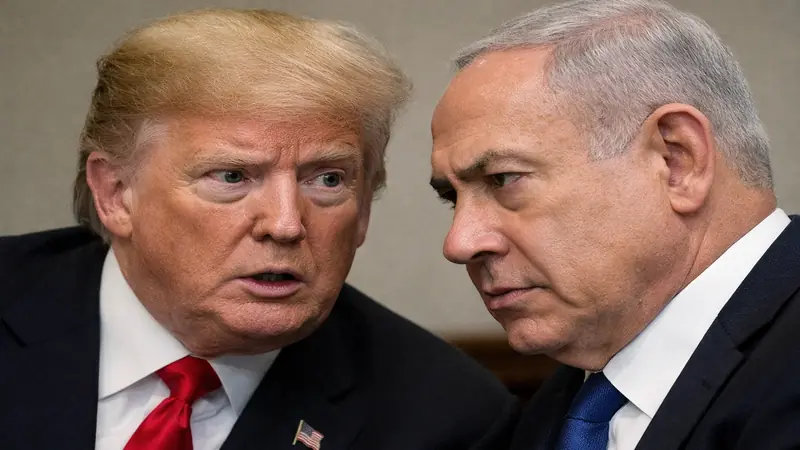
At first glance, it looked like a routine political reaction — a familiar exchange between long-aligned figures. But something about this moment didn’t sit quite right. There was a pause, a subtle hesitation, as if expectations and reality briefly slipped out of sync.
The phrase Trump stunned Netanyahu Lebanon stance is now circulating for a reason. Not because of open conflict, but because of what felt unexpectedly unscripted.
This moment didn’t emerge in isolation. According to a Reuters report, the former president made it clear that Israel should avoid further escalation in Lebanon, framing the situation in a way that suggested a shift in expectations rather than continuity.
https://www.reuters.com/world/middle-east/trump-says-israel-banned-bombing-lebanon-2026-04-17/
That alone raises a quiet but important question: why would such a position appear to catch Netanyahu off guard?
The unexpected gap in a long-standing alliance
For years, the assumption has been near-total alignment between Trump and Netanyahu, particularly on matters of regional security and Middle East policy.
But alignment, in practice, is rarely static.
What stood out here wasn’t disagreement — it was surprise. And in diplomatic terms, surprise often signals something deeper: a breakdown in communication, or a shift that hasn’t been fully shared across channels.
Lebanon is not a peripheral issue. It sits within a dense web of geopolitical tension involving Hezbollah, Iran, and ongoing border friction. Any recalibration here carries broader implications.
This becomes clearer when looking at how quickly positions appear to evolve. An analysis from Axios noted that Israeli officials were reportedly caught off guard by Trump’s framing, pointing to a possible gap between perceived alignment and real-time decision-making.
https://www.axios.com/2026/04/17/lebanon-strikes-israel-trump-prohibited
______________________________________________
🔴 Help keep this independent voice alive and uncensored -> Buy us a Coffee <-
That gap — even if temporary — is where the real story begins to take shape.
Institutional pressure vs. political alignment
A closer look suggests this may not be about personal disagreement at all.
Netanyahu’s position is likely shaped by institutional pressures — military assessments, intelligence briefings, coalition dynamics, and internal governance constraints. These forces don’t always move in sync with political relationships, even long-standing ones.
In that sense, what appears to be misalignment may actually be a reflection of system-level decision-making.
Trump’s reaction, then, becomes more revealing than it first appears. It suggests that his expectations were based on a previous understanding — one that may no longer fully apply under current conditions.
This connects to a broader shift in how global alliances function. They are increasingly adaptive, influenced by economic pressure, regional instability, and evolving security calculations.
Public perception, however, tends to lag behind these changes.
Media framing and the illusion of consistency
Most coverage has framed this moment as a personal reaction — Trump being surprised by Netanyahu.
But that framing may miss the deeper structural signal.
Media narratives often emphasize continuity: stable alliances, predictable partnerships, consistent policy directions. The reality underneath is far more fluid.
When leaders appear out of sync, even briefly, it exposes that fluidity.
This tension extends beyond leadership dynamics. A broader international perspective from Le Monde highlights how internal political opposition in Israel reacted strongly to the situation, suggesting that domestic pressure may also be shaping outward policy positions.
https://www.lemonde.fr/en/international/article/2026/04/18/in-israel-opposition-criticizes-ceasefire-with-lebanon-imposed-by-donald-trump-on-benjamin-netanyahu_6752557_4.html
What followed raised further questions: if this level of surprise exists between closely aligned figures, how many other shifts are unfolding quietly, without public visibility?
A signal, not an anomaly
It’s easy to dismiss moments like this as minor or temporary.
But patterns tend to reveal themselves through small inconsistencies.
Global politics is moving through a period of recalibration. Alliances are being tested not through open conflict, but through subtle divergence — quiet adjustments driven by systemic pressures rather than public declarations.
Leaders adapt. Institutions respond. Messaging catches up later.
And occasionally, that gap becomes visible — just for a moment.
The deeper question
This may not ultimately be about Trump or Netanyahu.
It may be about the systems they operate within — systems that are becoming more fluid, more reactive, and less predictable.
If even close alliances can drift without clear signaling, what does that suggest about the stability of broader geopolitical relationships?
And more importantly, how many of these quiet recalibrations are already underway — just out of view, waiting for another unscripted moment to reveal them?
About the Author

1 thought on “Trump stunned Netanyahu Lebanon stance — what it reveals behind the scenes”