Canadian steelmakers are turning toward domestic demand as U.S. tariffs continue to reshape the industry.
Washington tried to protect American steel with a 50% tariff wall. Instead, Canadian steelmakers are discovering something they arguably should have prioritized years ago: their own domestic market. But beneath the optimistic headlines lies a harder question. Can Canada rebuild its industrial independence before more workers pay the price?
The Trade War That Forced Canada to Look Inward
For decades, Canada’s steel industry operated on a familiar economic assumption: the United States was its most important customer, and access to the American market was essential to its survival.
Then Washington changed the rules.
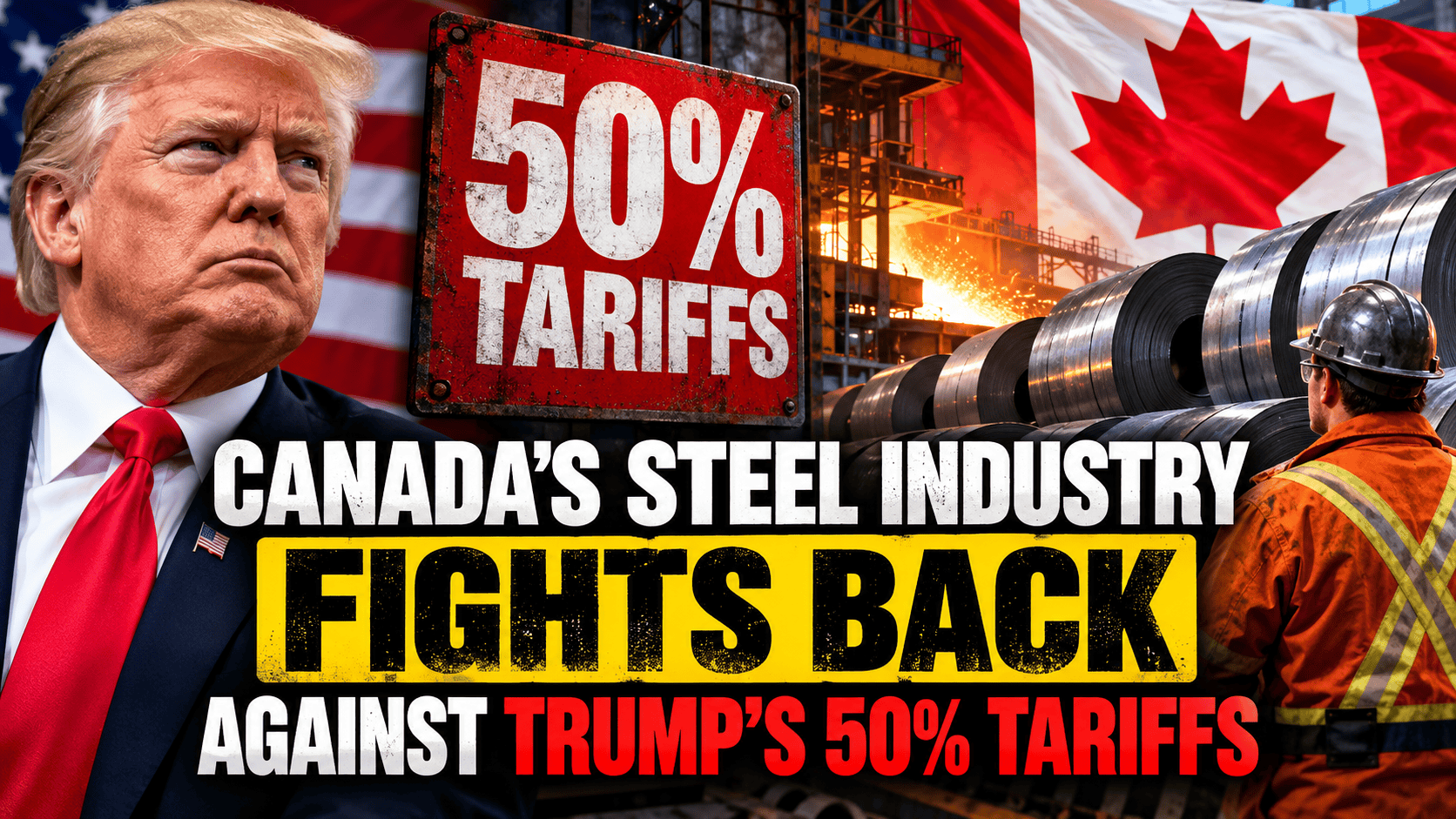
In June 2025, U.S. President Donald Trump increased tariffs on imported steel from 25% to 50%, delivering another severe blow to Canadian producers already struggling with global competition and uncertain demand.
The consequences were immediate and painful.
According to figures reported by Reuters on October 16, 2026, Canadian steel shipments to the United States fell approximately 60% in 2025. Hundreds of Canadian workers lost their jobs, and major producers were forced to reconsider business strategies built around American customers.
Yet something unexpected has been happening.
Canadian companies are increasingly turning toward Canadian customers, supported by infrastructure construction, energy development, industrial investment and government purchasing policies.
The question is whether this represents the beginning of a genuine industrial recovery or simply a temporary adjustment to an increasingly hostile trading relationship.
Canadian Steel Is Winning Back Its Own Market
______________________________________________
🔴 Help keep this independent voice alive and uncensored.
Support independent journalism and help keep Chris Wick News going.
👉 Support Chris Wick on GoFundMe
One of the most revealing developments is how much Canadian-produced steel is now being consumed domestically.
According to figures compiled by the United Steelworkers union, the domestic share of steel used in Canada increased significantly.
Canadian-made share of domestic steel consumption
2024
41%
2025
51%
10 percentage-point increase
Source: United Steelworkers calculations reported by Reuters, October 16, 2026.
That is a meaningful shift.
For the first time in this comparison, Canadian-produced steel accounted for a majority of domestic consumption.
It also raises an uncomfortable question: Why did Canada need an American trade war to rediscover the importance of buying its own steel?
For years, Canadian manufacturers faced competition from foreign producers while governments emphasized international trade and open markets.
Now, faced with restricted access to the United States, domestic purchasing has become a matter of economic resilience.
That does not mean Canada can replace its lost American sales overnight. It does suggest that a stronger domestic market could help reduce the industry’s vulnerability to future trade disputes.
The West Is Building, and Steelmakers Are Paying Attention
Western Canada is emerging as an important source of new demand.
Energy developments, mining operations, infrastructure construction and data centres require significant amounts of steel.
Among the projects identified in Reuters’ reporting is a 1.2-gigawatt data centre development in Saskatchewan.
Prime Minister Mark Carney has also suggested that a proposed new oil pipeline to Canada’s Pacific coast could generate additional steel demand.
These developments point toward a broader economic reality.
Steel is not simply another manufactured commodity. It is a foundational material for transportation, energy infrastructure, industrial facilities, construction and national defence.
A country that cannot reliably supply its own essential materials risks becoming dependent on decisions made elsewhere.
And dependence becomes particularly dangerous when political relationships deteriorate.
However, new projects do not automatically guarantee contracts for Canadian steelmakers. Price, production capacity, product specifications and procurement rules will determine how much of that demand remains inside Canada.
Ottawa Is Spending Money to Keep the Industry Alive
The federal government has not been sitting on the sidelines.
In May 2026, Ottawa announced approximately C$1 billion in financing support for the steel, aluminum and copper industries.
The government has also pursued import restrictions and measures encouraging the purchase of Canadian-produced materials.
These policies are intended to help domestic manufacturers withstand American tariffs while limiting the pressure from lower-cost foreign steel.
But government intervention comes with difficult questions.
How long should taxpayers support industries struggling against international competitors?
Will domestic purchasing policies create lasting industrial strength, or will companies become dependent on continuing government protection?
And will Ottawa ensure that public financial assistance produces measurable benefits for Canadian workers?
There is a legitimate argument for protecting strategically important domestic production.
There is also a legitimate concern about spending public money without clear accountability.
Both deserve scrutiny.
Ontario Steelworkers Are Still Paying the Price
Despite signs of improvement, the recovery is far from universal.
Ontario has experienced some of the industry’s most painful consequences.
Algoma Steel, one of Canada’s largest steel producers, announced plans in December 2025 to eliminate approximately 1,000 positions.
The company has since emphasized a strategy focused more heavily on Canadian demand for steel plate used in infrastructure, construction and defence.
Meanwhile, Cleveland-Cliffs, which acquired Stelco in 2024, has faced scrutiny over planned job reductions at its Hamilton operations.
The Carney government has even threatened legal action over the company’s employment decisions.
Cleveland-Cliffs is scheduled to report quarterly financial results on October 19, potentially providing further insight into its Canadian operations.
For affected workers and their families, however, the economic debate is considerably more personal.
A stronger domestic steel market means little to someone who has already lost a job unless that recovery eventually produces new employment opportunities.
And that remains one of the biggest unanswered questions.
Trump’s Tariffs May Have Exposed a Canadian Weakness
The broader story is not simply about whether Donald Trump’s tariffs succeeded or failed.
From Washington’s perspective, the policy is intended to protect American manufacturing and strengthen domestic industrial production.
But for Canada, the tariffs have exposed the risks of relying too heavily on a single export destination.
Before the trade conflict intensified, approximately 90% of Canadian steel exports went to the United States.
That degree of concentration leaves an industry vulnerable when its largest customer changes the terms of trade.
Canada is now attempting to diversify, but diversification requires more than political speeches.
It requires competitive factories, reliable energy, investment, transportation infrastructure, skilled workers and customers willing to purchase Canadian products.
It also requires confronting the reality that steel manufactured in other countries can sometimes be substantially cheaper.
Protectionist policies may buy Canadian producers time. They cannot, by themselves, guarantee long-term competitiveness.
The Bank of Canada’s April 2026 Monetary Policy Report also documented significant pressure on steel exports, production and employment, while acknowledging that government measures were supporting domestic producers.
In other words, the industry is adjusting, but the damage has not disappeared.
The Hidden Risk: A Recovery Built on Government Protection
There is another issue receiving less attention.
Canada’s steel producers are competing in a global market already burdened by excess production capacity.
According to Canadian trade authorities, global steel overcapacity reached approximately 640 million metric tonnes in 2025.
That creates enormous pressure on prices and makes it difficult for smaller producers to compete without some form of trade protection.
Canadian steelmakers may benefit from import quotas and government purchasing programs today, but what happens if those measures are weakened or removed?
What happens if major infrastructure projects are delayed?
What happens if construction slows or public spending becomes unsustainable?
These are not arguments against supporting Canadian steel.
They are reasons to demand an industrial strategy capable of surviving beyond the current trade dispute.
A genuine recovery must eventually stand on competitive production, sustainable demand and private investment, not government assistance alone.
Canada Has an Opportunity, but It Is Not a Victory Yet
There is something revealing about this entire situation.
For years, Canada’s economic relationship with the United States was treated as a permanent advantage.
Geography, trade agreements and integrated supply chains made the arrangement seem almost unbreakable.
Then a political decision in Washington demonstrated just how quickly that advantage could become a liability.
Canada’s steel industry is now being pushed toward a different model: sell more at home, diversify customers and reduce exposure to American trade policy.
That may ultimately prove beneficial.
But celebrating too early would ignore the workers already displaced, the financial pressures facing producers and the continuing uncertainty surrounding future trade relations.
The latest developments show that Canadian steelmakers are finding ways to adapt. They do not establish that the industry’s broader problems have been solved.
The Bigger Question: Who Controls Canada’s Industrial Future?
Steel is about more than factory output or quarterly earnings.
It is about whether Canada possesses the industrial capacity to build the infrastructure, energy systems and defence equipment its economy requires.
The United States has made clear that it is willing to use tariffs to advance its own industrial priorities.
Canada now faces a choice.
It can continue treating domestic manufacturing as something that must compete for attention with imported alternatives, or it can develop a serious long-term strategy for maintaining essential industrial capabilities.
That strategy should be transparent, economically defensible and accountable to the Canadians financing it.
The real test is not whether Canadian steelmakers can survive Trump’s tariffs. It is whether Canada can turn a trade crisis into lasting industrial strength.
And if it takes a 50% tariff from Washington to make Canadian leaders recognize the value of Canadian steel, perhaps the most important question is why that recognition took so long.
Chris Wick News — Independent News. Uncomfortable Questions. No Political Team Gets a Free Pass.
Sources
1. Reuters — Canadian steelmakers offset some US tariff pain with domestic demand (October 16, 2026) https://www.reuters.com/business/canadian-steelmakers-offset-some-us-tariff-pain-with-domestic-demand-2026-10-16/
2. Bank of Canada — Monetary Policy Report, April 2026 https://static.bankofcanada.ca/uploads/pdf/mpr-2026-04-29.pdf
3. Canada Border Services Agency — Statement of Reasons, Heavy Plate Expiry Review, 2026 https://www.cbsa.gc.ca/sima-lmsi/er-rre/hp2026/hp2026-de-eng.html
4. RBC Economics — Tracking the Impact of U.S. Tariffs on Five Targeted Canadian Industries https://www.rbc.com/en/economics/canadian-analysis/featured-analysis/insights/tracking-the-impact-of-u-s-tariffs-on-five-targeted-canadian-industries/
About the Author