AI promises economic transformation, but the IMF warns that inadequate safeguards could create serious global risks.
Artificial intelligence promises a revolution in productivity and wealth. But the head of the International Monetary Fund is warning that the world may be racing toward a technological future without understanding who will pay the price if things go wrong.
The AI Revolution Has a Problem Nobody Can Afford to Ignore
The artificial intelligence gold rush is accelerating, governments are celebrating its potential, and technology companies are pouring enormous sums into the infrastructure needed to power it.
But behind the excitement, an uncomfortable question is beginning to emerge.
What happens if the world’s most expensive technological gamble fails to deliver what everyone has been promised?
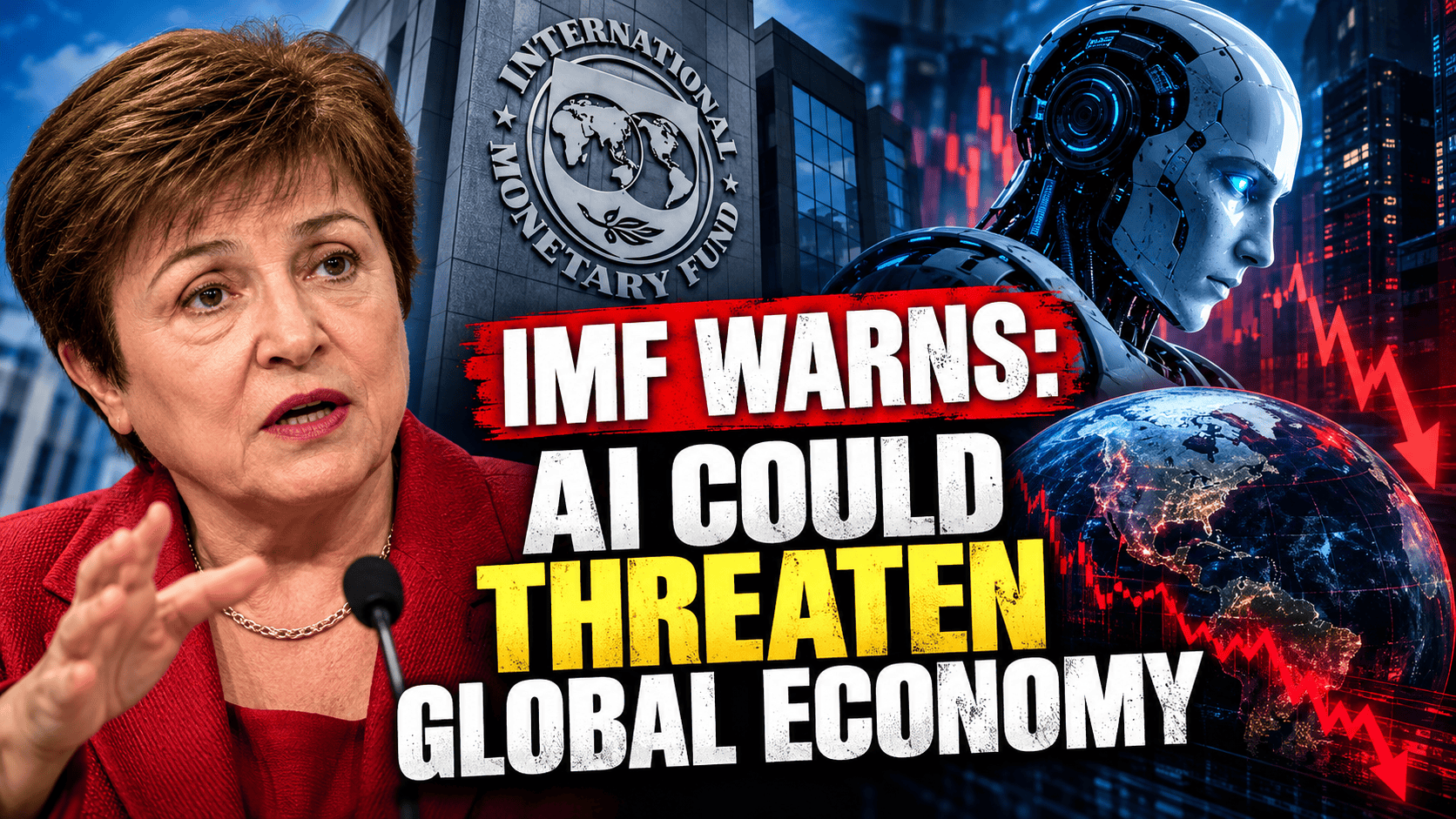
That question moved into the international spotlight on Friday, October 16, when International Monetary Fund Managing Director Kristalina Georgieva warned that artificial intelligence could create more risks than opportunities unless governments and technology companies establish meaningful safeguards.
Speaking during the IMF and World Bank annual meetings in Bangkok, Thailand, Georgieva acknowledged that AI is already contributing to economic activity. However, she cautioned that its rapid development could introduce serious financial and social consequences if expectations outpace reality.
Her message was not that artificial intelligence should be stopped.
It was that the world may be moving too quickly without establishing the protections needed to prevent a technological revolution from becoming an economic disaster.
Billions Invested, But Who Is Measuring the Risk?
The AI boom has become one of the defining investment stories of the decade.
______________________________________________
🔴 Help keep this independent voice alive and uncensored.
Support independent journalism and help keep Chris Wick News going.
👉 Support Chris Wick on GoFundMe
Technology companies are expanding data centres, purchasing advanced computing equipment, securing electricity supplies and betting heavily on a future in which artificial intelligence transforms nearly every major industry.
The financial expectations are enormous.
But the returns remain uncertain.
During the discussions surrounding the IMF meetings, economists raised concerns about the possibility that AI’s promised productivity improvements might arrive more slowly than investors anticipate.
Harvard economist Dani Rodrik identified a particularly troubling dilemma.
If artificial intelligence succeeds in dramatically increasing productivity, it could also displace substantial numbers of workers.
If those productivity gains fail to materialize, the massive investments supporting the AI boom could face a painful financial correction.
In other words, success could create an employment crisis, while disappointment could trigger an investment crisis.
Neither outcome is inevitable. Both represent risks that governments, businesses and financial institutions must confront rather than dismiss.
The People Building AI Are Asking for Rules
One of the more revealing developments at the Bangkok meetings was that calls for stronger oversight did not come exclusively from politicians or international financial institutions.
They also came from within the artificial intelligence industry itself.
Jack Clark, co-founder of AI developer Anthropic, joined the discussion and supported the development of practical standards, independent evaluations and greater transparency.
Clark explained that his company conducts safety testing and makes information about those evaluations available. He also expressed support for making appropriate oversight practices more widespread rather than leaving them entirely voluntary.
That raises a fundamental issue.
Should the companies developing some of the world’s most powerful technologies also be the primary authorities deciding whether those technologies are safe?
Industry expertise is essential. Governments cannot realistically regulate systems they do not understand.
But relying exclusively on corporate promises creates obvious conflicts of interest.
Companies are responsible to investors, customers and their own commercial survival. Public safety, economic stability and individual rights do not always align neatly with those priorities.
The challenge is establishing oversight that is technically competent, independent and accountable without giving governments unlimited power over technological development.
The Bigger Danger May Be Economic Dependence
There is another dimension to this debate that deserves considerably more public attention.
As artificial intelligence becomes integrated into banking, healthcare, transportation, employment and government services, societies may become increasingly dependent on systems that relatively few people fully understand.
That dependence could create new vulnerabilities.
An error in a consumer chatbot is inconvenient.
An error in an automated financial system, critical infrastructure network or public-sector decision-making process could have consequences extending far beyond the individual using it.
The risks include cybersecurity failures, unreliable automated decisions, concentrated corporate influence and the potential erosion of meaningful human oversight.
These are not arguments against technological progress.
They are arguments against confusing technological sophistication with institutional accountability.
A system does not become trustworthy simply because it is powerful, profitable or described as revolutionary.
And when a technology becomes deeply embedded in everyday life, the public deserves more than assurances from the organizations selling it.
Washington Sees Opportunity While the IMF Sees Danger
Not everyone attending the international meetings shared the IMF’s emphasis on risk.
U.S. Treasury Undersecretary Erin Browne argued that international financial institutions should devote greater attention to the possibility of positive economic surprises created by artificial intelligence.
That position reflects an important counterargument.
AI could help businesses become more efficient, accelerate scientific discovery, improve medical research and make sophisticated tools available to smaller organizations that previously could not afford them.
Excessive regulation could also slow innovation, protect established companies from competition and make it more difficult for new developers to enter the market.
The disagreement is therefore not simply between people who support AI and people who oppose it.
It is about how much uncertainty society should tolerate, who should manage that uncertainty and who ultimately bears the consequences when predictions prove wrong.
Canada Cannot Afford to Ignore the Warning
For Canada, the debate extends well beyond Silicon Valley and international financial conferences.
Canadian workers, businesses and public institutions are increasingly exposed to the economic changes associated with artificial intelligence.
Administrative work, customer service, software development, financial analysis and other information-intensive occupations could undergo substantial changes as AI capabilities improve.
Some jobs may become more productive. Others may be redesigned, reduced or eliminated.
The speed and scale of those changes remain uncertain.
Canada also faces difficult questions about electricity infrastructure, digital sovereignty, privacy protections and its dependence on foreign technology providers.
If AI becomes essential to economic competitiveness, countries without sufficient infrastructure or domestic capabilities could find themselves increasingly dependent on a small number of international companies.
That creates a policy dilemma.
Canada needs investment and innovation.
But it also needs transparency, competition, cybersecurity protections and practical strategies for workers whose livelihoods may be disrupted.
Simply announcing more AI investment will not answer those questions.
The Ethical Question Nobody Should Be Allowed to Avoid
Perhaps the most important part of Georgieva’s warning concerns ethics.
Artificial intelligence is often discussed as though its development were an unstoppable natural phenomenon.
It is not.
People build these systems. Corporations finance them. Governments establish the legal environment in which they operate.
The decisions being made today will influence how AI is used, who controls it and how its economic benefits are distributed.
That makes accountability essential.
Who is responsible when an AI system causes financial harm?
Who determines whether automated decisions are discriminatory or unfair?
Who has access to the information needed to independently evaluate these systems?
And who protects ordinary citizens when the interests of governments and technology corporations overlap?
Those questions cannot be answered by marketing campaigns, political slogans or promises of future prosperity.
They require enforceable responsibilities, meaningful transparency and independent scrutiny.
At the same time, safeguards must be designed carefully enough to prevent regulation from becoming an excuse for censorship, excessive surveillance or the concentration of power.
Protecting the public from artificial intelligence should not become a justification for controlling the public through artificial intelligence.
Chris Wick News Analysis: The Real Race Is About Control
The most revealing aspect of this debate may be how quickly artificial intelligence has moved from an emerging technology into a central concern for the world’s most powerful financial institutions.
The IMF is not warning about a distant science-fiction scenario.
It is discussing economic exposure, employment disruption, infrastructure demands and the possibility of financial instability.
Those are immediate policy concerns.
There is also an uncomfortable contradiction at the centre of the AI revolution.
The companies developing these systems are asking society to embrace extraordinary technological change, while some industry leaders simultaneously acknowledge the need for stronger safeguards.
That does not mean the technology is inherently dangerous or that its developers are acting irresponsibly.
It means the consequences of failure could extend far beyond the companies creating it.
And that is precisely why public accountability matters.
The world should welcome genuine innovation. But innovation should never be treated as a blank cheque.
Governments must demonstrate that their regulatory proposals protect citizens rather than simply expanding bureaucratic authority.
Technology companies must demonstrate that their safety commitments extend beyond public relations.
And international financial institutions must examine both the benefits and the potential costs without exaggerating either.
Artificial intelligence could become one of the most productive tools humanity has ever developed.
It could also deepen inequality, disrupt employment and expose the global economy to risks that remain poorly understood.
The outcome is not predetermined.
The real question is whether humanity will remain in control of the technology it creates—or surrender critical decisions to systems and institutions that operate beyond meaningful public scrutiny.
The IMF’s warning should be treated as the beginning of that conversation, not the end.
Chris Wick News | Independent News. Uncomfortable Questions. No Political Team Gets a Free Pass.
Sources
Reuters — IMF chief says AI risks may exceed opportunities without safeguards and ethical framework (October 16, 2026)
Associated Press — IMF-World Bank meetings focus on global risks and potential benefits of AI (October 16, 2026)
https://apnews.com/article/faba248f0609534a0d8284dec1b46a81
About the Author