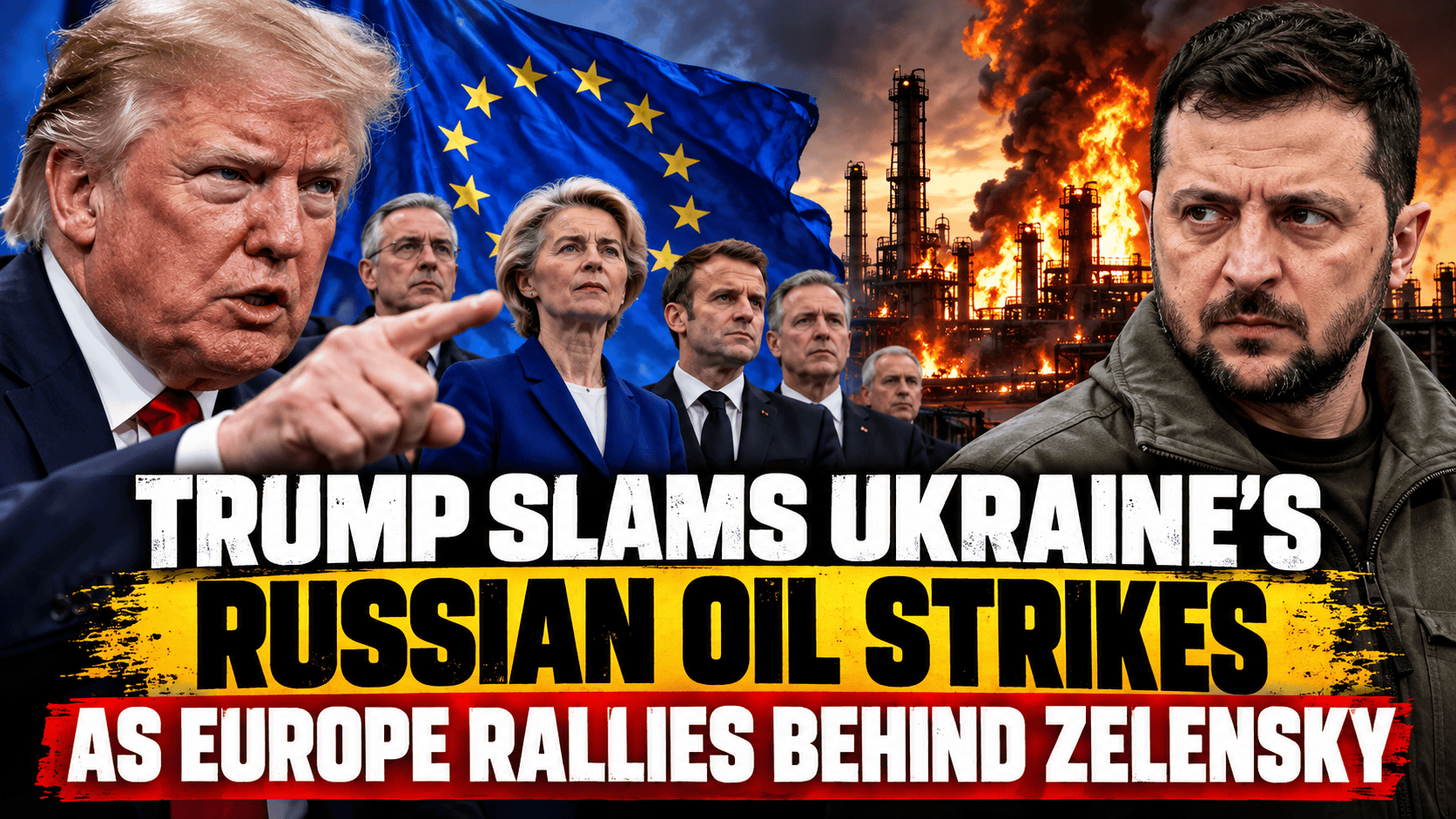
Illustrative editorial artwork depicting growing tensions between Washington, Kyiv and European leaders over Ukraine's military strategy and Russian energy infrastructur
Washington wants lower energy prices. Kyiv wants to weaken Russia’s war machine. Europe wants Ukraine to survive. But as winter approaches, the widening divide between these objectives is exposing a dangerous fracture in the Western alliance.
A War Within the Alliance: Who Really Controls Ukraine’s Future?
The war in Ukraine is no longer simply a confrontation between Moscow and Kyiv. It is increasingly becoming a test of how far Washington and Europe are willing to go to support Ukraine when their own economic and political interests collide.
On October 16, European Union leaders gathered in Brussels to reaffirm their support for Ukrainian President Volodymyr Zelensky, just as U.S. President Donald Trump intensified his criticism of Ukrainian attacks on Russian oil refineries.
Trump described the renewed strikes as a “disgrace,” arguing that attacks on Russian energy infrastructure were contributing to higher global oil prices.
For Ukraine, however, the calculation is different.
Russian oil revenues help sustain Moscow’s economy and its military operations. Targeting refineries offers Kyiv a way to impose economic costs on Russia while defending itself against a much larger military power.
And that raises an uncomfortable question: Is Washington more concerned about stopping Russia’s war, or stopping the economic consequences of Ukraine fighting back?
The answer may determine the next phase of this conflict.
Trump’s Oil Price Problem Meets Ukraine’s Survival Problem
Trump’s criticism comes at a politically sensitive moment.
______________________________________________
🔴 Help keep this independent voice alive and uncensored.
Support independent journalism and help keep Chris Wick News going.
👉 Support Chris Wick on GoFundMe
With the November U.S. midterm elections approaching, higher fuel prices have become another economic pressure point for the White House.
The administration has linked Ukraine’s strikes against Russian refining facilities to elevated energy costs, even as the broader energy market faces disruptions associated with the war involving Iran.
But attributing global fuel prices primarily to Ukrainian strikes oversimplifies a market shaped by international conflicts, production decisions, transportation disruptions and consumer demand.
Ukraine sees Russian energy infrastructure as a strategic vulnerability.
Russia sees those same facilities as critical economic assets.
And Washington sees the potential consequences at the fuel pump.
These are three very different priorities, and they are becoming increasingly difficult to reconcile.
The dispute intensified after Trump announced an understanding under which Ukraine and Russia would avoid attacks on each other’s energy facilities. Zelensky subsequently said Ukraine would no longer observe that arrangement, arguing that Russian attacks had continued.
The existence and terms of a mutually accepted ceasefire remain disputed.
A ceasefire that restrains one side while attacks from the other continue is unlikely to survive.
That is not an argument against diplomacy. It is an argument for agreements that are verifiable, reciprocal and enforceable.
Europe Is Standing Behind Zelensky — But For How Long?
European leaders have attempted to project unity in Brussels, emphasizing continued financial and military assistance to Ukraine.
Yet public declarations of solidarity are only part of the equation.
Ukraine needs air-defense systems, military equipment, functioning electrical infrastructure and billions of dollars in continuing assistance.
Its financial situation remains particularly difficult.
According to figures reported by Reuters, Ukraine faces an estimated $32.6 billion unfunded budget gap for 2027, excluding approximately $40 billion in direct military supplies expected from international partners.
Those are enormous commitments for governments already confronting their own fiscal pressures.
European taxpayers are also facing higher energy costs and competing domestic priorities.
The political question is therefore unavoidable.
How long can European governments promise unlimited determination when the financial resources available to deliver on those promises are limited?
That does not mean European support is about to collapse. It means the sustainability of that support deserves the same scrutiny as the speeches delivered in Brussels.
A government can declare solidarity in a matter of seconds. Financing a prolonged war requires years of difficult decisions.
Russia’s Energy War Is Coming Home to Ukrainian Civilians
While political leaders debate sanctions, refineries and military financing, Ukrainian civilians are facing another dangerous winter.
Russian drone and missile attacks have continued to strike Ukrainian cities and infrastructure.
In the Volyn region near Poland, authorities reported that Russian attacks left approximately 370,000 people without electricity.
Strikes on Kharkiv reportedly killed three people, while emergency power restrictions were introduced in Kyiv.
These reports underline why Ukraine considers energy infrastructure a central battlefield.
Electricity is not merely an economic commodity during wartime.
It powers hospitals, water systems, communications networks, heating equipment and essential public services.
When electricity disappears during freezing temperatures, the consequences can extend far beyond temporary inconvenience.
Ukraine’s strikes on Russian refineries and Russia’s attacks on Ukrainian infrastructure are not necessarily equivalent in their targets or legal implications. Distinctions between military objectives and civilian infrastructure matter under international humanitarian law.
But both campaigns demonstrate how energy has become one of the central instruments of modern warfare.
The battlefield now extends from military positions to electrical grids, oil refineries, industrial facilities and household heating systems.
Putin Is Watching the Western Alliance Fracture
Russian President Vladimir Putin has downplayed the damage caused by Ukrainian attacks on Russian refineries.
But the diplomatic consequences may be more significant than the immediate physical destruction.
Moscow has an obvious strategic interest in weakening the political cohesion of countries supporting Ukraine.
Every public disagreement between Washington and Brussels creates uncertainty about the future of Western military assistance.
Every dispute between Trump and Zelensky raises questions about Kyiv’s negotiating position.
And every European disagreement over financing, sanctions or energy policy presents Russia with another potential opportunity.
That does not prove Moscow is directing these disagreements. Western governments have their own legitimate political and economic interests.
Nevertheless, Russia can benefit from divisions among its adversaries without having to create those divisions itself.
Moscow has also moved to place Russian assets belonging to several European companies under temporary state management, according to Reuters.
The economic confrontation is therefore expanding beyond sanctions and energy supplies into the treatment of foreign-owned businesses.
This is no longer just a military war. It is an economic and diplomatic struggle over which governments can withstand the greatest pressure.
The Question Nobody in Brussels Can Afford to Ignore
European leaders insist Ukraine must be defended.
Trump insists the war needs to end and energy prices must come down.
Zelensky insists Ukraine cannot accept arrangements that leave Russia free to continue attacking.
Each position reflects a different political reality.
But none resolves the fundamental contradiction.
Ukraine cannot indefinitely sustain a modern industrial war without outside support. Europe cannot assume American assistance will remain unchanged. And Washington cannot assume Kyiv will accept every diplomatic compromise simply because the White House wants a quick agreement.
There is also the question of Russia itself.
The Kremlin rejected a Ukrainian proposal for a 60-day ceasefire intended to facilitate elections, saying it preferred a comprehensive peace agreement.
That rejection illustrates how difficult even temporary arrangements have become.
A durable settlement requires more than declarations from Washington, Brussels or Moscow. It requires enforceable terms, credible security arrangements and an agreement the parties are prepared to implement.
Chris Wick News Analysis: Is Peace Becoming Secondary to Politics?
Here is the larger problem.
When politicians discuss war, they frequently speak in terms of victory, leverage, deterrence, national interests and strategic advantage.
Those are legitimate considerations.
But the people living beneath the drones and missiles are not political abstractions.
They are the ones who lose their homes, their electricity, their livelihoods and sometimes their lives.
Trump is entitled to question the economic consequences of attacks on Russian energy infrastructure.
Zelensky is entitled to argue that Ukraine must defend itself against Russian aggression.
European leaders are entitled to view Ukraine’s security as inseparable from their own.
But every government involved should face the same basic questions: What is the achievable objective? What will it cost? Who pays? And what does a realistic end to this war actually look like?
Political leaders should be expected to explain those answers rather than substitute slogans for strategy.
If Ukrainian attacks on Russian refineries are unacceptable because they increase energy prices, how should Ukraine respond to continued Russian attacks on its own energy infrastructure?
If Europe intends to replace uncertain American assistance, where will the necessary financing come from?
And if negotiations are the answer, what mechanism will prevent another ceasefire from collapsing?
These questions are not expressions of loyalty to Russia, Ukraine, Trump or the European Union.
They are questions of accountability.
The Bottom Line
The Brussels summit exposes a growing reality: the United States, Europe and Ukraine may share an interest in ending the war, but they increasingly disagree over how that outcome should be achieved and what sacrifices are acceptable along the way.
Trump is looking at global energy prices and American political pressures.
Zelensky is looking at Ukraine’s survival.
Europe is looking at the security of an entire continent.
Putin is looking for opportunities to strengthen Russia’s position.
And civilians are left living with the consequences.
The danger is not merely that Western unity could weaken.
It is that competing political priorities could produce a strategy that is neither capable of securing a sustainable peace nor sufficient to prevent the conflict from continuing.
Peace cannot simply be announced at a podium. It has to survive the realities of the battlefield.
And right now, those realities are becoming more dangerous.
Chris Wick News — Independent news. Uncomfortable questions. No political team gets a free pass.
Sources
Reuters — EU Leaders Rally Around Zelenskiy as Trump Calls Ukrainian Strikes on Russia a ‘Disgrace’ https://www.reuters.com/world/europe/eu-leaders-rally-around-zelenskiy-trump-calls-ukrainian-strikes-russia-disgrace-2026-10-16/
Associated Press — Russia Strikes Nine Ukrainian Regions as Strain Grows Between Zelenskyy and Trump https://apnews.com/article/025bdb5cebc0be727a6197ce37f2c365
Euronews — EU Summit: Leaders Rally Behind Zelenskyy Amid Row With Trump https://www.euronews.com/2026/10/16/eu-summit-leaders-to-rally-behind-zelenskyy-amid-bitter-row-with-trump
Financial Times — EU Vows to Maintain Russia Sanctions After US Pivot https://www.ft.com/content/ee6dfd48-fa31-4bde-9962-2f9f09c36798
About the Author