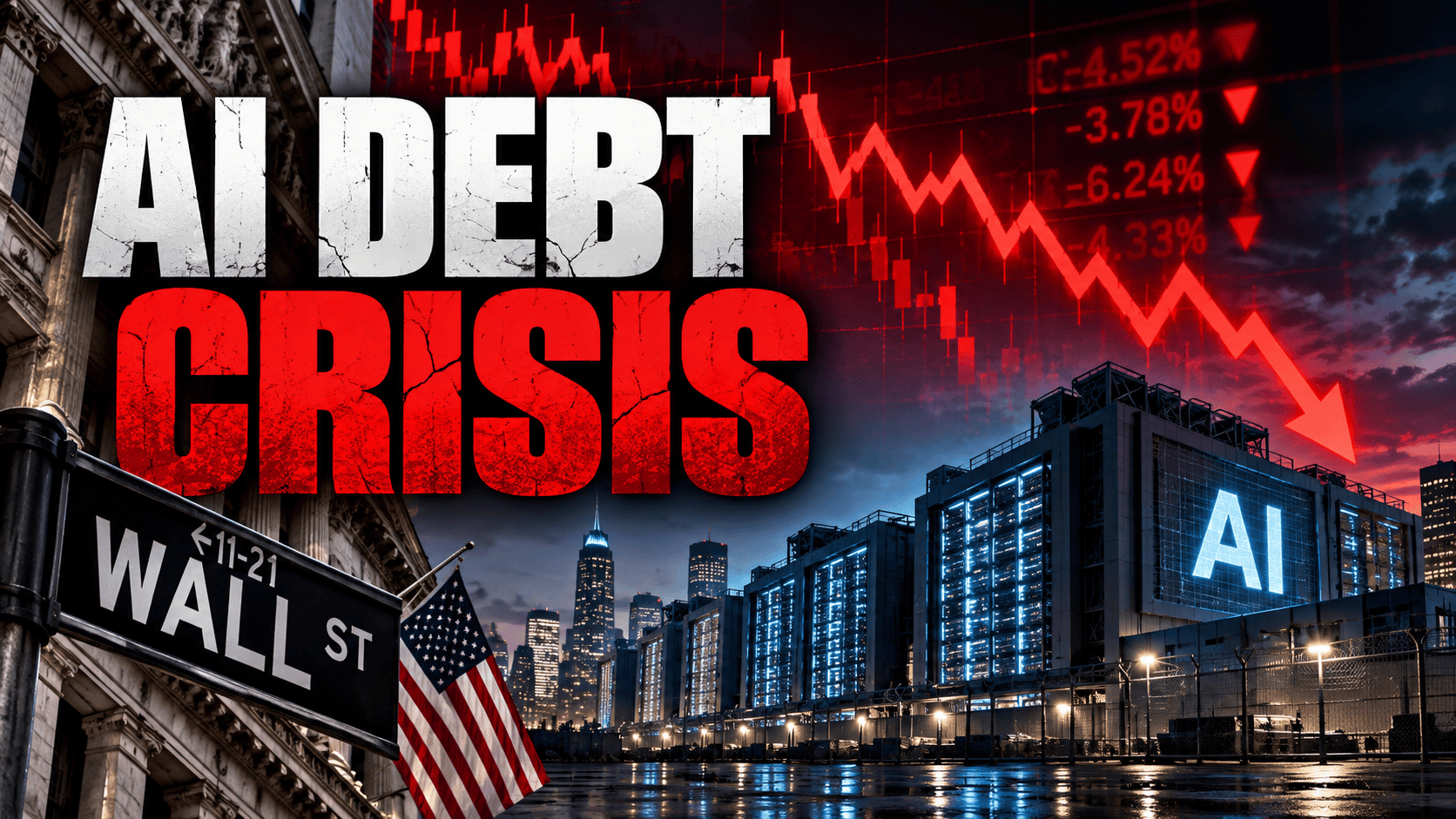
Rising borrowing costs and debt concerns are putting pressure on the artificial intelligence investment boom.
Artificial intelligence was supposed to be the next great economic revolution. But as billions pour into data centres and technology infrastructure, a troubling question is emerging: What happens when the debt comes due before the profits arrive?
The AI Boom Is Facing a Financial Reality Check
For years, investors have been sold an extraordinary vision of the future: artificial intelligence transforming industries, revolutionizing productivity, and generating enormous profits for companies willing to invest early.
There is just one problem.
Building that future is costing an astonishing amount of money, and Wall Street is beginning to question whether the financial returns will arrive quickly enough.
On October 15, Reuters reported that the cost of protecting against defaults on American technology-company debt had reached record levels, exposing growing concerns about the financial stability of the artificial intelligence investment boom.
The warning signs are appearing in an area of financial markets that ordinary investors rarely follow: credit default swaps.
These instruments may sound complicated, but their message is relatively straightforward. Investors are increasingly willing to pay more to protect themselves against the possibility that certain companies will fail to meet their debt obligations.
And some of the numbers are becoming difficult to ignore.
CoreWeave: The AI Industry’s Financial Warning Signal
One of the most concerning developments involves CoreWeave, a data-centre and cloud infrastructure company deeply involved in the artificial intelligence expansion.
______________________________________________
🔴 Help keep this independent voice alive and uncensored.
Support independent journalism and help keep Chris Wick News going.
👉 Support Chris Wick on GoFundMe
According to Reuters, citing LSEG data, CoreWeave carries nearly $50 billion in debt.
Meanwhile, its five-year credit default swap spread has surged beyond 1,000 basis points.
That level corresponds to a market-implied default probability approaching 63% over five years under the assumptions used in the calculation.
It is important to understand what that means.
It does not establish that CoreWeave will default. Credit default swap pricing reflects market conditions, recovery assumptions, liquidity, and investor demand for protection.
Nevertheless, it represents a dramatic increase in perceived financial risk.
CoreWeave’s bonds maturing in 2032 were trading at approximately 78 cents on the dollar, with yields exceeding 16%, according to Reuters.
Investors demanding those kinds of returns are signaling considerable concern about the risks involved.
The question is no longer simply how quickly artificial intelligence can grow. It is whether companies financing that growth can survive the financial pressures along the way.
Oracle, SoftBank and Other Technology Giants Face Rising Costs
CoreWeave is not alone.
Credit default swap spreads have also widened for several prominent technology companies and investors.
Reuters reported the following five-year spreads on October 15:
| Company | CDS spread |
|---|---|
| CoreWeave | Over 1,000 basis points |
| SoftBank | 424 basis points |
| Oracle | 288 basis points |
Other companies, including Amazon, Alphabet, Meta, and Nvidia, have experienced record-high credit protection costs, although their spreads remain considerably narrower than those of the most heavily pressured companies.
These figures should not be interpreted as evidence that all these businesses face equivalent financial dangers.
A highly leveraged data-centre operator and a diversified technology corporation with substantial operating cash flow have very different financial profiles.
But the broader trend matters.
Credit markets are increasingly questioning how much financial risk is being accumulated in the race to dominate artificial intelligence.
Higher Interest Rates Could Expose the Weaknesses
The timing could hardly be more uncomfortable for companies dependent on borrowed money.
Hotter-than-expected American inflation figures have increased concerns that interest rates could remain elevated or rise further.
Higher borrowing costs create an obvious problem for businesses spending heavily today in anticipation of revenue years into the future.
Consider the financial pressures involved.
A company borrows billions to construct data centres, purchase specialized chips, secure electricity, and develop supporting infrastructure.
The investments begin accumulating financing costs almost immediately.
But the revenue required to justify those expenditures may take considerably longer to materialize.
If interest rates increase, refinancing becomes more expensive. If anticipated customer demand disappoints, the financial burden becomes even harder to manage.
That combination can quickly transform an ambitious expansion strategy into a serious balance-sheet problem.
The wider technology selloff on October 15 demonstrated how sensitive investors have become to these risks. Asian technology shares suffered particularly sharp declines as concerns over artificial intelligence spending collided with inflation and interest-rate uncertainty.
Is Artificial Intelligence Becoming Another Speculative Bubble?
The comparisons with previous speculative booms are becoming increasingly difficult to dismiss.
During the dot-com era, investors poured enormous sums into internet companies based on expectations of future growth.
The internet ultimately transformed the world.
But that did not prevent many early investors from suffering devastating losses.
A technology can change civilization while still becoming the centre of an unsustainable investment bubble.
That distinction deserves far more attention in today’s artificial intelligence debate.
There is little serious dispute that artificial intelligence has substantial commercial potential.
The uncertainty concerns valuations, financing structures, competition, and how much revenue companies can realistically generate from their investments.
In July, credit-rating agency Fitch warned that a significant correction in the artificial intelligence market was becoming a major global credit risk.
The International Monetary Fund also identified an AI-driven market selloff among potential threats to financial stability in October.
These warnings do not establish that a collapse is inevitable.
They do, however, challenge the assumption that the AI investment boom can continue expanding indefinitely without a financial reckoning.
The Hidden Danger: Debt Doesn’t Disappear When Optimism Fades
Stock-market enthusiasm can change almost overnight.
Debt obligations are considerably less forgiving.
A company whose share price falls dramatically may continue operating successfully if its underlying business remains healthy and its financing is manageable.
But a business that depends on repeated borrowing to finance expansion can face a more immediate crisis when lenders demand higher returns or refuse additional financing.
That is why developments in the credit markets deserve attention.
They can reveal financial pressures that are not always obvious from stock prices or optimistic corporate announcements.
The danger is not necessarily that artificial intelligence itself fails.
The danger is that some companies may have borrowed too aggressively, invested too quickly, or assumed that future revenue would arrive sooner than realistic market conditions allow.
If enough heavily indebted businesses encounter those problems simultaneously, the consequences could extend beyond individual technology stocks.
Lenders, institutional investors, infrastructure suppliers, and other companies connected to the AI expansion could experience secondary effects.
How widely those pressures spread would depend on the size and structure of their exposures.
Not Every AI Company Is in Trouble
There is another side to this story that should not be overlooked.
Artificial intelligence continues to attract genuine commercial demand, and some businesses are reporting substantial revenue growth.
Reuters reported that AI developer Anthropic’s third-quarter revenue rose 45% from the previous quarter, according to an investor who attended a company presentation.
Meanwhile, semiconductor manufacturer TSMC reported strong quarterly profits amid continued demand for advanced chips.
Those developments illustrate why it would be premature to declare the entire artificial intelligence industry financially unsustainable.
The more important distinction is between businesses capable of generating durable cash flow and those relying heavily on future expectations to justify today’s enormous financing commitments.
That distinction could determine which companies emerge stronger from a market correction and which struggle to survive it.
Who Ultimately Pays if the AI Gamble Goes Wrong?
There is a broader public-interest question that deserves scrutiny.
If the artificial intelligence investment boom experiences a serious financial correction, who absorbs the losses?
In ordinary circumstances, shareholders and creditors bear the consequences of unsuccessful corporate investments.
But when financial exposures become large and interconnected, economic damage can spread through retirement portfolios, investment funds, lending institutions, and employment markets.
That does not mean taxpayers will necessarily be required to rescue troubled technology companies.
Nor does current credit-market stress prove that a systemic financial crisis is approaching.
However, the scale of AI-related borrowing makes transparency increasingly important.
Investors deserve clear information about debt obligations, repayment schedules, customer concentration, and the assumptions supporting enormous infrastructure investments.
Regulators should also understand whether financial institutions have accumulated concentrated exposures that could become dangerous during a prolonged downturn.
The public should not have to discover the extent of those risks only after markets begin to unravel.
The Chris Wick News Perspective: Follow the Money, Not the Hype
Artificial intelligence may well become one of the most transformative technologies in modern history.
But technological promise is not a substitute for financial discipline.
The latest credit-market developments expose a fundamental contradiction at the heart of the AI boom.
Companies are committing extraordinary amounts of capital to build the infrastructure of tomorrow while investors are increasingly concerned about their ability to meet the financial obligations of today.
That does not automatically make artificial intelligence a bubble.
It does make the financial assumptions supporting the boom worthy of much tougher examination.
The most important question may not be whether artificial intelligence will change the world.
It may be how many companies, investors, and creditors can afford to wait for that transformation to become profitable.
And if the credit markets are sending a warning, perhaps it is time to stop treating every billion-dollar AI investment as an automatic sign of progress.
Because history has demonstrated something repeatedly:
A revolutionary idea can be genuine.
The financial speculation surrounding it can still go terribly wrong.
Sources
Reuters — AI credit jitters drive US tech default insurance to record highs (October 15, 2026) https://www.reuters.com/business/media-telecom/global-markets-cds-ai-urgent-2026-10-15/
Reuters — Tech sell-off gathers pace as chipmakers hammered (October 15, 2026) https://www.reuters.com/world/china/global-markets-wrapup-1-2026-10-15/
Reuters — Fitch warns AI market correction emerging as major global credit risk (July 28, 2026) https://www.reuters.com/world/china/fitch-warns-ai-market-correction-emerging-major-global-credit-risk-2026-07-28/
Reuters — Explainer: What are credit default swaps and why are they spooking AI investors? (July 29, 2026) https://www.reuters.com/business/finance/global-markets-cds-explainer-2026-07-29/
Associated Press — A tech sell-off drags stocks lower as markets in South Korea and Japan sink (October 15, 2026) https://apnews.com/article/e889ad7dee2b7dd959f1b8bc87366914
About the Author