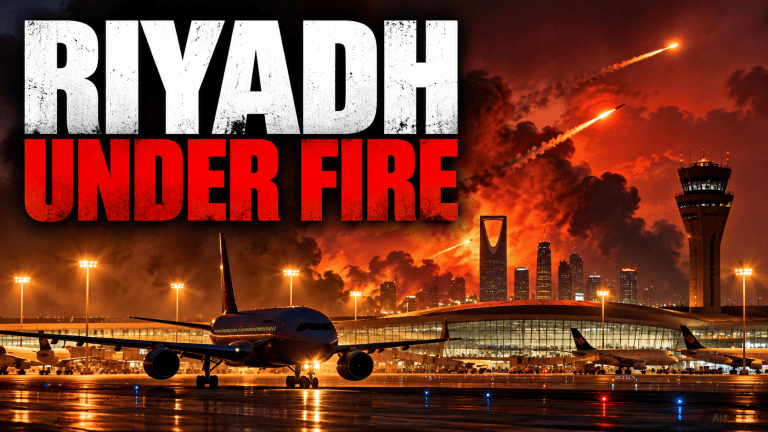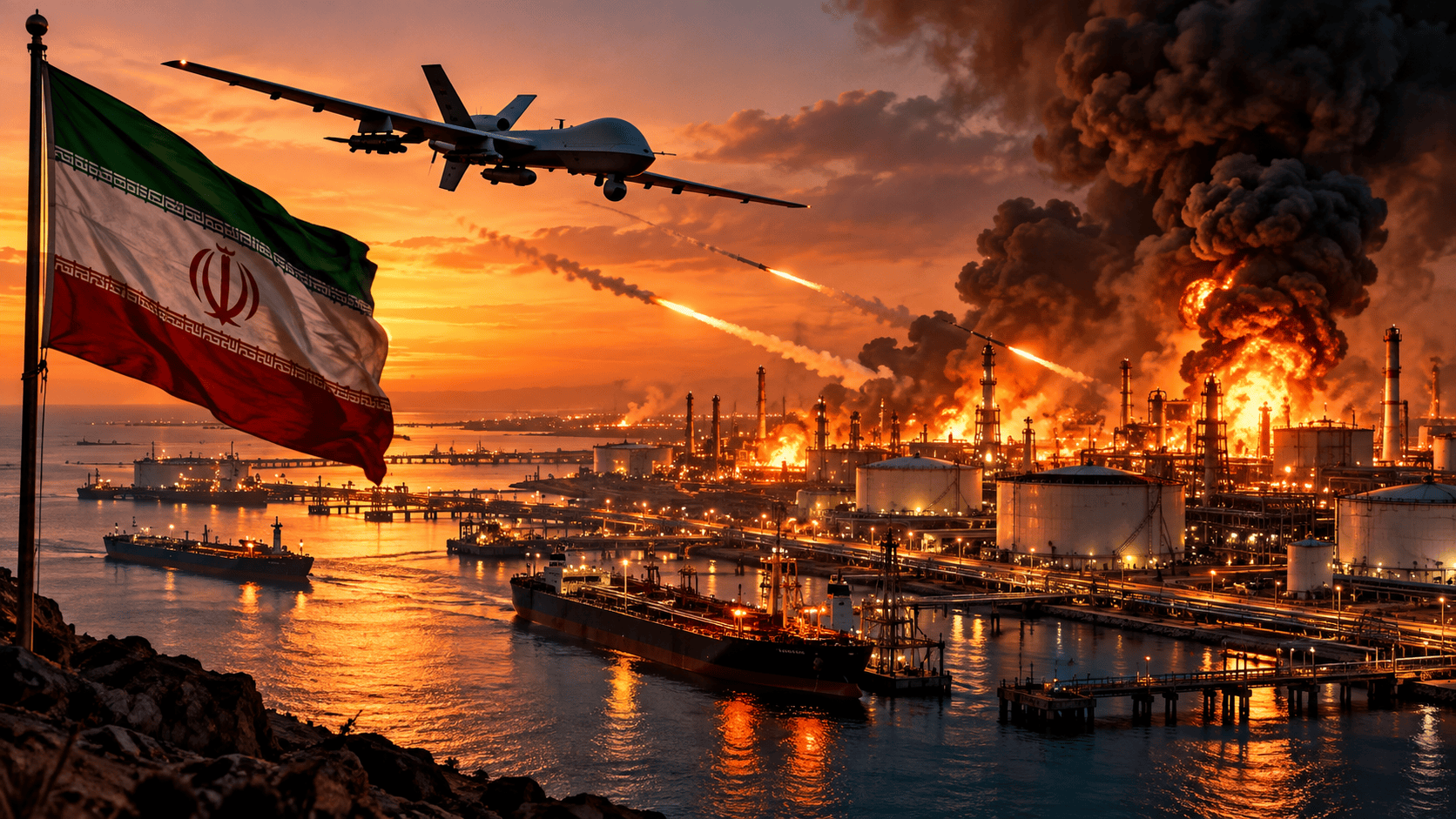
The United States commands overwhelming military firepower. But Iran’s campaign against critical infrastructure is exposing an uncomfortable reality: winning battles means little when an adversary can systematically disrupt the systems keeping an entire region alive.
The War Nobody Can Afford to Lose — and Nobody Can Easily Win
There is something deeply unsettling about a war in which the most powerful military on Earth can dominate the skies while its adversary threatens the economic foundations of an entire region.
That is the increasingly dangerous reality emerging from the conflict involving Iran, the United States, Israel, and America’s Gulf allies.
An October 15 Reuters investigation has documented a campaign of Iranian missile and drone strikes against vital infrastructure throughout the Persian Gulf. The findings suggest that Tehran has adopted a strategy that does not require matching American military strength.
Instead, Iran is attacking the systems upon which American allies, international energy markets, and regional stability depend.
According to Reuters, Iran and allied armed groups have conducted at least 135 attacks against 84 infrastructure sites since the American and Israeli bombing campaign began on February 28, 2026.
Those numbers deserve attention.
But the more disturbing question is what they reveal about the vulnerabilities of modern warfare.
What happens when military superiority cannot guarantee economic security?
______________________________________________
🔴 Help keep this independent voice alive and uncensored.
Support independent journalism and help keep Chris Wick News going.
👉 Support Chris Wick on GoFundMe
And perhaps more importantly, how much damage can an adversary inflict before the cost of continuing a war becomes politically unbearable?
Iran Is Not Trying to Outgun America. It Is Trying to Outlast It.
The conventional expectation is that a country possessing superior aircraft, naval forces, surveillance systems, and precision weapons should eventually overwhelm a weaker opponent.
That calculation becomes considerably more complicated when the weaker opponent refuses to fight on those terms.
Iran’s infrastructure campaign appears designed to exploit that complication.
Rather than relying exclusively on direct confrontations with American forces, Tehran has struck facilities whose disruption can generate consequences far beyond the immediate physical damage.
Oil terminals. Natural gas facilities. Airports. Pipelines. Transportation networks.
These are not merely industrial installations.
They are the economic arteries of the Persian Gulf.
When one is damaged, the consequences can spread through transportation, manufacturing, energy supply, insurance markets, and international trade.
And repairing a damaged facility is not always as simple as replacing a broken pipe or rebuilding a wall.
Specialized industrial components can require lengthy manufacturing, transportation, and installation processes. Even a relatively limited strike can therefore create disruptions lasting weeks or longer.
That is precisely what makes this strategy so consequential.
A missile does not have to destroy an entire industrial complex to impose enormous economic costs.
It only has to disable something that cannot easily be replaced.
The Gulf’s Most Important Facilities Have Become Targets
Reuters identified significant damage involving several strategically important installations.
At Fujairah in the United Arab Emirates, attacks disrupted oil-handling infrastructure at a port whose location outside the Strait of Hormuz makes it particularly important when shipping through the strait becomes dangerous.
In Qatar, strikes damaged specialized cooling equipment at the Ras Laffan liquefied natural gas complex.
Saudi Arabia also experienced attacks against pumping infrastructure associated with a critical oil pipeline, while airports across multiple Gulf countries came under attack.
Consider the strategic implications.
Alternative oil routes exist partly to reduce dependence on the Strait of Hormuz.
But what happens when those alternatives become targets themselves?
The assumption that energy supplies can simply be redirected around a dangerous maritime chokepoint becomes much less reassuring when the pipelines, pumping stations, and export terminals supporting those routes are also vulnerable.
This is not evidence that Iran controls every possible route or can indefinitely prevent Gulf energy exports.
It is evidence that the region’s emergency alternatives are not immune to attack.
That distinction matters.
The ability to threaten an alternative route may be enough to influence shipping decisions, investment, insurance costs, and political calculations.
The Strait of Hormuz Is No Longer the Only Vulnerability
For decades, strategic discussions about the Persian Gulf have focused heavily on the Strait of Hormuz.
And for good reason.
It is one of the world’s most important energy shipping corridors.
But concentrating exclusively on the strait risks overlooking a broader vulnerability.
Energy security depends on an interconnected network of production facilities, storage terminals, pumping stations, ports, pipelines, electricity supplies, and transportation infrastructure.
Disrupting any critical part of that network can interfere with the others.
Iran appears to understand this.
A country does not need permanent control of a shipping corridor to generate international economic pressure.
It can also threaten the facilities that make the corridor commercially useful.
The distinction is important because military planners can deploy warships, aircraft, and surveillance systems to protect shipping lanes, yet still face enormous challenges defending every industrial installation across several countries.
There are simply too many potential points of vulnerability.
And each additional defensive requirement consumes resources that could otherwise be deployed elsewhere.
The result is a strategic dilemma.
How does Washington guarantee the security of an economic system spread across thousands of kilometres while simultaneously conducting military operations against the country threatening it?
There is no inexpensive answer.
What Are Gulf Governments Telling Their Citizens?
One of the most troubling aspects of the Reuters investigation concerns the gap between some official descriptions of attacks and the damage uncovered by reporters.
Reuters found that public explanations frequently offered limited detail about affected equipment and the resulting disruptions.
In some incidents, authorities attributed damage to debris, while the investigation identified strikes affecting particularly important industrial components.
This raises legitimate questions about government transparency.
Are authorities withholding operational details because disclosing them could assist future attacks?
Are they attempting to prevent public alarm and economic instability?
Or are some governments also trying to limit scrutiny of the effectiveness of their defensive systems?
These explanations are not mutually exclusive.
There are legitimate security reasons to restrict information about critical infrastructure during wartime.
Publishing precise technical vulnerabilities could create additional risks.
But there is also a public-interest obligation to explain the scale and consequences of attacks, particularly when citizens, workers, investors, and businesses bear the costs.
The question is not whether governments should publish sensitive engineering information.
They should not.
The question is whether the public is receiving an accurate picture of how severely the region’s essential infrastructure has been affected.
Because reassurance without meaningful disclosure is not the same thing as accountability.
America’s Military Advantage Has a Political Price Tag
The United States possesses military capabilities that Iran cannot realistically match in a conventional confrontation.
That does not automatically mean Iran lacks leverage.
A conflict can become politically and economically unsustainable long before one side is militarily defeated.
American leaders must consider more than battlefield outcomes.
They must also consider the stability of allied governments, energy markets, global commerce, military expenditures, and public tolerance for a prolonged confrontation.
Iran’s strategy appears intended to increase those costs.
An August assessment by the Institute for the Study of War and the Critical Threats Project described Iranian efforts to increase economic pressure, undermine American willingness to continue military operations, and reinforce Tehran’s influence over the Strait of Hormuz.
That analysis is consistent with the broader pattern Reuters has now documented.
But it is important not to confuse strategic disruption with military victory.
Iran has also faced substantial attacks against its own infrastructure and economy.
The United States has expanded strikes against Iranian transportation and other facilities, generating serious concerns about civilian consequences and further escalation.
Both sides are imposing costs.
Both sides are exposing civilian populations to greater risk.
And neither side can assume that inflicting more damage will automatically produce the political outcome it wants.
That is what makes this confrontation particularly dangerous.
When Civilian Infrastructure Becomes a Battlefield
There is another issue that cannot be ignored.
Oil facilities, airports, electricity networks, and water infrastructure may support military activity, but they also sustain civilian life.
Their destruction can have consequences extending far beyond armed forces.
Workers lose income.
Businesses suspend operations.
Transportation becomes unreliable.
Electricity and water supplies can be threatened.
Families who have no influence over military decisions may find themselves paying the highest price.
International humanitarian law does not make every infrastructure facility immune from attack. A facility may qualify as a military objective under specific circumstances.
But military necessity does not eliminate obligations concerning distinction, proportionality, and precautions to protect civilians.
The legal assessment depends on the purpose and use of the target, the anticipated military advantage, and the expected civilian harm.
These standards apply regardless of which country launches the attack.
If Washington condemns Iranian strikes against civilian infrastructure, it must also be prepared to explain the legal and military justification for its own infrastructure strikes.
And if Tehran claims to be defending its sovereignty, that claim does not excuse attacks that unlawfully endanger civilians in neighbouring countries.
Accountability cannot depend on which flag appears on the aircraft or missile.
The Question Washington Cannot Avoid
The central question is no longer simply whether American forces can strike Iranian targets.
They clearly can.
The more difficult question is whether military pressure can deliver a sustainable political outcome without causing a regional economic crisis.
Iran’s infrastructure campaign has complicated that calculation.
The Gulf states are not interchangeable military bases or energy suppliers. They are sovereign countries with populations, economies, and national interests of their own.
Their willingness to absorb prolonged disruption cannot be assumed.
Nor can the ability of global markets to absorb repeated damage to critical energy infrastructure.
The more infrastructure becomes part of the battlefield, the harder it may become to contain the consequences of the conflict.
And the longer the confrontation continues, the greater the possibility that economic pressure will influence decisions as much as military objectives.
That does not establish that Iran is winning.
It establishes that traditional measurements of military strength may not capture the full strategic picture.
The Real Warning Is Bigger Than Iran
Perhaps the most significant lesson from this conflict extends well beyond the Persian Gulf.
Modern nations have built extraordinarily sophisticated infrastructure systems.
They have also created extraordinary dependencies.
Energy production relies on specialized machinery.
Transportation depends on interconnected networks.
Cities require continuous electricity, communications, and water supplies.
Global commerce depends on systems functioning reliably across national borders.
These systems create prosperity and efficiency.
But they also create vulnerabilities that a determined adversary may exploit.
Iran’s campaign illustrates how precision weapons can turn relatively small points of physical damage into much larger economic consequences.
And the lesson will not be lost on military planners elsewhere.
The uncomfortable reality is that a country can possess the world’s most advanced weapons and still struggle to protect every critical component of the economic systems upon which its allies depend.
Military power remains essential.
But it is not an unlimited insurance policy against disruption.
Final Analysis: Who Is Actually Controlling the Cost of This War?
Washington can point to its overwhelming conventional military capabilities.
Tehran can point to the continuing vulnerability of Gulf infrastructure.
Neither fact tells the complete story.
The real measure of strategic success will involve more than the number of targets destroyed or missiles intercepted.
It will involve whether the conflict produces a stable and defensible political outcome, whether essential infrastructure can be protected, and whether civilian populations can escape an escalating cycle of destruction.
Reuters’ investigation has exposed an important dimension of this war: targeted damage to infrastructure can impose costs far beyond the immediate battlefield.
That should concern policymakers on every side.
Because the most dangerous moment in a war may arrive when each side believes it can force the other to surrender by making the economic consequences unbearable.
And the people who eventually pay that price are rarely the ones making the decisions.
The question is no longer simply who has the strongest military.
It is who can endure the consequences of a war that increasingly targets the foundations of modern life.
Chris Wick News — Independent news. Uncomfortable questions. No political team gets a free pass.
Sources
Reuters — How Iran’s Precision Strikes Picked Apart Gulf Infrastructure (October 15, 2026)
https://www.reuters.com/investigates/special-report/iran-crisis-infrastructure-attacks
Institute for the Study of War / Critical Threats Project — Iran Update Evening Special Report (August 1, 2026)
https://www.criticalthreats.org/analysis/iran-update-evening-special-report-august-1-2026
About the Author