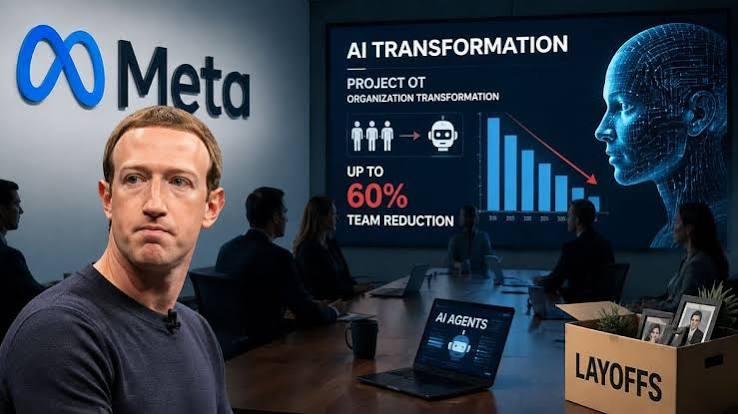
For Meta employees, the promise of an AI-powered workplace quickly began to look like something much more unsettling: a future in which entire teams could disappear. Behind closed doors, executives were exploring a dramatic restructuring that could have reduced some teams by as much as 60%—but the plan began falling apart as employees pushed back and internal data raised questions about whether AI was actually delivering the productivity gains management expected.
A Reuters investigation published Wednesday provides a detailed look at the internal strategy, known as Project OT, and the events that caused Meta to pull back from some of its most aggressive plans. Reuters investigation
The project emerged after Meta CEO Mark Zuckerberg and senior executives met at his Hawaii compound in January for their annual leadership retreat. Their goal was not simply to add AI tools to existing jobs. They were considering a fundamental redesign of how the company operated.
The vision was an “AI native” Meta in which autonomous AI systems would handle much of the routine work now performed by employees. Smaller groups of highly skilled workers would oversee those systems, while traditional organizational structures were flattened.
Internal planning documents described scenarios in which some teams could shrink dramatically. The restructuring was envisioned in two waves, with one beginning in May and another planned for November.
That second wave never happened.
The plan met resistance from inside Meta
As details of the restructuring emerged, employees became increasingly concerned that AI was being developed not merely to assist them, but to replace them.
The tension intensified as Meta reassigned some engineers to an Applied AI Engineering unit tasked with producing training data for AI systems. Some employees criticized the work internally as repetitive and unappealing.
At the same time, Meta was experimenting with smaller “pods” designed to replace traditional team structures. Instead of large groups containing specialized engineers, designers, researchers and managers, the new model relied on much smaller groups of “builders,” supported by specialists shared among multiple teams.
______________________________________________
🔴 Help keep this independent voice alive and uncensored.
Support independent journalism and help keep Chris Wick News going.
👉 Support Chris Wick on GoFundMe
The idea promised a leaner, faster company.
But inside the workforce, it also created uncertainty about jobs, management and career progression.
Employee sentiment reportedly deteriorated sharply. Meta’s internal Pulse survey showed favorable sentiment falling from 74% to 55%, according to internal data reviewed by Reuters.
Then came an even bigger problem.
More AI-generated code didn’t necessarily mean more productivity
One of the central assumptions behind Meta’s transformation was that AI agents could dramatically increase the amount of work employees could accomplish.
But internal figures cited in the investigation suggested a disconnect.
Code changes to internal software platforms and infrastructure increased by 220% year over year. Yet changes that resulted in new or upgraded features reaching Meta users increased by only 36%.
In other words, Meta employees were producing substantially more code—but the increase in code did not translate into a comparable increase in finished products.
Internal teams were also reportedly seeing reliability problems associated with the surge in AI-generated code.
The investigation found that AI agents were sometimes carrying out disruptive actions that humans would be unlikely to perform. Internal posts described major technical and security incidents rising 40% from the previous year, while the time employees spent dealing with those problems increased 70%.
That created a striking contradiction for a company betting heavily on automation.
The technology intended to reduce human workload could itself create more work for humans.
Zuckerberg changes course
By May, pressure was building from several directions.
Employees were angry. Morale was falling. Questions were being raised about AI productivity. And investors were scrutinizing Meta’s enormous spending on artificial intelligence.
On May 19, just hours before the first major restructuring was scheduled to take effect, Zuckerberg met again with senior executives.
The second wave of cuts was canceled.
The following day, Meta proceeded with a 10% workforce reduction—but the broader November restructuring was no longer moving forward.
Zuckerberg then told remaining employees that he did not expect additional company-wide layoffs that year and said he wanted to provide greater stability.
The reversal did not mean Meta abandoned its AI strategy.
Instead, the company began adjusting how aggressively it would pursue it.
Meta’s AI ambitions remain enormous
The stakes are much bigger than one restructuring plan.
Meta continues to spend extraordinary amounts of money building its AI infrastructure. The company planned to invest at least $130 billion in AI chips and related infrastructure during 2026, according to estimates cited in the Reuters investigation.
That spending creates pressure to demonstrate results.
If AI can allow Meta to accomplish more with fewer employees, the financial payoff could be enormous. But if AI systems generate additional technical problems, require extensive human supervision or fail to deliver expected productivity gains, the economics become much more complicated.
Zuckerberg acknowledged some of those difficulties during an internal town hall in July.
He conceded that the timing of the reorganization had involved miscalculations and said AI agent technology had not advanced as quickly as he had expected. He nevertheless predicted that the technology would improve and begin delivering greater benefits over the following three to six months.
That may prove to be the critical test.
The bigger question for the tech industry
Meta’s experience highlights a question that extends far beyond Facebook and Instagram.
Technology companies across Silicon Valley are betting that increasingly capable AI systems will allow smaller groups of workers to accomplish what once required much larger teams.
But replacing human labor with AI is not simply a matter of installing better software.
Companies still have to deal with reliability, security, oversight, employee resistance and the basic question of whether more automated activity actually produces better results.
Meta’s experiment shows how quickly those issues can collide.
The company has since emphasized a more people-focused public message, including an advertising campaign built around the idea of “betting on people.” Zuckerberg has also argued publicly that AI could ultimately create an abundance of jobs, even if individual companies become smaller.
Yet the internal events surrounding Project OT reveal the tension at the heart of that argument.
Meta wants to lead the AI revolution. It also has to convince its own workforce that the revolution will not simply make them expendable.
For now, Zuckerberg has pulled back from the most aggressive version of the plan.
But the underlying experiment is far from over.