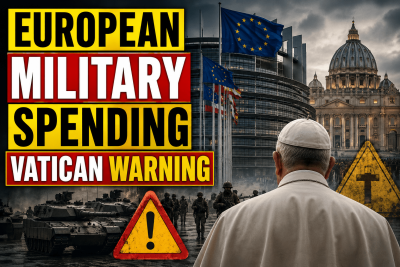
Something unusual is happening at the intersection of faith and power. As Europe quietly accelerates its military ambitions, a voice not typically associated with defense policy has stepped in—raising questions that don’t fit neatly into political talking points.
What Actually Happened
Recent remarks attributed to Pope Leo have drawn attention after he expressed concern over the European Union’s growing focus on military spending. The comments arrive at a time when several EU nations are increasing defense budgets, citing security risks tied to geopolitical instability, particularly in Eastern Europe and beyond.
While European leaders continue framing military expansion as necessary for stability, the Vatican’s tone introduces a different lens—one centered on moral cost rather than strategic gain.
This development follows a broader trend. According to a Reuters report, multiple EU states have already committed to long-term defense increases, with discussions intensifying around joint procurement and military coordination:
https://www.reuters.com/world/europe/eu-defense-spending-surge-analysis-2025-03-18/
Why This Moment Matters
The timing is difficult to ignore.
Europe is navigating overlapping pressures—energy instability, shifting alliances, and persistent tensions tied to the Ukraine conflict. In that context, defense spending has become less controversial among policymakers.
But the Vatican’s intervention subtly reframes the conversation.
It doesn’t challenge the existence of threats. Instead, it questions the trajectory—how quickly priorities shift toward militarization, and what may be deprioritized in the process.
That shift in tone matters because it introduces friction into what has otherwise been a largely unified political direction.
The Pattern Behind the Event
______________________________________________
🔴 Help keep this independent voice alive and uncensored -> Buy us a Coffee <-
This isn’t the first time religious institutions have spoken during periods of military expansion.
Historically, moments of rapid defense buildup often trigger parallel moral or humanitarian critiques—especially when public spending begins to tilt heavily toward security over social investment.
A Financial Times analysis recently highlighted how European defense budgets are now approaching levels not seen since the Cold War, signaling a structural shift rather than a temporary response:
https://www.ft.com/content/defense-spending-europe-cold-war-levels-2025
The pattern suggests something deeper than reactionary policy.
It points to a recalibration of Europe’s long-term identity—moving from economic union toward something closer to strategic autonomy with military capability.
Where the Tensions Are Building
The pressure points are forming in several areas at once:
- Eastern Europe, where security concerns remain immediate
- Western Europe, where economic trade-offs are becoming harder to ignore
- EU leadership circles, where unity is essential but not guaranteed
There’s also a quieter tension emerging between institutional voices.
Political leaders are operating within a framework of deterrence and preparedness. The Vatican, meanwhile, is operating within a framework of ethics and human consequence.
Those two perspectives don’t always clash—but they rarely move in the same direction at the same pace.
What This Could Signal Next
If defense spending continues on its current trajectory, Europe may soon face a more visible divide—not necessarily between countries, but between priorities.
Will security dominate the agenda for the next decade?
Or will competing voices—economic, social, and moral—begin to slow or reshape that momentum?
An Al Jazeera report recently noted that public opinion across parts of Europe is still divided on long-term military expansion, particularly when weighed against inflation and domestic concerns:
https://www.aljazeera.com/news/2025/02/11/europe-defense-spending-public-opinion-divided
That uncertainty suggests this conversation is far from settled.
And the fact that it’s now being echoed beyond political institutions hints that the next phase may not be defined solely by policy decisions—but by how those decisions are perceived, questioned, and ultimately accepted.
There’s a quiet tension building beneath the surface. Not loud enough to dominate headlines yet—but steady enough to shape what comes next.
About the Author