





It doesn’t look like a breaking point. Not yet.
Ships are still moving. Oil is still flowing. Markets are still pretending this is manageable.
But something about the Strait feels… different this time.
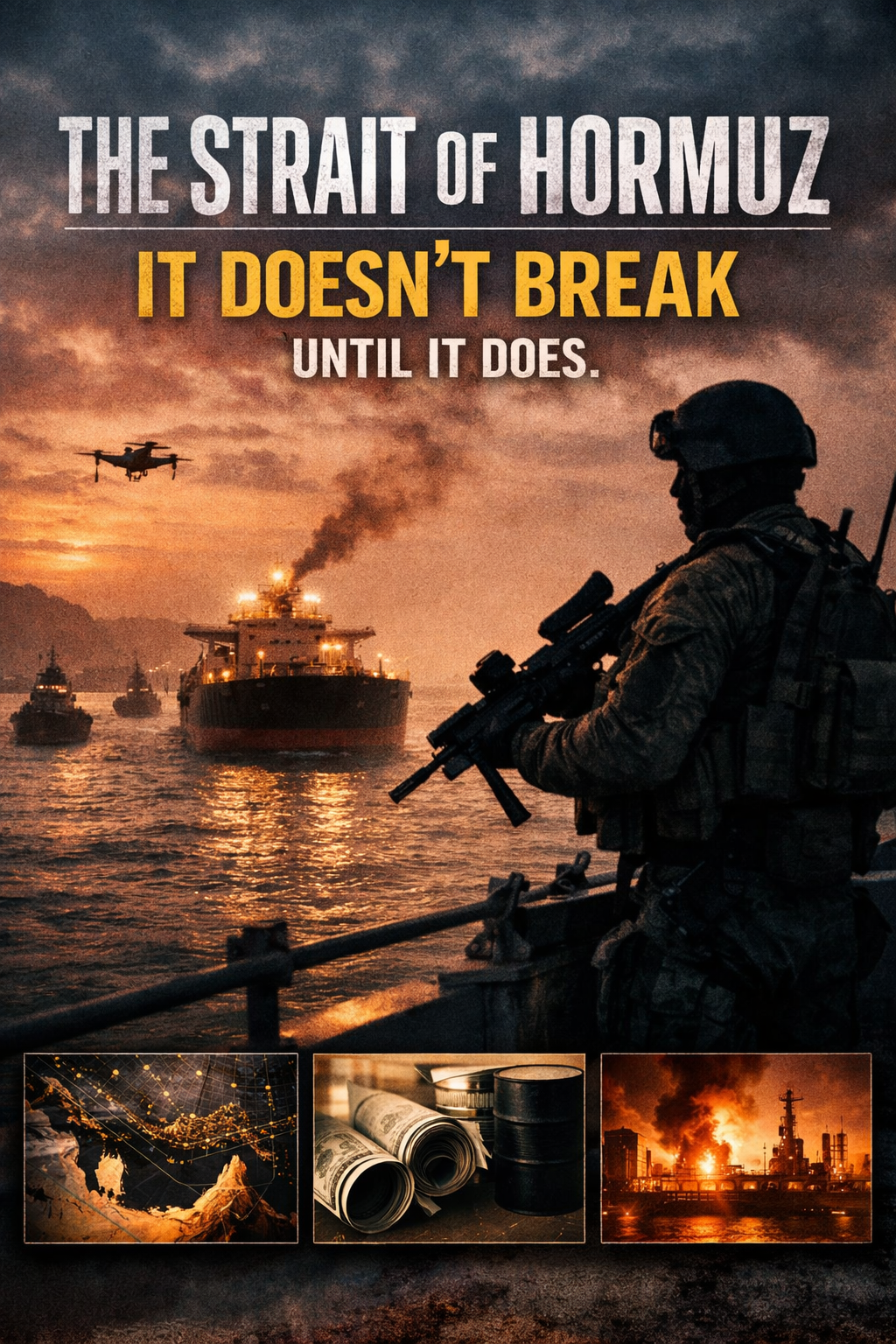
For decades, the Strait of Hormuz has been treated like a pressure valve — tense, unpredictable, but ultimately controlled. A narrow passage carrying a massive portion of the world’s oil supply, watched closely but rarely disrupted in a way that truly forces change.
That assumption may be starting to wear thin.
The current situation doesn’t announce itself loudly. There’s no single moment you can point to and say: this is when it shifted. Instead, it’s a series of small adjustments — military positioning, political language, shipping patterns — that only make sense when viewed together.
This becomes clearer when looking at how energy markets have started reacting in subtle ways, not with panic, but with hesitation. Prices don’t spike wildly. They drift. Insurance costs quietly rise. Routes get reconsidered.
Nothing dramatic. Just enough to signal that confidence is no longer absolute.
At the center of it all is a fragile balance. The Strait isn’t just a shipping lane — it’s leverage. And leverage, once recognized, tends to get used.
What’s different now is the layering of pressures. Regional tensions, shifting alliances, economic strain, and a global system already stretched thin. No single factor dominates, but together they create something less stable than it appears on the surface.
A similar pattern appeared in earlier energy disruptions — not sudden collapses, but slow tightening. Systems don’t usually fail all at once. They weaken in ways that are easy to dismiss until they’re not.
What happened next raised more questions than answers.
Some tankers have altered course without much explanation. Others continue as usual, but under heavier surveillance. Military escorts appear more frequently, though rarely acknowledged directly.
Meanwhile, governments issue statements that feel carefully calibrated — firm enough to reassure, vague enough to avoid commitment.
It’s a delicate script. And it suggests awareness of something that isn’t being fully said.
This connects to a broader shift in how energy security is being understood.
For years, the conversation focused on supply — how much oil exists, where it comes from, who controls it. Now, the focus is quietly moving toward movement — how reliably that oil can travel from one place to another.
That’s a different kind of vulnerability.
And it’s harder to fix.
The idea of a global energy supply disruption used to imply a dramatic event — a blockade, a conflict, a visible break in the system. But increasingly, disruption looks quieter than that.
Delays. Rerouting. Rising costs passed along slowly.
A system that still works, just not as smoothly as before.
And once that friction starts to build, it doesn’t always go away.
There’s also the question of timing.
Why now?
Why this accumulation of pressure in a place that has always been sensitive, but rarely decisive?
The answer may not lie in the Strait itself, but in everything surrounding it — economic shifts, geopolitical recalculations, and a world that is less coordinated than it used to be.
Small fractures tend to matter more in systems already under strain.
Nothing has officially changed.
That’s what makes it easy to overlook.
But the signals are there, scattered across shipping data, policy language, and market behavior. Not loud enough to alarm. Just consistent enough to notice.
And once you see the pattern, it’s hard to unsee.
What just happened in global shipping routes may change how this is understood.
A deeper look at this pattern reveals something unexpected.
This may connect to a broader shift that’s quietly underway.
Primary Sources & Analysis
- U.S. Energy Information Administration
World Oil Transit Chokepoints Report
→ Confirms the Strait handles ~20% of global oil and is one of the most critical chokepoints in the world.
- International Energy Agency
Middle East and Global Energy Markets Analysis
→ Details how most Gulf exports rely on the Strait and how limited bypass options are.
- International Energy Agency
Emergency Oil Stock Release Announcement
→ Shows how disruptions in the Strait can force global emergency responses.
Supporting Market & Flow Data
- Institute for Energy Research
Energy Supplies Under Middle East Conflict
→ Explains how ~20% of global oil and LNG flows through the Strait and why it’s so vulnerable.
- Ballast Markets
Strait of Hormuz Oil Chokepoint Analysis
→ Breaks down trade volume, global dependency, and lack of alternatives.
______________________________________________
Help Keep Independent Journalism Alive & Support a Senior
Even a small contribution to my GoFundMe helps me continue this work and get a used car to stay mobile.