
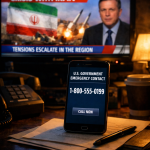







There are moments in geopolitics when the noise grows louder.
And others when it becomes very quiet.
The Israeli strike on Tehran this week did both.
Explosions were reported across parts of the Iranian capital. Israeli officials acknowledged the operation soon after. Iranian authorities confirmed impacts but offered limited detail. The statements were measured. Controlled. Almost clinical. Yet beneath the formal language, something larger seemed to shift.
This was not a covert sabotage mission whispered about months later. It was declared.
Public.
Intentional.
The Israel strike on Tehran did not arrive without context. Tensions have been building steadily across the region—through proxy confrontations, shadow campaigns, maritime incidents, and calibrated retaliations. The pattern has been familiar: pressure, response, pause. Escalation, then deniability.
This felt different.
When governments move from ambiguity to acknowledgment, it often signals a recalculation. Not necessarily toward full war. But toward new rules.
Israel framed the strike as necessary. Iranian officials signaled consequences without detailing timelines. International leaders urged restraint. Markets reacted briefly, then steadied. Airlines adjusted routes. Diplomats made calls.
Life continued.
That may be the most unsettling part.
For years, confrontation between Israel and Iran has operated in the margins—cyber operations, targeted strikes in third countries, precision actions attributed but rarely owned. It allowed both sides to test limits without fully crossing them.
This time the boundary seemed more visible.
Was it a warning? A deterrent demonstration? A message aimed as much at regional actors as at Tehran itself?
The Middle East has a long memory for symbols. A strike inside a capital carries a weight that echoes beyond immediate damage. It signals reach. Capability. Resolve. It also invites calculation.
How will Iran respond—and when?
Tehran does not typically move in haste. Responses can unfold indirectly, through regional partners or asymmetrical channels. The next development may not resemble the last one. That uncertainty lingers.
Washington’s position remains measured but closely aligned with Israel’s security posture. European leaders are urging de-escalation, wary of energy disruptions and regional instability. Meanwhile, Gulf states watch carefully, aware that regional balance can shift quickly when two major powers test each other openly.
History offers cautionary lessons. Direct strikes between adversaries rarely exist in isolation. They accumulate. Each action changes the threshold of what is considered normal.
And normalization is powerful.
When bold actions become procedural, the space for miscalculation narrows.
There is also the domestic dimension. Leaders on both sides face internal pressures—political, economic, strategic. External confrontation can unify, distract, or harden public resolve. It can also backfire if escalation spirals beyond expectation.
The world has seen this pattern before. Controlled escalation is rarely as controlled as planners intend.
Yet for now, the region sits in a tense equilibrium. Not calm. Not chaos. Something in between.
The airspace over parts of the Middle East tells part of the story—rerouted flights tracing cautious arcs around sensitive zones. Financial markets signal alertness but not panic. Energy traders monitor supply lines.
Signals everywhere.
Clarity nowhere.
The question is not only whether this expands into wider conflict. It is whether a new baseline has quietly been established—one where open strikes between long-time adversaries become another accepted instrument of statecraft.
If so, the silence after the explosions may matter more than the explosions themselves.
Because sometimes escalation does not roar.
It settles in.
______________________________________________
Help Keep Independent Journalism Alive & Support a Senior
Even a small contribution to my GoFundMe helps me continue this work and get a used car to stay mobile.