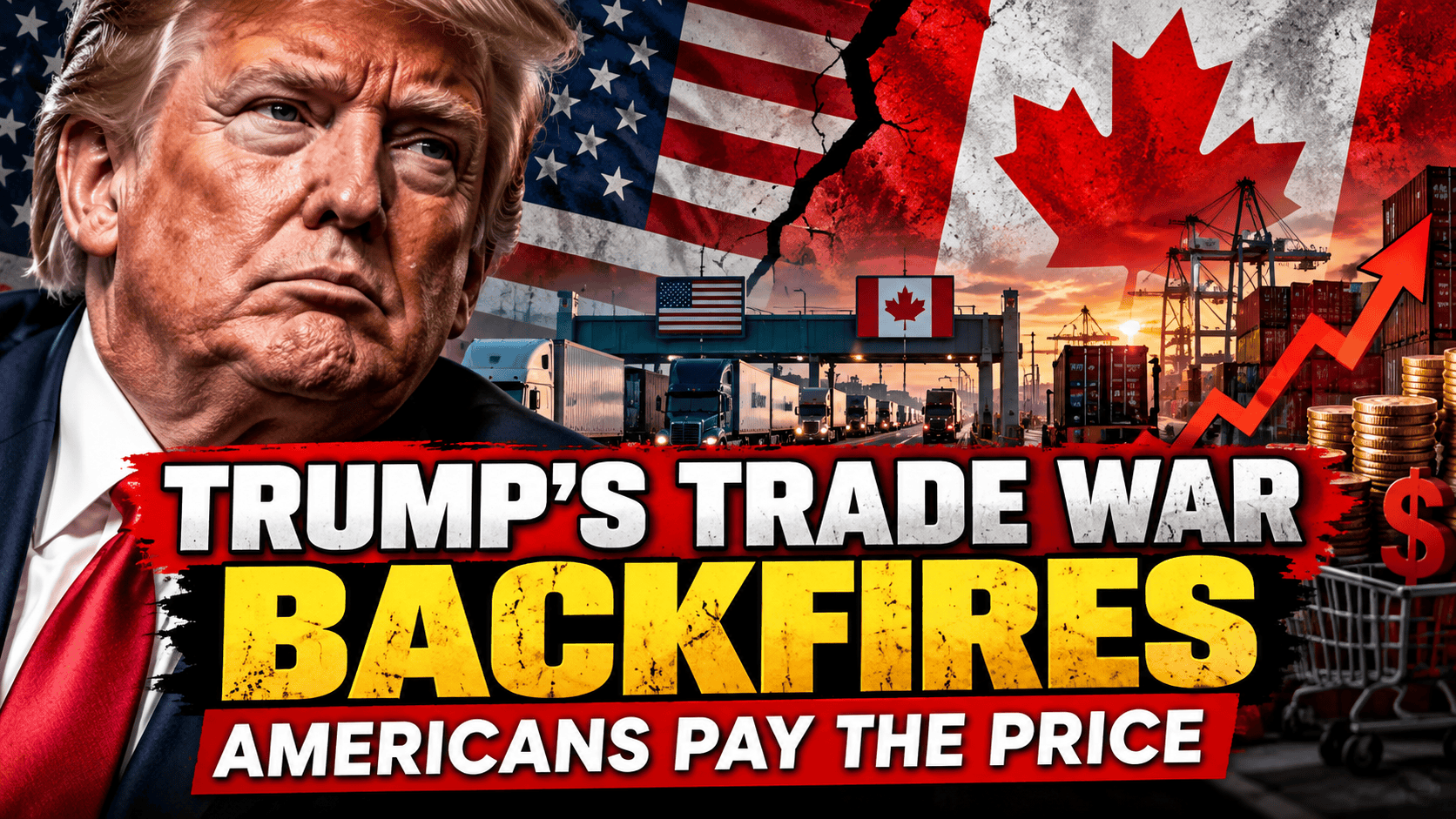
Trump promised to punish Canada. Instead, his trade war is becoming a political headache for Republicans trying to convince American voters that the administration’s economic policies are working.
The irony is difficult to ignore.
A president who built his political identity around putting America first is now facing criticism over trade policies that may be hurting the very American businesses and communities he promised to protect.
And with the November midterm elections approaching, some Republican candidates have a problem they cannot simply dismiss as another attack from the Democrats.
Their own voters are feeling the economic consequences.
When America First Starts Hurting Americans
Donald Trump’s trade confrontation with Canada was presented as a strategy to strengthen American industry, protect domestic jobs and force better trade arrangements.
But tariffs come with a price.
When American importers purchase goods subject to tariffs, those businesses generally pay the duties to the U.S. government. They must then decide whether to absorb the additional expense, negotiate lower prices with suppliers or pass some of the cost along to customers.
That means American manufacturers, retailers and consumers can end up carrying part of the financial burden.
______________________________________________
🔴 Help keep this independent voice alive and uncensored.
Support independent journalism and help keep Chris Wick News going.
👉 Support Chris Wick on GoFundMe
For businesses operating across the Canada–U.S. border, the consequences can be especially complicated.
Automotive manufacturing, for example, relies on deeply integrated supply chains. Components can cross the international border multiple times before a finished vehicle reaches a dealership.
Disrupt those supply chains with additional costs and uncertainty, and businesses face difficult decisions about pricing, investment and employment.
A tariff designed to punish a foreign country can become an additional expense for businesses at home.
That is the contradiction now confronting Republicans in economically vulnerable states.
Republican Candidates Face an Uncomfortable Reality
According to reporting published by The Washington Post on October 25, Trump’s trade confrontation with Canada has created political difficulties for Republican candidates in important electoral contests.
The problem is particularly relevant in communities where cross-border commerce supports local employment and economic activity.
For candidates trying to win over business owners, manufacturing workers and families concerned about affordability, defending every aspect of the administration’s trade strategy may not be politically attractive.
Some Republicans have consequently sought to distinguish their positions from Trump’s approach.
That does not necessarily mean they oppose tariffs altogether.
Trade protection remains popular among certain voters, particularly those who believe American manufacturing has suffered from decades of globalization and unfair international competition.
But supporting domestic industry and supporting every tariff imposed by Washington are not necessarily the same thing.
Republican candidates are discovering that political loyalty does not automatically pay a factory’s operating expenses.
And voters struggling with higher costs may be more interested in their financial circumstances than in another campaign speech about economic nationalism.
Canada Was Supposed to Be the Loser
Canada and the United States maintain one of the world’s most important bilateral trading relationships.
Canadian businesses depend heavily on access to American markets. American businesses, meanwhile, rely on Canadian energy, raw materials, manufactured components and agricultural products.
This relationship is not a one-way street.
When Washington imposes tariffs on Canadian goods, Canadian exporters can suffer reduced demand, lost contracts and pressure on profit margins.
But American companies that depend on Canadian products can also face increased expenses.
The economic damage does not necessarily stop at the border.
Canadian retaliation, changes in purchasing decisions and uncertainty surrounding future trade arrangements can further complicate the relationship.
This is why trade disputes between closely integrated economies can produce consequences that extend well beyond the industries politicians initially intended to target.
The question is not whether Canada experiences economic pain.
It does.
The question is whether imposing that pain produces benefits substantial enough to justify the costs Americans also bear.
That is a much harder argument to make when voters are already concerned about affordability.
The Political Timing Could Not Be Worse
The November 2026 midterm elections are approaching.
Republicans are fighting to maintain political support while Democrats attempt to turn public frustration over the economy into electoral gains.
Trump’s tariff policies have become part of that broader argument.
Democrats can point to the additional costs and economic uncertainty associated with trade restrictions.
Republicans defending the administration can argue that tariffs provide leverage in negotiations, protect strategically important industries and encourage investment in American production.
Both arguments deserve scrutiny.
The real test is whether the policy delivers measurable economic benefits that outweigh its costs.
Promises of future prosperity are not the same as evidence that businesses and households are better off today.
For Republican candidates in border states, this distinction could matter enormously.
A politician can defend a tariff in Washington. Convincing a struggling business owner to celebrate it is another matter entirely.
Is Trump’s Trade Strategy Becoming a Political Liability?
Trump’s supporters argue that confronting trading partners is necessary to secure better agreements and rebuild American industrial strength.
Critics argue that broad tariffs create unnecessary economic disruption, increase costs and undermine relationships with important allies.
The truth is that the consequences vary by industry.
Some domestic producers may benefit from reduced foreign competition.
Other businesses may face higher input costs, disrupted supply chains or retaliation against their exports.
Consumers may experience higher prices, although the extent of those increases depends on market conditions and how businesses respond.
That complexity rarely survives political campaign slogans.
Yet it matters enormously when evaluating whether a trade policy is actually succeeding.
If Republican candidates increasingly distance themselves from the administration’s approach, it raises an uncomfortable political question:
How effective can a trade strategy be if the president’s own allies are reluctant to defend its consequences?
Political disagreement within a party does not prove that an economic policy has failed.
But it can reveal growing concern about whether voters believe the policy is working.
The Bigger Problem for Washington
The Canada–U.S. trade confrontation is about more than tariffs.
It raises questions about economic sovereignty, political leverage and the long-term reliability of relationships between major trading partners.
Canada has strong incentives to maintain access to the American market.
But repeated trade disputes may also encourage Canadian businesses and policymakers to pursue alternative markets and reduce their dependence on Washington.
That would not happen overnight.
Geography, existing infrastructure and decades of commercial integration make the bilateral relationship difficult to replace.
Nevertheless, political uncertainty can influence investment decisions long before any permanent economic separation occurs.
And once businesses begin restructuring supply chains, those decisions can have consequences lasting well beyond a single presidential administration.
Final Thoughts: Who Really Pays for a Trade War?
Trump promised to use American economic power to secure better treatment from Canada.
But tariffs are not political weapons that strike only their intended targets.
They create costs, incentives and consequences on both sides of the border.
For American businesses dependent on Canadian trade, those consequences can be immediate.
For Republican candidates defending the administration’s economic record, the political consequences may become increasingly difficult to ignore.
The approaching midterms will help reveal how voters judge the administration’s broader economic performance, although tariffs will be only one factor influencing their decisions.
And that brings us to the central contradiction.
Trump promised to make Canada pay.
But when American businesses absorb higher costs, workers face uncertainty and consumers encounter additional financial pressure, Americans may end up paying part of the bill themselves.
The question voters should be asking is simple:
Was this trade war designed to strengthen the American economy, or has political confrontation become more important than the economic results?
Because at the end of the day, patriotic slogans do not pay the bills.
And neither does political loyalty.
Sources
The Washington Post — October 25, 2026
How Trump’s trade war with Canada has hurt GOP candidates in key races
Read the original reporting