When political promises collapse, who carries the consequences?
When politicians make promises they cannot keep, ordinary Canadians are left holding the bill. The question is no longer whether governments fail. It’s why the people responsible so rarely face meaningful consequences.
The Promise Is Free. The Failure Is Expensive.
Canadians pay the bills.
Politicians make the promises.
And when those promises collapse, somehow it’s always the taxpayer standing at the counter with a wallet in hand.
Funny how that works.
During election campaigns, politicians become masters of certainty. They know how to fix housing. They know how to control spending. They know how to make life affordable. They know how to repair healthcare, protect communities, and restore public confidence.
They have a plan.
They have a slogan.
They have a camera crew.
______________________________________________
🔴 Help keep this independent voice alive and uncensored.
Support independent journalism and help keep Chris Wick News going.
👉 Support Chris Wick on GoFundMe
But when the election signs come down and the promises begin collecting dust, something remarkable happens.
The promises become complicated. The explanations become longer. And the accountability becomes harder to find.
Meanwhile, Canadians are still expected to pay.
The Political System Has a Convenient Escape Hatch
Imagine running a private business where you repeatedly promise customers something you cannot deliver.
Eventually, customers walk away. Contracts get challenged. Investors demand answers. Someone may lose their job.
Government operates differently.
Politicians can point to changing economic conditions, international crises, provincial jurisdiction, previous administrations, bureaucratic obstacles, or unexpected costs.
Sometimes those explanations are legitimate.
But sometimes they become convenient political shields.
And that raises an uncomfortable question.
At what point does a broken political promise stop being an unfortunate outcome and become a failure of leadership?
Canada has elections, parliamentary scrutiny, independent auditors, access-to-information laws, and other accountability mechanisms.
Those safeguards matter.
But having accountability mechanisms on paper is not the same as making accountability meaningful in practice.
A parliamentary committee can ask questions. An auditor can identify failures. Journalists can expose contradictions.
Yet Canadians may still be left wondering what actually changes afterward.
A report gets published.
A minister expresses concern.
Another review is announced.
And the machine keeps running.
Canadians Don’t Get to Escape the Consequences
When government spending exceeds projections, when public projects run over budget, or when policies fail to deliver their intended results, the financial consequences do not simply disappear.
They can affect public borrowing, future taxation, service priorities, and the resources available for other needs.
Not every government failure translates directly into a higher household bill. Economic pressures have many causes, and governments do not control every outcome.
But taxpayers ultimately finance government operations.
That is precisely why public spending deserves relentless scrutiny.
For a Canadian household struggling with groceries, rent, utilities, transportation, or property taxes, political excuses can sound remarkably distant from everyday reality.
A family cannot simply announce that its grocery budget has been exceeded and expect someone else to cover the difference.
A senior living on a fixed income cannot solve rising expenses by holding a press conference.
A small business owner cannot repeatedly miss financial targets without eventually confronting the consequences.
Yet political leaders can sometimes turn failure into another campaign promise.
The very problems they once promised to solve become the foundation of their next election platform.
And Canadians are invited to believe again.
Red Team. Blue Team. Same Accountability Question.
This is not exclusively a Liberal problem.
It is not exclusively a Conservative problem.
Nor is it limited to federal politics.
Governments of different political stripes have made ambitious commitments, underestimated challenges, revised priorities, and struggled to deliver results.
Opposition parties often demand accountability with extraordinary enthusiasm.
Until they become the government.
Then the explanations begin.
The real test of political integrity is not how loudly a party criticizes its opponents.
It is whether that same party accepts scrutiny when the responsibility belongs to its own leadership.
If a politician demands accountability from the opposition but excuses comparable failures within their own party, that is not principled oversight. It is political convenience.
Canadians should demand the same standards from everyone.
No exceptions for preferred parties.
No automatic forgiveness because a politician wears the right colour.
No treating legitimate criticism as betrayal.
The Most Dangerous Promise Is the One Nobody Measures
Perhaps the biggest weakness in political accountability is not simply that promises are broken.
It is that too many promises are made without clear, publicly understood measurements of success.
What exactly was promised?
How much was it supposed to cost?
When was it supposed to happen?
What measurable result was Canadians’ money supposed to produce?
And when the result falls short, who must explain why?
These are not radical questions.
They are basic questions that any responsible organization should be prepared to answer.
Governments already publish budgets, departmental results, public accounts, and audit findings.
The challenge is making that information understandable, accessible, and consequential.
Canadians should not need a team of accountants and researchers to determine whether a major election commitment was fulfilled.
A promise without a measurable outcome can become a political advertisement with no expiration date.
And that should concern every taxpayer.
Accountability Should Not End at the Ballot Box
Some people argue that elections provide the ultimate accountability.
Vote politicians out if they fail.
There is truth in that argument.
Democratic elections are essential. They allow citizens to replace governments peacefully.
But elections alone are not enough.
A government can make decisions that affect public finances for years beyond a single electoral cycle.
By the time voters deliver their verdict, money may already have been spent, contracts signed, and opportunities lost.
That does not mean every broken promise should become a criminal matter. A failed policy is not automatically fraud, corruption, or misconduct.
There is an important difference between an honest mistake, an unrealistic commitment, negligence, and deliberate wrongdoing.
But those distinctions make serious scrutiny more important, not less.
Canadians deserve transparent performance reporting, independent audits, meaningful parliamentary examination, and consequences where misconduct is actually established.
They also deserve politicians who can say three simple words:
We got it wrong.
Without blaming everyone else.
Without hiding behind another slogan.
Without treating taxpayers as an endless source of money and patience.
Chris Wick News Perspective: The Bill Always Has an Address
Here is the part of politics that deserves more attention.
Every promise sounds wonderful when someone else is expected to finance it.
Every new program comes with a price.
Every government initiative should face questions about its cost, purpose, effectiveness, and alternatives.
And every politician who asks Canadians for their trust should be prepared to explain what happened to the commitments that earned it.
This is not an argument that government should do nothing.
It is an argument that government should be held responsible for what it chooses to do.
Because accountability is not supposed to be a partisan weapon.
It is supposed to be a democratic obligation.
And Canadians should never have to choose between supporting a political party and demanding the truth.
Final Thought: The Darkest Part of the Promise
The darkest part of politics isn’t necessarily the broken promise.
It’s how easily a broken promise can be replaced by another one.
A new slogan.
A new campaign.
A new face standing behind a podium.
The old commitments fade. The financial consequences remain. The public is asked to start believing all over again.
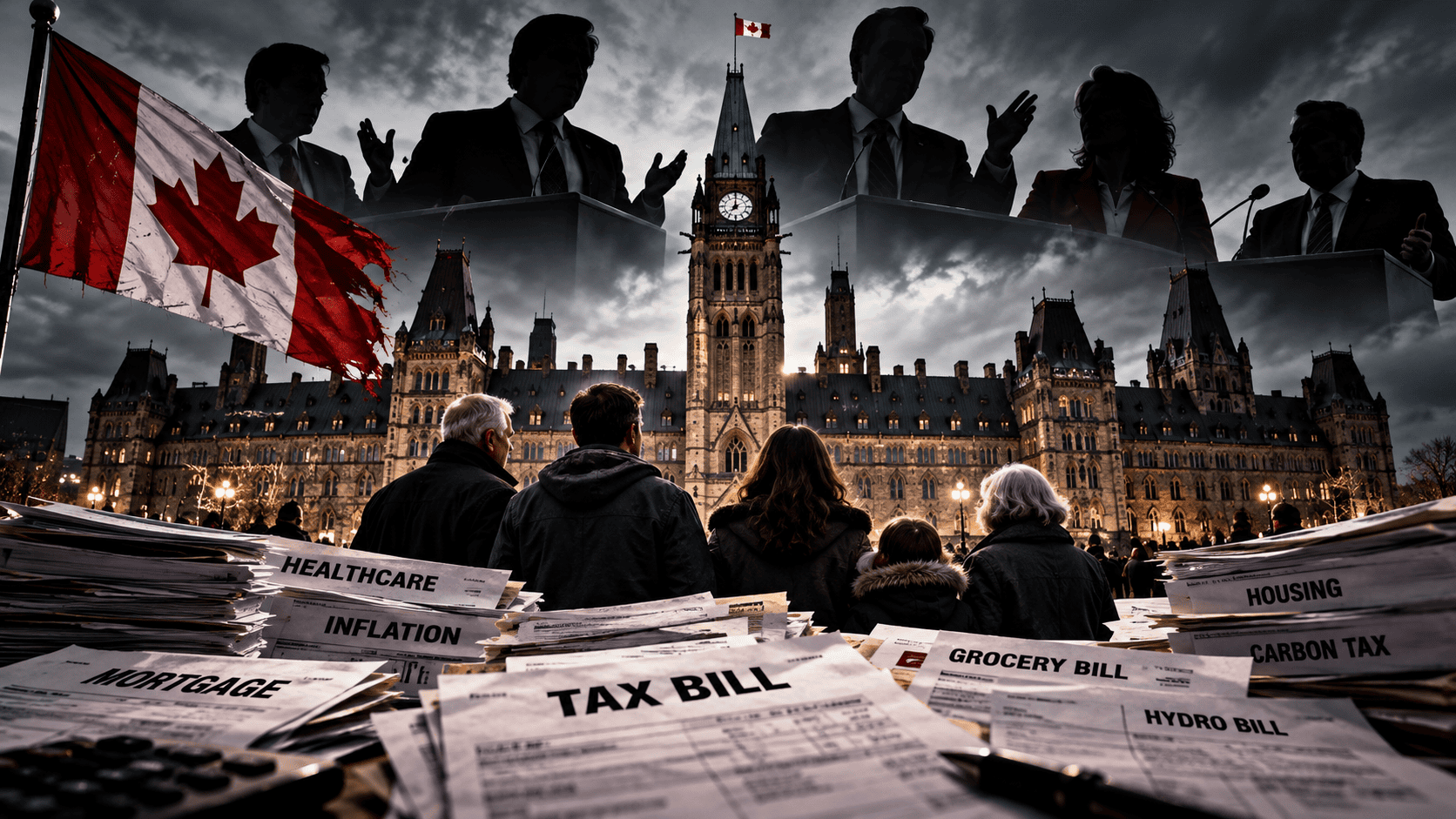
And somewhere, another Canadian opens another bill.
Canadians pay the bills. Politicians make the promises.
But when those promises collapse, perhaps the most disturbing question isn’t who made the mistake.
It’s whether the political system has become too comfortable letting the people who pay for failure carry more consequences than the people responsible for it.
And if that doesn’t bother us anymore, maybe the problem has become much bigger than politics.
Sources and supporting references
These official sources support the article’s discussion of Canadian government oversight, audits, spending, and performance reporting. The article itself is political commentary, not an allegation of specific criminal wrongdoing.
- Office of the Auditor General of Canada — https://www.canada.ca/en/auditor-general.html
 Canada
 - Treasury Board — Departmental Results Reports — https://www.canada.ca/en/treasury-board-secretariat/services/departmental-performance-reports.html Canada
- Government of Canada — Reporting of Government Spending — https://www.canada.ca/en/treasury-board-secretariat/topics/reporting-government-spending.html Canada
- Public Accounts of Canada — https://www.canada.ca/en/public-services-procurement/services/payments-accounting/public-accounts.html Canada
About the Author