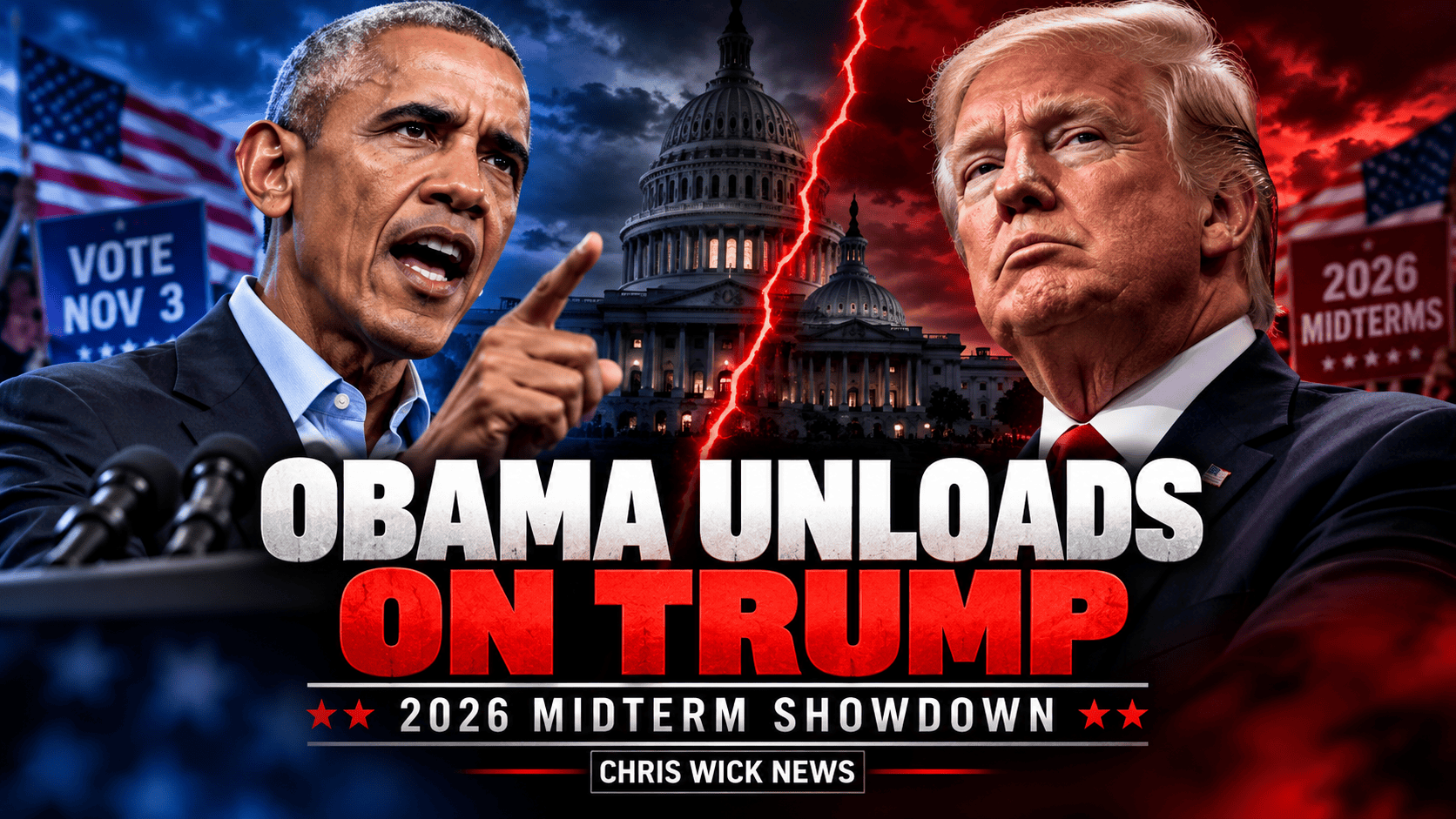
Former President Barack Obama returns to the political battlefield, accusing Donald Trump of corruption, mocking his Iran strategy, and warning that America needs to put the brakes on the White House before it’s too late.
By Chris Wick News | October 25, 2026
The gloves are off in Washington, and Barack Obama has just stepped back into the political ring.
With America’s November 3 midterm elections approaching, the former Democratic president has launched one of his sharpest public attacks on Donald Trump, accusing the current administration of corruption, questionable leadership, and turning the presidency into a vehicle for personal enrichment.
Speaking at campaign rallies in Cleveland, Ohio, and Detroit, Michigan, on Saturday, October 24, Obama delivered a blistering assessment of Trump’s second term.
And his message was unmistakable: the upcoming election isn’t simply about choosing members of Congress. It’s about deciding how much political power Americans are willing to leave in Trump’s hands.
But beneath the political fireworks lies a larger question.
Are Americans witnessing a genuine battle for government accountability, or another carefully orchestrated confrontation between two political establishments desperate to maintain control?
Obama Accuses Trump of Turning the Presidency Into a Personal Business
Obama’s most explosive criticism centred on allegations that Trump and those close to him have benefited financially from the presidency.
______________________________________________
🔴 Help keep this independent voice alive and uncensored.
Support independent journalism and help keep Chris Wick News going.
👉 Support Chris Wick on GoFundMe
During his Michigan appearance, Obama accused the president of using public office to advance private interests, arguing that Republicans have abandoned their traditional claims of responsible government.
These were serious accusations, delivered before an audience Democrats hope will help determine control of the United States Senate.
The allegations are not merely campaign rhetoric without any surrounding public debate.
An August Reuters/Ipsos survey found that 63% of respondents believed Trump and his family had benefited improperly from cryptocurrency ventures. Another 69% believed his private business interests influenced presidential policy decisions.
Those figures represent public perceptions, not proof of criminal wrongdoing.
Nevertheless, they demonstrate the political vulnerability Democrats are attempting to exploit.
For Trump, whose political identity has long rested on portraying himself as an outsider fighting entrenched Washington interests, allegations of personal profiteering strike directly at the foundation of his populist message.
The Iran War Becomes a Political Weapon
Obama also targeted Trump’s handling of the conflict involving Iran, challenging the administration’s claims of military and strategic success.
The former president argued that Iran has gained additional economic leverage through its ability to threaten commercial shipping around the Strait of Hormuz.
That narrow waterway remains one of the world’s most strategically important energy corridors.
Disruption there can affect international oil markets, transportation costs, and household energy expenses far beyond the Middle East.
Obama’s argument was that military pressure does not necessarily translate into lasting strategic control.
For ordinary Americans already concerned about rising living costs, that distinction matters.
And Canadians have reason to pay attention as well.
Energy market instability can influence Canadian gasoline prices, business transportation expenses, and the broader economic outlook.
The political question is whether Trump’s confrontational approach has strengthened American influence or introduced new economic vulnerabilities.
Republicans defend the administration’s broader strategy as an effort to confront hostile governments and protect American interests.
Democrats increasingly portray the same strategy as expensive, destabilizing, and poorly managed.
Neither side can escape the economic consequences if international tensions continue affecting global energy supplies.
Obama Mocks Trump’s White House Makeover
Not every attack was directed at foreign policy or financial ethics.
Obama also ridiculed the extravagant appearance of Trump’s White House renovations, using humour to portray the president as more interested in spectacle than effective government.
He compared the redesigned White House aesthetic to an imagined establishment created by Saddam Hussein and the Cheesecake Factory.
The joke drew attention because it reduced a larger political criticism to an easily understood image: a presidency consumed by luxury, appearance, and personal branding.
Obama also mocked Defense Secretary Pete Hegseth, suggesting that the administration was devoting attention to military appearance and physical standards while more consequential national security issues demanded leadership.
Political ridicule has become a powerful weapon in modern American campaigning.
Trump himself has spent years using nicknames, insults, and public humiliation to weaken opponents.
Now Obama is demonstrating that Democrats are willing to fight on similar terrain.
But whether political comedy changes votes is another matter entirely.
Michigan Could Help Decide Who Controls Washington
Obama’s appearance in Detroit was intended to support Democratic Senate candidate Abdul El-Sayed, who faces Republican Mike Rogers.
The contest is particularly important because control of Congress could determine how much legislative freedom Trump enjoys during the remainder of his presidency.
Democrats hope that Obama’s popularity among their supporters will increase turnout, particularly among voters who might otherwise remain home.
Republicans, meanwhile, are relying heavily on Trump’s ability to energize his own political base.
The president has repeatedly encouraged supporters to treat the midterm elections as though his own name were on the ballot.
That strategy carries both opportunity and risk.
Trump remains a powerful mobilizing force among loyal Republicans, but his polarizing leadership can also motivate opponents.
If Democrats secure control of one or both chambers of Congress, they could gain substantial influence over legislation, investigations, spending negotiations, and oversight of the executive branch.
If Republicans retain control, Trump could emerge with renewed political momentum.
Two Former Presidents, One Deeply Divided Country
The spectacle of Obama attacking Trump highlights how much American politics continues to revolve around competing presidential personalities.
Obama represents an earlier Democratic administration that promised change, institutional stability, and a different approach to American leadership.
Trump built his political movement by challenging that establishment and promising to confront institutions he argues have failed ordinary Americans.
Yet both men have governed during periods of substantial political division, international conflict, and economic frustration.
That history raises uncomfortable questions for both political parties.
Have either Republicans or Democrats delivered the long-term stability, affordability, and accountability their supporters were promised?
Are voters being offered meaningful policy alternatives, or simply competing explanations for why the other side deserves blame?
And why does American political debate so frequently return to personalities rather than measurable results?
These questions deserve more attention than campaign insults.
What the 2026 Midterms Mean for Canada
Although Canadians cannot vote in American elections, the outcome will have consequences north of the border.
The United States remains Canada’s largest trading partner, and decisions made in Washington influence Canadian exporters, manufacturers, energy producers, and consumers.
A divided Congress could complicate Trump’s legislative agenda, although presidential powers over trade and foreign policy would remain significant.
Republican victories could strengthen the administration’s political position heading into the final two years of Trump’s term.
For Canadian businesses, the central concern is predictability.
Trade disputes, tariff uncertainty, international instability, and sudden changes in American economic policy can make investment decisions more difficult.
Canadian leaders will therefore be watching November 3 closely, regardless of their personal opinions about Trump or Obama.
The Bigger Question: Accountability or Political Theatre?
Obama’s return to the campaign trail gives Democrats a recognizable and influential voice at a critical moment.
His criticisms are designed to turn frustration with Trump’s leadership into votes for Democratic candidates.
But accusations, jokes, and dramatic speeches are not substitutes for transparent government or sound economic policy.
Trump’s administration deserves scrutiny over its financial relationships, foreign policy decisions, and use of executive authority.
The same standard should apply to Democratic administrations and politicians.
Accountability cannot be meaningful if it changes depending on which party occupies the White House.
Ultimately, Americans will decide whether Obama’s warnings reflect a genuine need for stronger congressional oversight or whether Trump’s supporters are correct that Democrats are attempting to obstruct an administration they fundamentally oppose.
The November 3 elections will provide an important answer.
One thing is certain: America’s political establishment is entering another confrontation, and the consequences will extend well beyond Washington.
For voters, the challenge is separating political entertainment from the decisions that affect their jobs, families, financial security, and future.
Because when the speeches end and the cameras disappear, ordinary people are the ones left living with the results.
What do you think? Is Obama exposing serious problems in Trump’s administration, or is this another round of establishment political warfare?
Sources
Reuters — Obama unloads on Trump while stumping for Democrats ahead of midterms
https://www.reuters.com/legal/government/obama-unloads-trump-while-stumping-democrats-ahead-midterms-2026-10-25/
Reuters — Trump faults aides as Republican midterm prospects dim
https://www.reuters.com/world/us/trump-faults-aides-republican-midterm-prospects-dim-2026-10-17/
Reuters — What you need to know about the 2026 US midterm elections
https://www.reuters.com/world/us/what-you-need-know-about-2026-us-midterm-elections-2026-10-19/
Reuters — Five takeaways from Trump’s midterm campaign rallies
https://www.reuters.com/world/us/five-takeaways-trumps-midterm-campaign-rallies-2026-10-24/
RTÉ — Obama blasts Trump’s ‘chaos and cruelty’ while campaigning for Democrats
https://www.rte.ie/news/us/2026/1025/1596761-obama-blasts-trump-while-campaigning-for-us-midterms/