Two Israeli soldiers are dead. Palestinian families face raids, displacement and military restrictions. Washington is threatening Iran again, and the Middle East is staring into another dangerous chapter
The Middle East Is Burning Again — And Nobody Seems Interested in Putting Out the Fire
Another attack. Another military operation. Another warning from Washington.
And once again, ordinary families are being pushed into the machinery of a conflict that appears to have no clear finish line.
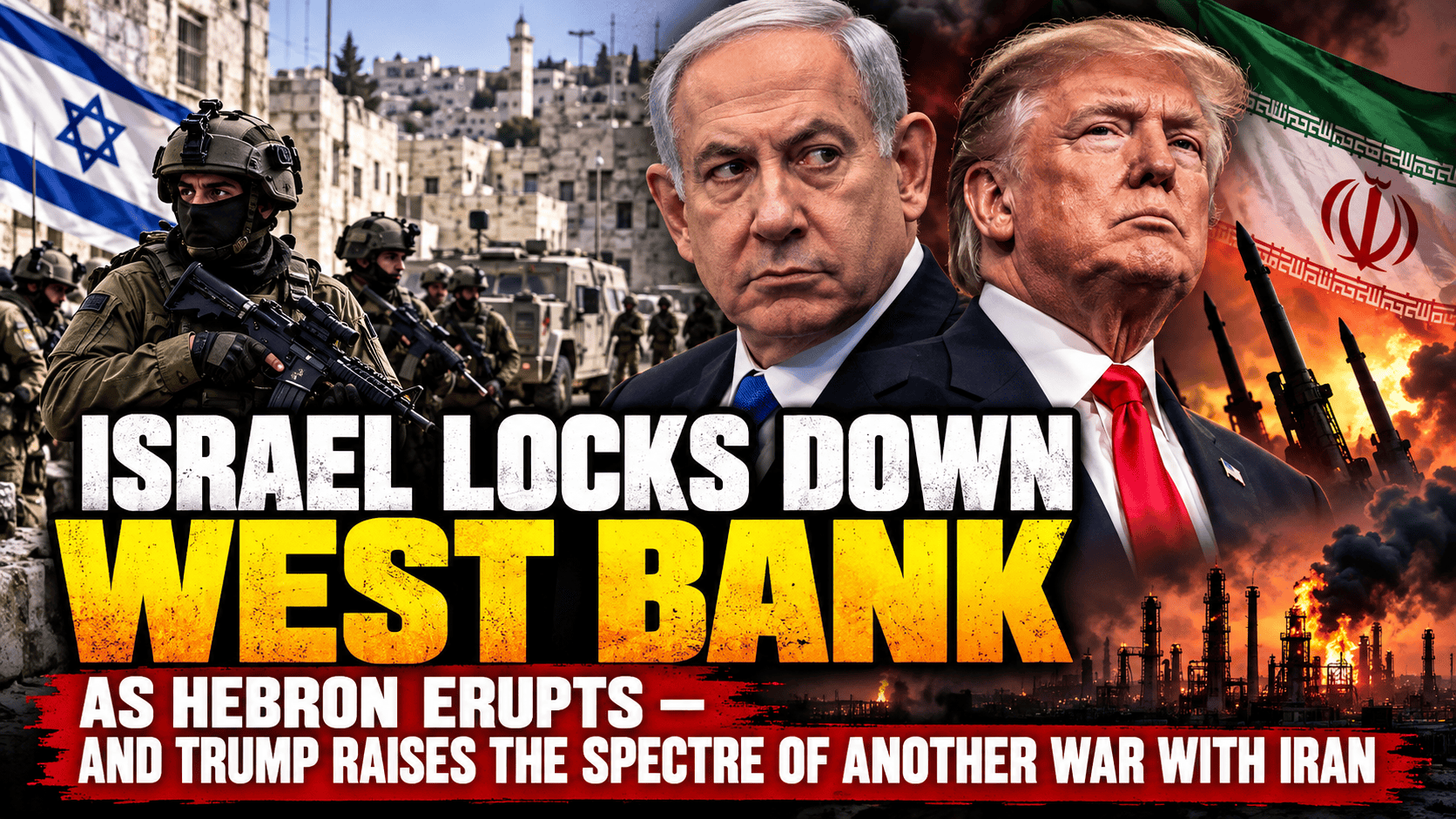
Israeli forces have launched a major military operation in Hebron, in the occupied West Bank, following a deadly shooting that killed two Israeli soldiers and wounded three others on October 23.
The Israeli military says its operation is targeted and intended to address security threats. But reports emerging from Palestinian communities paint a much broader and more troubling picture: raids, arrests, demolished buildings, forced evacuations and restrictions affecting entire communities.
Meanwhile, across the region, President Donald Trump is once again suggesting that American military strikes against Iran could resume.
Two flashpoints. One increasingly unstable region.
And a question that political leaders seem reluctant to answer:
How many military operations can the Middle East endure before the next escalation becomes impossible to contain?
Hebron: Two Soldiers Killed, an Entire Population Faces Restrictions
______________________________________________
🔴 Help keep this independent voice alive and uncensored.
Support independent journalism and help keep Chris Wick News going.
👉 Support Chris Wick on GoFundMe
The latest confrontation began when Palestinian gunmen attacked Israeli soldiers near the settlement of Telem, close to Hebron.
Two Israeli soldiers were killed, while three others were injured. Israeli forces subsequently killed the two Palestinian attackers.
The deaths were serious, and Israel has a legitimate responsibility to investigate attacks against its military personnel and protect people from further violence.
But what followed has raised questions about the scale and consequences of the response.
Israeli Prime Minister Benjamin Netanyahu ordered sweeping restrictions across the occupied West Bank.
Israeli troops began operations in Hebron and numerous other Palestinian communities. According to Al Jazeera’s October 24 reporting, raids extended to at least 15 towns in the northern West Bank, with dozens of Palestinians detained.
Reports also described Israeli bulldozers demolishing a three-storey building in Hebron and hundreds of Palestinian families being ordered to leave their homes.
For families caught in these operations, the consequences are immediate.
A parent may struggle to reach work. A patient may be unable to reach medical care. A child may be unable to attend school.
And none of those civilians necessarily had anything to do with the original shooting.
That is where a military response becomes a much larger moral and legal question.
When Does Security Become Collective Punishment?
Israel argues that its security operations are necessary to prevent further attacks.
That argument deserves examination, not automatic dismissal.
But military necessity does not eliminate the obligation to distinguish between armed attackers and civilians.
International humanitarian law prohibits collective punishment and imposes restrictions on the treatment of civilians in occupied territory.
Palestinian political figure Mustafa Barghouti warned that the closure of checkpoints and roads risks turning communities into isolated enclaves, cutting residents off from healthcare, education and economic activity.
According to Al Jazeera, nearly 1,000 checkpoints and gates across the West Bank were expected to be closed under the restrictions.
Imagine living in a town where the roads can suddenly close, soldiers can enter your neighbourhood, and your ability to reach a hospital depends on a military decision.
Now imagine being told that this is simply the price of security.
The difficult question is whether such measures genuinely prevent future violence or deepen the resentment that makes future violence more likely.
And if the restrictions punish people who had no involvement in the attack, what exactly is being accomplished?
Netanyahu Faces an Election — And the Timing Raises Questions
The latest escalation comes just days before Israel’s scheduled national election on October 27.
That timing matters.
Military crises can dominate political debate, shift public attention and place national security at the centre of an election campaign.
Netanyahu has long presented himself as a leader capable of confronting threats to Israel.
His supporters may view the Hebron operation as a necessary demonstration of resolve following the deaths of Israeli soldiers.
Critics, however, may question whether the scale of the response is proportionate and whether the political atmosphere surrounding the election is influencing decision-making.
There is no established evidence that the Hebron operation was launched for electoral advantage.
But asking whether military decisions are being influenced by political pressures is legitimate, especially when civilians bear the consequences.
A government should never receive a blank cheque simply because it invokes national security.
Trump Is Talking About Striking Iran Again
While the West Bank faces another military crackdown, a separate confrontation threatens to reignite the wider regional war.
President Donald Trump has suggested that the United States could carry out renewed military action against Iran.
His remarks follow months of confrontation involving American and Israeli operations against Iranian targets.
The possibility of renewed strikes carries consequences far beyond the immediate battlefield.
Iran is a major regional power. Its military capabilities, political alliances and strategic position around the Persian Gulf make any confrontation potentially dangerous for international energy markets and neighbouring countries.
And the economic warning signs are already visible.
Al Jazeera reported on October 24 that Brent crude had reached approximately $117.30 per barrel, reflecting fears of renewed conflict and supply disruption.
That number matters far beyond Tehran, Washington or Jerusalem.
It matters to truck drivers, farmers, manufacturers and families trying to keep their household budgets under control.
War has a way of reaching people who live thousands of kilometres from the battlefield.
Canadians Could Pay for a War They Never Voted For
For Canadians, the danger is not limited to foreign-policy headlines.
Canada may be geographically removed from the fighting, but its economy is deeply connected to global energy prices and international supply chains.
A sustained rise in crude oil prices can place upward pressure on gasoline, diesel, transportation and production costs.
Those pressures can eventually reach grocery shelves and household budgets, although the size and timing of price increases depend on several factors.
Canadian consumers have already spent years navigating affordability pressures.
Another prolonged energy shock would hardly be welcome.
And that raises an uncomfortable question.
Why should Canadian families face another round of economic uncertainty because political leaders overseas cannot find a durable diplomatic solution?
Canada cannot dictate the decisions of Israel, Iran or the United States.
But Canadian leaders can insist that military escalation be treated as a last resort rather than an ordinary instrument of political pressure.
They can also demand respect for civilian protection and international law, regardless of which government or armed group is involved.
The Dangerous Illusion of a Quick Military Victory
Every new military operation arrives with an explanation.
The targets are limited.
The objectives are necessary.
The action will restore security.
The threat will be eliminated.
Yet history repeatedly demonstrates how difficult it can be to turn battlefield success into lasting political stability.
Destroying a weapons depot does not automatically resolve a political dispute.
Killing armed attackers does not necessarily prevent new recruits from taking their place.
And launching airstrikes does not guarantee that an adversary will abandon its strategic objectives.
Sometimes military action is necessary to confront immediate threats.
But necessity must be demonstrated, objectives must be defined, and the consequences must be weighed.
Otherwise, each operation risks becoming the justification for the next.
A deadly attack produces retaliation.
Retaliation produces anger.
Anger produces further violence.
And eventually, entire generations grow up knowing little beyond checkpoints, bombardments, displacement and fear.
That is not a strategy for peace.
It is a cycle of conflict.
The Real Cost Is Paid by People Without Power
Behind every headline are people who have little influence over the decisions shaping their lives.
Israeli families are mourning soldiers killed in the Hebron attack.
Palestinian families are facing military raids and restrictions.
Iranian civilians are living under the threat of renewed military strikes.
And families across the wider region are watching another confrontation unfold without knowing where it will lead.
Their experiences are not identical, and the responsibilities of governments and armed groups must be assessed individually.
But civilians should not become expendable simply because leaders claim their cause is justified.
There is something deeply disturbing about a world where military threats generate endless political commentary while the suffering of ordinary people becomes background noise.
Wars are announced by leaders.
Their consequences are lived by everyone else.
The Question Nobody Wants to Answer
Israel says it needs security.
Palestinians demand freedom from occupation and military restrictions.
Iran insists on defending its sovereignty.
Washington says military pressure is necessary to protect American interests and deter threats.
Each government has its own explanation.
But explanations are not the same as solutions.
And military power, however overwhelming, cannot by itself resolve every political conflict.
The danger now is that separate confrontations across the Middle East will reinforce one another, creating a broader crisis in which every new incident becomes a reason for further escalation.
The people making these decisions have security details, government aircraft and protected offices.
The families living with the consequences often have none of those protections.
At what point do we stop accepting endless military escalation as a substitute for diplomacy?
And perhaps the darker question is this:
If the people ordering these operations had to live alongside the civilians enduring them, would they still be so quick to choose another war?
Chris Wick News will continue examining the political decisions, military developments and economic consequences shaping this escalating regional crisis.
Sources
1. Al Jazeera — Iran war live: Israel launches ‘targeted’ Hebron operation after attack (October 24, 2026)
https://www.aljazeera.com/news/liveblog/2026/10/24/iran-war-live-israel-launches-targeted-hebron-operation-after-attack
2. Al Jazeera — Israel raids towns, detains dozens of Palestinians in occupied West Bank (October 24, 2026)
https://www.aljazeera.com/news/2026/10/24/israel-raids-towns-detains-dozens-of-palestinians-in-occupied-west-bank
Editorial disclaimer: This article contains independent news analysis and opinion by Chris Wick News. Reported developments are attributed to the cited news organizations. Commentary, questions and interpretations are the author’s own and should not be confused with independently established facts. This article reflects information available during a developing situation on October 24, 2026; details may change as additional reporting becomes available.