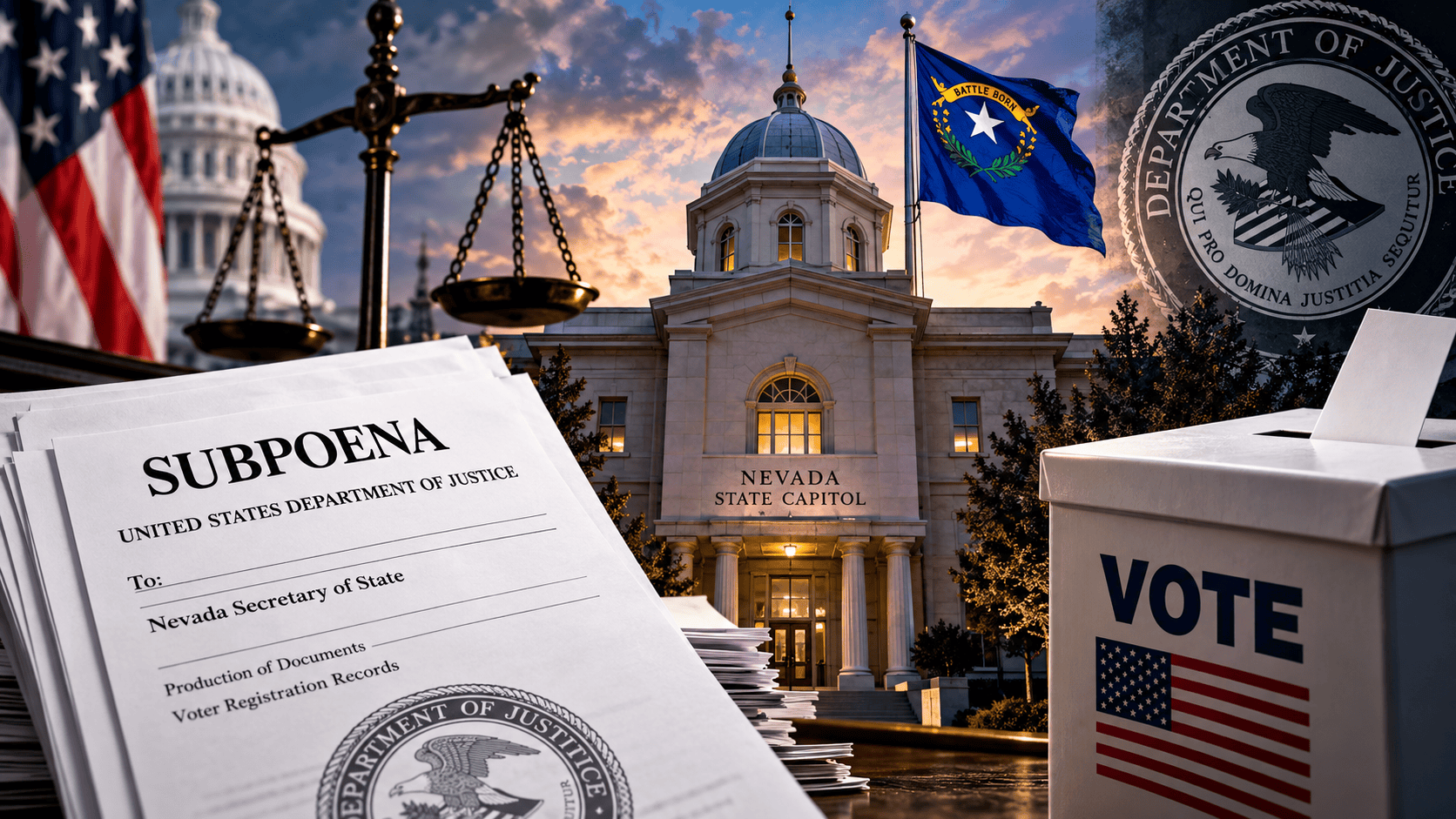
Nevada's election administration faces federal scrutiny as seven Justice Department subpoenas fuel controversy ahead of the 2026 midterms.
Seven federal subpoenas. One battleground state. Two competing narratives about election integrity. As Nevada prepares for November’s midterm elections, a confrontation between Washington and the state’s chief election official is raising questions that extend well beyond the 2026 vote.
A Battle Over Ballots — or a Battle Over Control?
Election integrity is supposed to be something Americans can agree on.
Eligible citizens should be able to vote. Ineligible individuals should not. Ballots should be counted accurately, election officials should follow the law, and the public should have confidence that the results reflect the will of voters.
Those principles sound straightforward.
But in Nevada, they have become the centre of an increasingly bitter political confrontation involving the Trump administration, federal investigators and Democratic Secretary of State Cisco Aguilar.
According to an October 15 Reuters investigation, the U.S. Department of Justice issued seven subpoenas seeking voter-related information from Aguilar’s office between June 16 and September 2, 2026.
The requests arrived as Nevada prepared for a closely watched midterm election and Aguilar faced a reelection challenge from Republican Jim Marchant.
The administration maintains that its efforts are intended to protect election integrity.
Aguilar sees something different: an attempt to overwhelm his office, weaken his campaign and potentially influence who controls Nevada’s election machinery ahead of the 2028 presidential contest.
______________________________________________
🔴 Help keep this independent voice alive and uncensored.
Support independent journalism and help keep Chris Wick News going.
👉 Support Chris Wick on GoFundMe
The public deserves more than competing accusations.
It deserves evidence.
Seven Subpoenas and a Growing Federal Investigation
The number of subpoenas is significant, but the more important questions concern their purpose, legal justification and scope.
Federal authorities have a legitimate interest in investigating potential violations of election law. If credible evidence suggests that ineligible individuals are registered or voting, those allegations should be examined.
However, federal investigative authority is not unlimited.
States retain substantial constitutional responsibility for administering elections, and requests for sensitive voter information raise legitimate questions about privacy, proportionality and federal jurisdiction.
Nevada’s election chief argues that the demands have consumed staff resources and diverted attention from preparing for November.
The political consequences are also becoming apparent.
Aguilar told Reuters that the investigations have interfered with fundraising and campaign activities. He also reported losing some financial supporters who feared potential repercussions for their businesses.
Those are serious allegations, although the existence of subpoenas and their political consequences do not, by themselves, establish improper motives.
The critical distinction is between investigating possible election violations and using investigative powers for political advantage.
That distinction should apply regardless of which political party occupies the White House.
The Disputed Numbers: 16,000, 185 and 2,000
Perhaps the most revealing aspect of the controversy involves the numbers being used to justify federal scrutiny.
The Department of Homeland Security initially identified as many as 16,000 potential noncitizens on Nevada’s voter rolls.
That figure naturally attracted attention.
But subsequent discussions between federal and state officials exposed a dispute over what the data actually demonstrated.
According to records reviewed by Reuters, federal officials initially discussed 185 cases they believed had been confirmed.
Nevada officials disputed those findings, maintaining that their own records showed the individuals were citizens.
DHS subsequently told Reuters that at least 2,000 names from its original list had been identified as belonging to noncitizens.
Aguilar challenged the reliability of that assertion and said the state had not received credible supporting evidence.
These distinctions matter.
A database match suggesting someone might be a noncitizen is not necessarily proof of their current citizenship status.
A noncitizen appearing on a registration list is also not proof that the person cast a ballot.
And even a verified registration violation does not automatically establish an organized scheme capable of changing an election outcome.
At the same time, government officials should not dismiss genuine discrepancies without examining them.
If federal authorities possess reliable evidence, they should provide it through appropriate legal channels so that the findings can be independently evaluated.
If the data are inaccurate, the public deserves to know how those errors occurred.
Election integrity requires accurate evidence, not simply alarming numbers.
Jim Marchant and the Political Stakes
Aguilar’s Republican challenger, Jim Marchant, welcomes the federal scrutiny.
Marchant argues that voters have lost confidence in Nevada’s election administration and believes the investigations will encourage closer examination of Aguilar’s record.
That position may appeal to voters who remain suspicious of election procedures.
But suspicion is not proof.
Marchant has continued to promote claims that the 2020 presidential election was improperly decided, despite the absence of substantiated evidence establishing widespread fraud sufficient to overturn its outcome.
Aguilar rejects Marchant’s accusations and maintains that Nevada’s election procedures are secure.
The two candidates represent sharply different approaches to public confidence.
Marchant emphasizes the need to challenge existing election institutions.
Aguilar emphasizes defending those institutions against what he considers unjustified federal interference.
Voters will ultimately decide which argument they find more convincing.
But neither candidate should receive a free pass from scrutiny.
Why Nevada Matters Beyond November
Nevada is not simply another state holding an election.
It is a competitive political battleground where relatively small shifts in voter participation can influence statewide and national outcomes.
Donald Trump carried Nevada in the 2024 presidential election by approximately 46,000 votes.
The state also has a substantial Latino electorate, making questions about citizenship verification and immigration enforcement especially politically sensitive.
Aguilar has warned that aggressive federal investigations could discourage eligible voters from participating, particularly if they fear being wrongly identified as noncitizens.
That concern deserves examination.
But so does the competing argument that credible citizenship verification procedures can strengthen public confidence.
The challenge is to accomplish both objectives without sacrificing either.
Protecting lawful voting rights and enforcing eligibility requirements are not mutually exclusive goals.
The real test is whether authorities can pursue them fairly, transparently and without partisan selectivity.
The Federal Government’s Losing Court Battles
The Nevada dispute is part of a broader confrontation over federal access to voter registration records.
Reuters reported that the Justice Department had brought lawsuits against 30 states and the District of Columbia seeking voter information, and had lost 26 of those cases, including its case against Nevada.
Those outcomes are important because they demonstrate that courts have imposed limits on the administration’s efforts to obtain voter records.
They do not necessarily mean every federal investigation is illegitimate.
Nor do they establish that every state election system is free from errors.
They do show that government agencies must operate within legal boundaries, even when invoking national election security.
The Constitution does not give federal officials unlimited authority to demand sensitive state election records simply because they believe doing so would improve oversight.
The proper relationship between state administration and federal enforcement remains central to this dispute.
The Questions Washington and Nevada Both Need to Answer
Rather than treating this controversy as another opportunity for partisan outrage, Americans should demand specific answers.
- What precise evidence justified seven separate subpoenas?
- What categories of voter information were requested, and why were they necessary?
- Can DHS substantiate its latest citizenship findings with independently verifiable records?
- How will authorities protect eligible voters from erroneous identification?
- What safeguards prevent federal investigative powers from being used to influence election campaigns?
- Are comparable investigative standards being applied consistently across states, regardless of political leadership?
These are reasonable questions, not accusations of wrongdoing.
A transparent investigation should be capable of answering them.
The Bigger Picture: Election Integrity Cannot Belong to One Party
There is a dangerous temptation in modern American politics to treat election security as a partisan weapon.
When one party demands investigations, its supporters describe those efforts as necessary accountability.
When the opposing party faces similar scrutiny, its supporters may characterize the same investigative tools as political intimidation.
Neither standard is acceptable.
If evidence demonstrates election fraud, it should be investigated and prosecuted according to law.
If government officials abuse investigative authority, that conduct should face equally serious scrutiny.
And if political candidates make allegations that cannot be substantiated, journalists should say so plainly.
The public should not be expected to choose between blind trust in election administrators and blind trust in federal investigators.
Both institutions are accountable to the people.
Chris Wick News Analysis: The Evidence Must Come First
The Nevada confrontation illustrates a broader problem in American political life.
Confidence in elections cannot be manufactured through press conferences, political slogans or repeated accusations.
It must be earned through transparent procedures, verifiable evidence, independent oversight and consistent application of the law.
The Trump administration has every right to pursue credible allegations of illegal voting within its lawful authority.
Nevada officials have every right to challenge demands they believe exceed that authority.
But neither side should expect Americans to accept its position without supporting documentation.
Seven subpoenas may ultimately reveal legitimate investigative concerns, an excessive use of federal authority, or a more complicated combination of both.
The publicly available evidence does not yet establish a definitive answer about the administration’s motives.
What is clear is that the controversy has placed one of America’s most competitive election states at the centre of a consequential dispute over voting rights, federal power and political accountability.
The question is not whether Americans should demand secure elections. They absolutely should.
The question is whether the government can demonstrate that its actions are justified by evidence rather than political advantage.
And that is a question every American should be asking, regardless of party affiliation.
Sources
Reuters — Seven subpoenas engulf Nevada election chief in key midterm battle (October 15, 2026)
Democracy Docket — FBI subpoenas Nevada election chief’s office for voter-related information (September 4, 2026)
Las Vegas Review-Journal — Nevada election chief pushes back on Trump administration scrutiny
CNN — The Lead with Jake Tapper, September 8, 2026 transcript
https://transcripts.cnn.com/show/cg/date/2026-09-08/segment/01
About the Author