The Middle East is moving deeper into dangerous territory, and the latest developments in Yemen are another warning that the conflict surrounding Iran is far from contained.
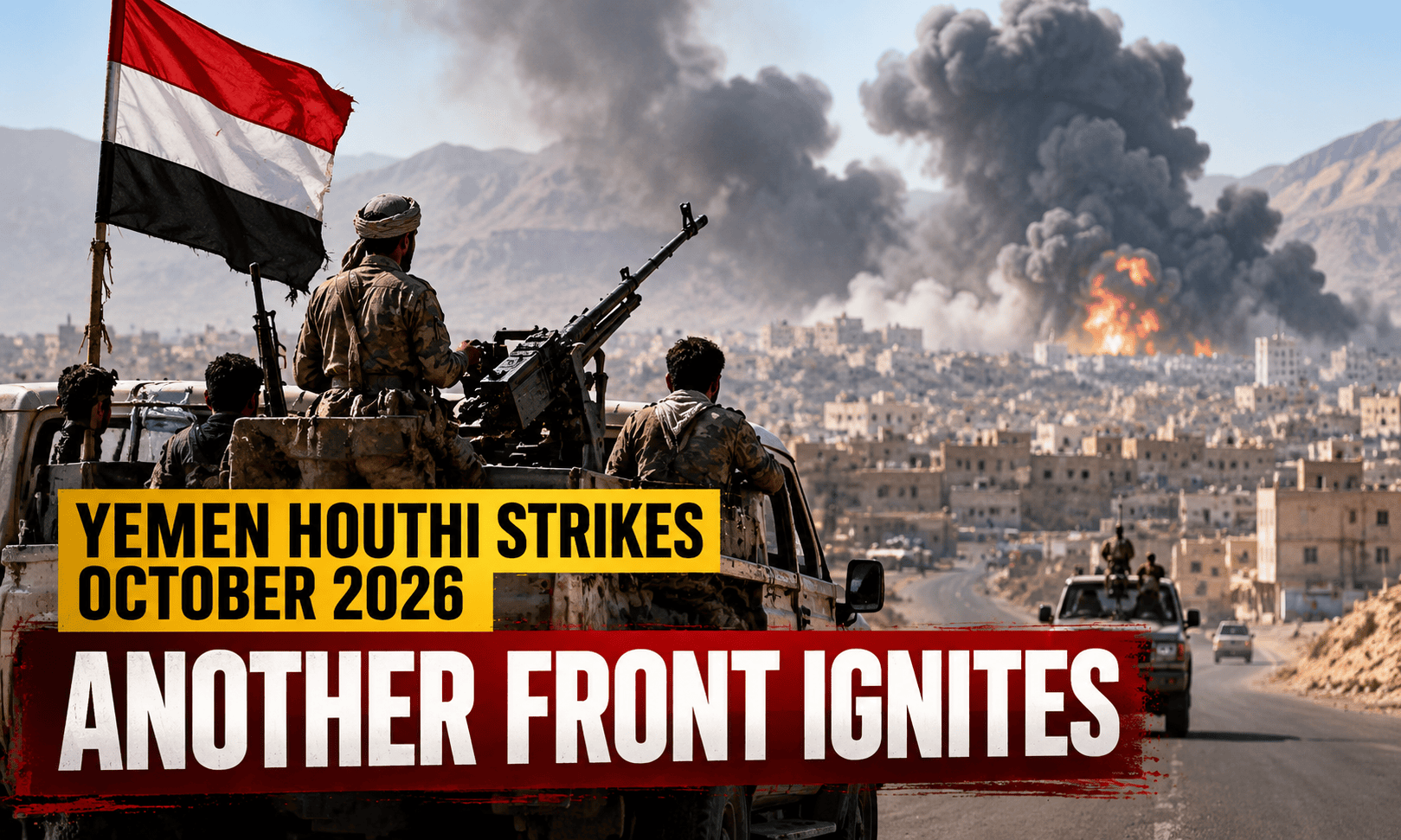
Yemeni government forces say they have launched attacks against Houthi positions in several parts of the country, including the capital, Sanaa. Meanwhile, regional governments are condemning an attack on infrastructure serving the Saudi Arabian city of Medina.
These developments raise an increasingly uncomfortable question: How many separate confrontations can erupt across the region before they become impossible to contain?
Yemen Opens Another Dangerous Chapter
According to Al Jazeera’s October 2 live coverage, Yemeni army spokesman Majed al-Nuzaili said government forces struck what he described as high-value Houthi targets in Sanaa.
Government forces also reported carrying out 20 air attacks against Houthi positions in the Taiz governorate. The coverage identified Sanaa, Saada and Taiz as locations involved in the latest operations.
The claims indicate an expansion of military activity across several strategically important areas of Yemen.
However, the publicly accessible reporting does not independently establish the extent of the damage, the number of casualties or whether the operations achieved their intended objectives.
Those unanswered questions matter.
In an already volatile region, battlefield announcements can create political and military consequences long before their results are independently verified.
Saudi Arabia Faces Another Security Warning
______________________________________________
🔴 Help keep this independent voice alive and uncensored -> Buy us a Coffee <-
The military developments in Yemen are unfolding alongside renewed concerns about Saudi Arabian security.
Regional governments and Islamic organisations have condemned a Houthi attack on infrastructure serving Medina, one of Islam’s holiest cities.
Egypt, Qatar and Türkiye were among those expressing support for Saudi Arabia following the reported incident.
The response demonstrates how quickly an attack involving Saudi infrastructure can become a broader diplomatic issue.
It also raises questions about the potential consequences of further attacks.
Will regional governments limit their responses to condemnation and diplomatic support, or could additional incidents generate pressure for stronger security measures?
There is no confirmed answer in the available reporting.
What is clear is that the latest confrontation has drawn attention beyond Yemen’s borders.
The Iran Connection Makes the Situation More Complicated
Yemen’s Houthis are aligned with Iran, placing their activities within a much larger regional security picture.
That relationship does not establish that Tehran directed these particular incidents. No such operational direction is demonstrated in the available report.
Nevertheless, the relationship is important when examining how developments in Yemen intersect with the broader conflict involving Iran.
A military operation that begins as a confrontation between Yemeni forces and the Houthis can carry implications for governments already concerned about regional security.
This is one of the central dangers of a conflict involving multiple armed groups, governments and competing strategic interests.
Each confrontation has its own circumstances. Yet the political consequences can extend well beyond the immediate battlefield.
And when tensions are already elevated, the space for misunderstanding becomes particularly important.
The Dangerous Difference Between Military Action and Political Control
There is another issue receiving less attention in the immediate headlines.
Military forces can announce successful attacks without those operations necessarily producing a lasting political settlement.
Striking targets is one thing.
Establishing security, preventing retaliation and creating conditions for negotiations are entirely different challenges.
Yemen has experienced prolonged conflict, competing authorities and repeated military confrontations.
The latest announcements offer no clear indication that a durable settlement is approaching.
Instead, they raise questions about what comes after the strikes.
If the operations weaken Houthi positions, what political or military developments follow?
If the Houthis respond with further attacks, how will Yemen’s government and neighbouring countries react?
And if the confrontation intensifies, what mechanisms remain available to prevent additional escalation?
These are not predictions. They are questions that military announcements alone cannot answer.
A Regional Conflict With No Simple Boundaries
One of the most troubling aspects of the current Middle Eastern security environment is the number of overlapping disputes.
Yemen’s internal conflict has its own history and political dynamics. Saudi Arabia has its own security concerns. Iran’s regional relationships add another layer of complexity.
Treating every confrontation as a single coordinated war would oversimplify those realities.
Ignoring the connections between them would be equally misleading.
The immediate concern is whether governments and armed groups can prevent individual incidents from triggering wider responses.
The condemnation of the attack involving Medina illustrates how quickly an event in one country can generate reactions from several others.
Those diplomatic reactions do not necessarily mean that additional military action will follow.
But they show how closely regional governments are watching developments.
What Happens When the Fighting Stops Being Contained?
There is a familiar pattern in prolonged conflicts.
Military action is announced. Officials explain its purpose. Governments issue statements. Attention shifts toward the next confrontation.
What often remains unresolved is the underlying political dispute.
The latest fighting in Yemen illustrates that problem.
Government forces are reporting attacks against Houthi positions. Regional governments are condemning threats to Saudi infrastructure. Yet the available reporting provides little evidence of an immediate political breakthrough.
That leaves a difficult question hanging over the region.
Is the current escalation moving the parties closer to security, or creating another cycle of military action and retaliation?
The distinction matters because the consequences of prolonged conflict extend beyond armed forces and political leaders.
Civilians, essential infrastructure, economic activity and regional stability can all be affected when fighting continues.
Those consequences deserve attention alongside every announcement of a military operation.
The Bigger Question Nobody Can Afford to Ignore
The latest developments in Yemen are not proof that a wider regional war is inevitable.
They are evidence that serious military confrontations remain active while tensions surrounding Iran continue.
There is a significant difference.
One describes what is happening. The other assumes an outcome that has not been established.
For now, the reported strikes in Sanaa and Taiz, the developments involving Saada and the international condemnation of the attack affecting Medina represent another difficult moment for regional security.
The immediate questions concern retaliation, restraint and the possibility of diplomatic intervention.
The longer-term question is whether the parties involved have a realistic political path away from repeated confrontation.
Because military operations can change conditions on the ground without resolving the disputes that produced the fighting.
And until those disputes are addressed, every new confrontation carries the possibility of another.
Chris Wick News — Independent reporting, analysis and perspective.
About the Author